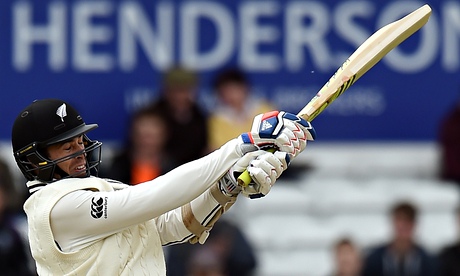
England should know about Tim Southee the batsman. In his first Test match at Napier in 2008 he hit 77 not out at No10 in 40 balls, smashing nine sixes in the process, albeit in a losing cause. On Monday he walloped 40 from 24 balls but with only one six, probably not in a losing cause.
England have a problem with Southee and his six-hitting, though they are not entirely alone in this. In Test cricket Southee has hit 53 sixes, which is 29% of the runs he has scored. This is a phenomenal proportion.
The next highest, out of players who have scored 1,000 Test runs, is Mohammed Rafique of Bangladesh on 19%. Adam Gilchrist, with 100, has hit the most sixes in Test cricket (10% of his output) but Chris Gayle on 98 (possibly) and Brendon McCullum on 95 (probably) could soon overtake him.
In today’s game sixes are as popular as mushy peas in this part of the world. In fact Headingley produced yet another record. In New Zealand’s second innings eight batsmen hit a six (and Trent Boult, the No11, did not have a chance to clear the boundary). This has never been done before. The previous record of seven was achieved by New Zealand in Sharjah in 2014 and South Africa in St Kitts in 2010.
Southee is not a great batsman; he averages 17 in Test cricket. But he is the sort of player that embarrasses England all too easily. They seem more vulnerable than most when slogging tail-enders take guard. Southee alongside Mark Craig added 67 from eight overs on Monday and it was mayhem.
England’s bowling at tail-enders had some of the old-timers snorting. Ian Botham, who was usually very effective against the tail, was more than perplexed having witnessed Stuart Broad set his field to the new batsman, Matt Henry, which had three men on the leg-side boundary. Surprise, surprise Broad bowled four bouncers from around the wicket, all of which were anticipated by Henry, two of which were hit for six. Tail-enders may have improved. So, too, have their bats. Even so England are inept in this phase of the game. Australia, who have a potent tail with a few imposters, will provide even more problems down the order.
Of course if catches are held the problems can sometimes be avoided. Yesterday Mark Wood beat the outside edge of Southee time after time. Then came the nick and it flew between the slip fielders to the boundary. Ian Bell, England’s latest second slip, did not move a muscle. There are several issues here.
The first relates to where the slips are standing. Throughout this series the England slip cordon has not adjusted its position according to who is on strike. At Lord’s they stood in exactly the same position whether Kane Williamson with his soft hands or McCullum with his more aggressive intentions was batting.
Here they declined to go deeper when Southee, whom they know is going to swish hard, was trying to locate Wood’s away-swingers. Hence there was no time for Bell or anyone else to pick up the flight-path of the ball from the edge of Southee’s bat.
Missing that catch would prove costly, more or less taking an England victory out of the equation once the rain descended on Headingley.
Then there is the question of personnel. Bell has been playing for England for a decade. Yet only now has he been promoted to second slip, the position where the greatest number of outfield catches go.
There is a reason for that. Bell is a slightly reluctant second slip. No matter how well he catches them in practice it seems that he may not be temperamentally suited to the responsibility of that position. His record this summer is far from perfect. England may not have the right combination.
Other options need to be explored before the Ashes for this is a vital part of the game. Adam Lyth is a regular for Yorkshire in the slip cordon, Joe Root is showing promise in that region, Chris Jordan is excellent when he is in the team. A settled cordon needs to be established.
After that missed chance Southee tormented England again. The bowlers declined to aim for the stumps, fearful that they might be whacked over their heads for six, preferring to be smashed over square leg instead. As ever the use of the yorker was spurned and the spinner was regarded as the last resort rather than an early solution. Apart from the weather it was a day to be enjoyed by the Kiwis and no doubt the Aussies looking on from afar with glee at England’s fragility.