We’re going to wrap it up from here now at Guardian Mission Control. We certainly enjoyed the show, and hope that you did too.
We’ll leave you with some some footage from earlier of the Soyuz craft carrying Britain’s first European Space Agency astronaut, Tim Peake, as it prepared to dock with the International Space Station.
A tense, last minute glitch with the Soyuz forced the crew to make an unusual manual approach to the orbiting outpost, but all turned out well.
Their arrival came slightly more than six hours after blasting off from the Baikonur Cosmodrome in Kazakhstan.
Some other messages of congratulations are coming in now. Here’s the Queen’s:
The Queen sends #GoodLuckTim message to #TimPeake @astro_timpeake as he joins @Space_Station #Principia #BritinSpace pic.twitter.com/KyGEjD19cQ
— BritishMonarchy (@BritishMonarchy) December 15, 2015
“The thoughts and prayers of the whole country are with him and he crew, especially at this time of the year,” she says.
“We join with his friends and family in wishing him a productive mission and a safe return to earth.”
Peake’s own soundbite to back home was “hope you enjoyed the show”.
Here’s the image from the ESA showing all those on board. It’s interesting to look at some of the detail in there.
That man in the black and white photograph gazing down from just over their shoulders? It appears to be Sergei Korolev, the father of the Soviet Union’s space program.
.@astro_timpeake on air: "hope you enjoyed the show!" #Principia pic.twitter.com/v9Gq6YpSFR
— ESA Operations (@esaoperations) December 15, 2015
Tim Peake’s mother Angela is on the phone now, and provides the soundbite of the day:
I think you would call today a spectacular day in the office.
Everybody sends their love and we hope you have a wonderful time.

Updated
Peake responds:
It was a beautiful launch. That first sunrise was absolutely spectacular.

Updated
And the link was lost just as Tim Peake was about to speak.
The Director General of the ESA had asked him: “You selected the window seat… what did you see?”
They’re putting on their headsets now and will be talking to earth very soon, after some voice checks first.
They look like they’re in a good mood, despite those little worries earlier surrounding the manual docking.
The whole crew is gathered now: Russians, Americans and a Brit.
Tim Peake and colleagues board ISS
And it’s happened rather quickly in the end. Tim Kopra is the first on board the ISS, followed by Tim Peake, and then the Soyuz pilot Yuri Malenchenko.
Same old story, you wait for hours for an astronaut to come through a hatch and then three come along at once.
Peak A Booooo!!! #TimPeake pic.twitter.com/MTU4as8HQP
— Michael Donington (@BBUKMIKE) December 15, 2015
Updated
The ISS has been passing over the Pacific, at a gentle pace of 17,500mph.
In the meantime, the ESA have been providing some more images of the outside of Soyuz docked with the space station.
.@astro_timpeake, @astro_tim and Yuri are in this #SoyuzTMA19M spacecraft, waiting to enter the Space Station pic.twitter.com/FDhwoMKaP2
— ESA Operations (@esaoperations) December 15, 2015
We’re unlikely to see any tweets from any of those on board the Soyuz, or the ISS, any time soon, though here’s a nice view earlier via Sergey Volkov:
На фото #СоюзТМА19М в 1 км от #МКС. Уже ждем открытия люков // A process of docking. #SoyuzTMA19M in 1 km to the ISS pic.twitter.com/1Awfoqjduc
— Sergey Volkov (@Volkov_ISS) December 15, 2015
Updated
Everyone’s getting in on the act, it seems.
Watch #Principia @spacegovuk live to see @astro_timpeake receive a special royal message! #TimPeake #BritInSpace - https://t.co/E8dAdcb9uz
— BritishMonarchy (@BritishMonarchy) December 15, 2015
The delay is due to a wait for pressure equalisation, according to the European Space Agency.
We can see the Soyuz craft now though as the space station’s hatch is open.
That was the hatch opening on the ISS side, namely from the Rassvet module.
And here we go. The hatch is opening..
Hang in there..
This is like waiting for a Royal Baby. Watching a door for ages with nothing happening. #TimPeake
— Emma Ward (@elbcw) December 15, 2015
Get that hatch open! Can't go up the pub until it does. #TimPeake #BritInSpace
— kerry bacon (@kelbacon) December 15, 2015
It’s not a quick process getting out of those space suits apparently, especially in micro gravity.
By now, hopefully they’ll have slipped into something a bit more comfortable, namely those familiar blue polo shirts that you’ll have seen Volkov and co wearing.

Updated
Scott Kelly is on hand with his camera. As is the way, he’s been taking some selfies.
Space Station astronauts getting ready to welcome the new arrivals. #Principia pic.twitter.com/61OY7GcQmP
— ESA Operations (@esaoperations) December 15, 2015
Updated
Things are getting going now. It’s smiles all round as the hatch is about to open.
It looks like Sergey Alexandrovich Volkov is at the head of the welcoming committee on the ISS side.
It’s likely to be around three minutes before we get pictures again from the International Space Station.
From there, it won’t be long until what will effectively be a press conference. It’s likely to take place in the Russian service module on the ISS.
It took Tim Peake and his colleagues less than nine minutes to reach a height of 208km from the Kazakh steppe.
The Guardian has put together an interactive tracing events today
While we’re waiting, we’re also now seeing some beautiful - and high quality - images of the Soyuz craft from earlier.

Not long now until the hatch opening takes place. The docking was nine minutes behind schedules, so it remains to be seen if that has a knock-on effect. The signs are good though:
Live now on @NASA TV hatch opening & crew greeting coverage as @Space_Station expands to 6. https://t.co/c7YsQe30bc pic.twitter.com/F9i9siJ0bu
— Intl. Space Station (@Space_Station) December 15, 2015
Tim Peake’s proud parents have been speaking about their son. His father, Nigel, told the BBC:
We would say once it’s a once in a lifetime experience, although of course Tim hopes it would be even more than that.
All the support from back home has been absolutely magnificent. We just think it’s so wonderful that there us all this international co-operation.
They all work together, live together, and it doesn’t matter what nationality they are.
So what’s going on up there now? Well, those involved in the hatch opening will be making sure that the seal is completely air tight and pressurised at all sides.
It’s crucial for the pressure to be the same on all sides so that there won’t be any problems when the hatch is opened.
When they’re ready, one of the last checks will actually be a rather simple one.
A knock will come from the astronauts on the Soyuz craft. They’ll wait for a knock back on the door from the International Space Station side.
If you’re coming late to the excitement today, here’s a wrap from a little earlier from the Guardian’s Science Editor, Ian Sample.
He writes:
Britain’s first European Space Agency astronaut, Tim Peake, has docked with the International Space Station after a tense, last minute glitch with the Soyuz spacecraft forced the crew to make an unusual manual approach to the orbiting outpost.
Veteran Russian commander Yuri Malenchenko took control of the Soyuz capsule for the final stretch to the station after the automatic docking system failed to operate properly.
The three crew inside the capsule reached the right orbit to rendezvous with the station after a clean launch from Baikonur cosmodrome on Tuesday morning, but a last minute problem with the spacecraft meant the docking was delayed.
Updated
It seems like that entry by Peake and his colleagues to the ISS is likely to go ahead as scheduled at 19.00GMT after all, despite the slight delay in docking. Thats according to the Europan Space Agency. Fingers crossed.
Updated
The first Briton in space, Helen Sharman, has been sharing her memories of travelling in space and the “living, breathing rocket” that was involved.
You’re in the hands of all the people who have worked together to put together those bits of the rocket, the engineers who have designed it, the mathematicians who have calculated the orbits, the teams of doctors and the trainers, and actually because you have built yup such a level of trust in them it is absolutely fine.
I don’t think any astronaut is scared, and that is because we tend to be scared of the unknown.
The training is so very good, there’s no unknown left. You know what you are going to do if something happens.
You know what your commander or engineer will do if something else happens. And you just get on with it.
You can hear her interview on BBC Radio 4 in full here.

Updated
The images from the ESA are still coming:
#SoyuzTMA19M docked to Space Station. Inside @astro_timpeake @astro_tim & Yuri are preparing for hatch opening pic.twitter.com/eW95qPd5xK
— ESA Operations (@esaoperations) December 15, 2015
Jo Johnson, Britain’s Science and Space minister has been responding to questions about the amount of money spent by Britain on the mission at a time when resource for services are being cut back
Investment in space science delivers a “terrific return for the economy,” he told the BBC a little earlier
“Every one pound on space science delivers a return of £10 to us,” Johnson said
He added that the British government was committed to increasing exports associated with the space industry.
Piers Sellars, the British-born astronaut who was selected as an astronaut candidate by NASA in April 1996, has been recalling his own time in space, saying that his view of the earth is “still burned on the back of my eyeball”.
Speaking about the likely legacy of Tim Peake’s mission, he said:
I think this is going to be particularly important for British kids. They might say: ‘that could be be me’. If nothing else they may find out that, they have to do the harder subjects like Maths.
That worked for me. I watched apollo (below) when I was 13 and it completely motivated me to pursue a science career.
I think there has been a change in the British government. I am hoping that the British government is going to get firmly behind this effort and make commitments.
In about 20 years there’s Mars, and I hope Britain will be at the forefront of that.

So now we’re in a waiting period as Soyuz’s systems are shut down and the process of sealing contact between it and the ISS gets underway.
#SoyuzTMA19M crew report they are fine and starting to shut down the spacecraft's systems as they are no longer needed. #Principia
— ESA Operations (@esaoperations) December 15, 2015
In the meantime this is Ben Quinn undertaking a manual handover on the blog from Stuart Clark.
The British astronaut’s journey into orbit is a reminder of the noble human purpose of space exploration outlined in the outer space treaty of 1967.
The Guardian view on Tim Peake’s space mission: a journey into the province of all mankind.
Docking has taken place.
Almost ten minutes after the scheduled time, Tim Peake has docked with the International Space Station.
The delay was caused by the first automated attempt having to be aborted and the spacecraft turned over to manual control. Yuri Malenchenko piloted the spacecraft in by hand.
It is not yet clear why the first approach attempt was aborted but following the docking, Moscow mission control told the astronauts they had been ‘a little bit worried.’
Mission control in Moscow has just admitted that they were a little bit worried.
The Soyuz has been captured by the ISS. Tim Peake is there.
contact light!
Here we go. Final approach. 3 metres range.
Docking system is ready. Crosshairs aligned. All ready for approach. Still waiting for ‘go’.
Malenchenko reports everything is ‘nominal’. Range is less than 20 metres and holding. Just waiting for final ‘go’ from Moscow control.
The docking hatch will not appear in the centre of Soyuz screen. The camera aims for a target off to the side of the hatch.
50 metres and inching closer.
Soyuz now back at 120 metres, lining up for another approach.
Signal strength now quite poor. TV images coming and going. Audio link still strong.
25 metres and closing...
Soyuz closing in again, this time steered by Yuri Malenchenko.
Soyuz is in manual control mode. Commander Yuri Malenchenko now has control of the spacecraft.
Soyuz is backing up. There is talk of ‘switching to manual’. Clearly something has not gone quite right with the docking. Nothing to worry about.
The Soyuz and ISS has now passed to the nighttime side of the Earth.
Tim Peake is now right above the UK at an altitude of about 420km. He is almost overhead from London. Docking due in 10 minutes.
50 metres away, 20 cm/s closing speed.
Soyuz now less than 65 metres from the station.
Here’s a speeded up view of a space station docking.
Maximum approach speed for docking will be no more than 30cm/s.
The Soyuz is now crawling towards the space station at just 5cm/s.
The Soyuz is now in fly around mode. This is to align it with the docking module.
This live view from the control room at Baikonur shows the International Space Station growing in size, as seen from the Soyuz capsule.
Updated
International Space Station within sight!
With docking scheduled in less than 40 minutes, this image from 5 January 2014 captures a Soyuz TMA-15M crew capsule (left) and an automated Progress cargo vessel docked to the International Space Station.
The Progress carried more than three tons of food, fuel, and supplies to the space station. It also took 880kg of propellant, 50kg of oxygen, 420kg of water, and 1419kg of spare parts, supplies and scientific experiment hardware.
The Soyuz is docked on the Rassvet module, which is where Tim Peake’s Soyuz will be docking this afternoon.

Updated
Tim Peake’s Soyuz capsule is now less than 10km away from the International Space Station.
The UK government have used the Time Peake launch to unveil a new National Space Policy document.
Part of the Foreword says:
Here in the UK we have a powerful, innovative space sector, inspiring and improving lives, and bringing in billions to our economy every year. We are rightly proud and need to preserve and build upon our success. There will be many transformations ahead in our use of satellite technology and space programmes which will lead to discovery, jobs and growth, radically improving transport, agriculture, education, entertainment and much more besides.
Even if the docking takes place at 17:24 GMT as planned, it will still be a couple of hours before they open the hatches and let the astronauts onto the International Space Station (ISS).
This is because the astronauts have to be absolutely certain that the seal is tight around the Soyuz and the ISS, so that no air can possibly escape.
To ensure this, they will perform a careful sequence of pressurising the docking modules. All the time they will be watching their instruments for leaks.
Once they are sure that everything is tight, they will begin to open the hatches. When it comes to the final one, the astronauts in the Soyuz will knock on the hatch.
One of the astronauts already onboard the ISS will knock back, thus giving final confirming that it is safe for the newcomers to enter.
This final hatch opening is scheduled today at 19:25GMT.
A screen grab from the video coverage from earlier today catches Tim Peake smiling and giving a thumbs up. The Earth can be seen out of the window.
This was soon after the Soyuz reached orbit because Peake is still wearing gloves and has his helmet visor down.
Upon reaching orbit, the crew check their instruments to make sure no oxygen is escaping. Once the integrity of the capsule is verified, they are free to remove their gloves and lift their helmet visors.

Updated
Now that the Soyuz capsule is in the same orbit as the International Space Station (ISS), at an altitude of about 420km, the approach and rendezvous phase can take place.
This will be an automatic procedure that will rely on the onboard computers and radar system to steer the ship. The ISS will not manoeuvre.
The radar system is known as Kurs. This is not an acronym but instead means ‘course’ in Russian. It begins looking for the ISS when they are still about 400km away from one another.
It usually locks on when they have closed to around 180km. At such a distance distance, the astronauts are unlikely to be able to see the space station as anything more than a point of light but the character string “3AXBAT” will appear on their computer screens, indicating that the Soyuz now knows where the ISS is located.
Approach and rendezvous is an automated process. The crew monitor that everything is going according to plan. The Soyuz is equipped with manual controls, and the crew are fully trained, just in case they need to perform the docking by hand.
As the spacecraft approaches the space station, it lines itself up first with the Kurs transmitter, rather than the docking port. It will approach the ISS and then ‘station keep’ 400 metres away.
Next, it will locate the docking port, which is higher up the space station’s body, and then manoeuvre up to draw in line while maintaining a distance of 400 metres.
It will inch closer to about 150 metres and then await a final go/no-go decision from ground controllers about whether to attempt the docking, after they review all available data.
Updated
All is going well. So far, the Soyuz craft looks all set for the planned docking attempt this afternoon.
The spacecraft is not launched straight onto a rendezvous trajectory with the International Space Station (ISS). Instead, the capsule is placed into an initial orbit, called the insertion orbit. This is because there are uncertainties in exactly how the rocket will launch and how it will travel through the atmosphere.
Once in the insertion orbit, its position and altitude can be precisely measured. The capsule will be about 220km above the ground. The ISS orbits at 420 km.
Two engine burns propel the capsule into an intermediate orbit of around 320km, so that the position can be precisely measured again. A final sequence of rocket burns propel the Soyuz onto the same orbit at ISS, ready for approach and docking.
This appears to have been completed successfully:
Updated

School children celebrate the launch of Tim Peake at London’s Science Museum.
Updated
International Space Station visible from UK tonight
The International Space Station will fly over the UK tonight, just ten minutes before the Soyuz carrying Tim Peake is scheduled to dock.
The football-pitch-sized space station will appear as a bright spot travel west to east. From London, it will appear to move almost overhead. From Manchester, it will be somewhat lower in the southern sky.
It will be visible from 17:14 GMT (clouds willing) and will take 3 minutes to cross.
The Soyuz space capsule carrying Tim Peake is in orbit around the Earth. Collaborating with mission controllers on Earth, the crew will now be manoeuvring the space capsule towards its rendezvous with the International Space Station (ISS).
The shortest possible route for this to take place is four orbits of the Earth, taking about six hours in total. To achieve this, however, a number of critical engine burns must all work perfectly.
If they do not, a much more leisurely approach will be initiated. This will take two days.
Once the capsule approaches the ISS, the final decision about whether to dock or not takes place 10 minutes before the scheduled time. This allows all systems on the Soyuz and the ISS to be fully readied.
There can also be a delay if the Sun is causing glare, which could dazzle the astronauts at a critical moment.
If all goes to plan, docking will take place today at 17:24 GMT.
Updated

Tim Peake is not the first Briton to go into space.
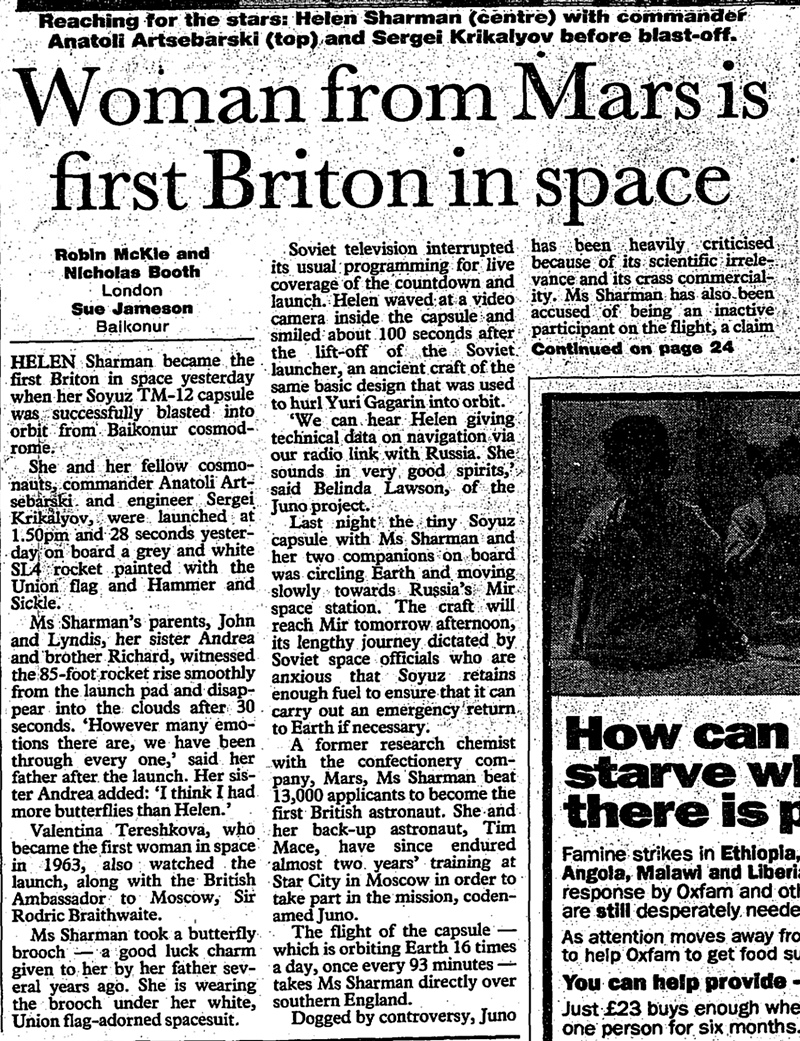
In 1991, Sheffield born Helen Sharman became the first Briton in space when she blasted into orbit aboard the Soviet Soyuz TM-12 space capsule.
Jason Rodrigues looks at how we covered some of the previous British astronauts.

This will be Tim Peake’s home for the next six months. The first module of the International Space Station(ISS) was launched in 1998 from Baikonur, where Tim Peake blasted off from this morning.
The first module was called Zarya, the Russian word for sunrise, although some preferred to call it the Functional Cargo Block.
Two weeks later the first American built module was delivered by space shuttle. Spacewalking astronauts connected the two together and construction began.
In 2000, the Russian module Zvezda (star) docked automatically with the others. This made the space station habitable because Zvezda contained sleeping quarters, kitchen and the all important space toilet. The first crew arrived in November 2000.
The ISS is now 72.8 x 108.5 x 20 metres, which is roughly the size of a football field.
It is not yet complete. A new Russian laboratory module, named Nauka, is planned for launch and docking in 2017.
Once he gets to the International Space Station, there is plenty for Tim Peake to do. He will spend much of his 40-hour working week on science experiments.
The International Space Station is the only laboratory where mid- to long-term research can be done in a weightless environment and hundreds of experiments are either ongoing or waiting to start.
The Press Association report that friends and relatives on the ground were hugging each other with relief as the news that the craft had entered space came through.
Rebecca Peake, Tim’s wife, was heard to say: “Wasn’t it an amazing sight? I had the biggest smile on my face.”

To celebrate today’s launch, school children aged 7-11 have been taking part in The Astro Science Challenge. This was to perform science experiments that complement those that Tim Peake will be performing during his mission.
More than 200 of them gathered today at the Science Museum to watch the launch. A further 9500 spread across the UK have been awarded ‘digital badges’ to honour their participation.
At the Science Museum, the children talked with scientists from several disciplines.
Liz Avery, Royal Observatory, Greenwich, told them that she was: “Really proud of all the work that you’ve produced. The astronomers have been really impressed! You all put a bit of a spin on [the tasks] to make them unique!”
Sophie Murray of the Met Office said that she was “Amazed by the work on Makewaves. Artwork, videos and animations of space weather were wonderful.”
Maria Rossini, British Science Association, said: “Everyone can be a scientist, regardless of how old you are.”
• The quote above from Sophie Murray was amended on 18 December 2015 to remove an incorrect sentence.
Updated
Launch video
Seems like the right time to celebrate with some space music. This is Public Service Broadcasting’s ‘Go!’ featuring recordings from the mission control team during Apollo 11’s Moon landing in 1969.
Summary
Britain’s first European Space Agency astronaut, Tim Peake, has blasted off on a six-month mission to the International Space Station from the Baikonur cosmodrome in Kazakhstan.
The 310-tonne Soyuz rocket launched into a clear blue sky over the Kazakh steppe at 11.03am GMT on a six-hour trip to deliver Major Peake and his two crewmates to the orbiting station.
Tim Peake bidding farewell to one of his sons earlier this morning.


The Prime Minister watched the launch.
It was great to watch Tim Peake blast off on his mission to join the International Space Station. pic.twitter.com/pqAw0ETuok
— David Cameron (@David_Cameron) December 15, 2015
So far everything is looking very good that the docking will take place this afternoon, after the Soyuz has flown around the Earth four times and caught up with the International Space Station. Docking due at 17:24 GMT.
Solar arrays will now deploy on the Soyuz to give them continued power on board.
Soyuz reaches orbit
Tim Peake is in orbit!

Updated
When the third stage engine stops firing, the astronauts feel a distinct jolt. Then they experience weightlessness. The dangly thing in the foreground of the capsule image will begin to float - it’s a ‘gravity indicator’.
Updated
Soyuz now in space
Soyuz and Tim Peake are now in space, they are above the 100km threshold. But not quite yet in orbit. A few more minutes to go.

Updated
All systems are ‘nominal’ - everything going well so far.
From launch to orbit will take nine minutes.
Tim Peake is on his way. Watch for the ‘Korolev cross’ as the boosters separate and fall away.
Soyuz blasts off
Blast off!

Updated
Ignition sequence initiated.
Capsule now on internal power.
One minute to go...
Tim Peake’s destination, the International Space Station, is flying overhead at the Baikonur cosmodrome right now. Sitting beneath it on the ground is the Soyuz rocket with Tim Peake on board. If it launches in three minutes, it can reach the station later today.
If all goes to plan and they launch on time, the Soyuz can reach the International Space Station in about six hours. If there is a delay, they will need to follow a much longer trajectory that will take two days to rendezvous.
Mission controllers are now playing Europe’s The Final Countdown to the astronauts in the space capsule.
Tim Peake saying goodbye to his two sons earlier today. He is behind glass because two weeks before the launch, astronauts go into quarantine to ensure that they do not take any infections into space.

I’d be very surprised if Tim Peake’s three-song playlist really is his chosen listening on the launchpad. For a start, it would all be over in 10 minutes or so, leaving him with a fair amount of waiting around, Second, one might – in the circumstances – opt for something a little more calming than his three choices (scientists are always unveiling reports about how uptempo rock makes people drive too fast; God knows what they would say about its effects on space travel).
Really, his three songs – U2’s Beautiful Day, Coldplay’s A Sky Full of Stars and Queen’s Don’t Stop Me Now – are more for the people following the launch. You’d be hard pressed to find three more obviously symbolic choices: he’s saying to the world everything’s great, space is up there, and I’m going.
Just be grateful he didn’t choose Another Girl, Another Planet by the Only Ones. Yes, it says “space travel’s in my blood / And there ain’t nothing I can do about it”, but it also insists: “I always flirt with death / I could kill, but I don’t care about it.” Which wouldn’t do at all.
In an interview in October, I asked Frank De Winne, head of the European Space Agency astronaut corps, how Tim would feel this morning. He said the most difficult time is in the Soyuz capsule just before launch.
There is a period of about 30 minutes, at least if everything goes well, when you have nothing to do and you just have to wait. You have finished all your checks, everything is ready, and you just have to wait for the launch to happen. And these are of course the most difficult moments because you have nothing to do, and you start reflecting by yourself. You are sitting on top of a rocket filled with liquids and fuel that is going to shoot you into space and you are gone for six months and you know that a lot of people will be watching you, that you have a very intense programme, that thousands of people have worked on your programme to do all the science and the work you need to do and it depends on you to do it correctly. And you start to reflect on that and it makes you quite silent I must say.
Updated
The spacesuits that the astronauts wear are not designed to walk in. They are tailored specifically for sitting in the launch capsule. Tight across the back, the suits tend to pull the astronauts into hunched positions when they walk. Each seat in the Soyuz is moulded specifically to the individual astronaut to allow maximum comfort during launch.
While the crew are waiting the Soyuz capsule, they can distract themselves with a playlist of music. The three tracks chosen by Tim are Queen’s Don’t Stop Me Now, U2’s Beautiful Day, and Coldplay’s A Sky Full Of Stars.
Before every launch, a Russian Orthodox priest blesses the rocket that will blast off into space. He then turns and blesses the media and well-wishers.

Updated
Tim Peake’s mission is named Principia after the great book published by Isaac Newton in 1687. Newton’s Philosophiae Naturalis Principia Mathematica (mathematical principles of natural philosophy) sets out Newton’s three laws of motion and his mathematical description of gravity. It is arguably the greatest work of science ever published.
The book was set in motion by astronomer Edmond Halley, who visited Newton in 1684 to ask him why the planets followed elliptical orbits around the Sun. In answering this question, Newton realised how forces of all kinds – not just gravity – produced motion. Almost three years of obsessive work resulted in the Principia.
Halley oversaw the production of the resulting book, even paying for its publication, because the Royal Society in London had exhausted its coffers on a previous book about fish (which flopped).
Updated

this morning. Photograph: Dmitry Lovetsky/AP
Tim Peake is heading into space today with two other astronauts. His commander on the flight is Russia’s Yuri Malenchenko. A veteran of 641 days in space, Malenchenko became the first person to marry in space, weding his fiancee via radio link while serving aboard the ISS in 2011. The third astronaut is Nasa’s Timothy Kopra. This will be his second visit to the ISS, having been there in 2009.
They are walking in ‘Soyuz configuration’. This is the order in which they will sit inside the capsule.
Updated

Soyuz is a three stage rocket. The first stage consists of four booster rockets that are strapped around the central second stage rocket motor. The third stage sits on top of the second stage and above that is the capsule in which Tim Peake and his fellow astronauts sit.
The arrangement of the first and second stage gives the rocket a distinctive cross-shape engine glow as it takes off.
Updated
Tim Peake will spend 173 days in space as part of Mission Principia. His time on the ISS will be devoted to experiments on new materials in a weightless environment and investigations into how the human body reacts to zero gravity

Tim Peake will launch today on a Russian Soyuz rocket. First launched on 28 November 1966, the Soyuz is the world’s most frequently used and most reliable rocket. It has flown more than 1700 times.
With the retirement of the US space shuttle in 2011, Soyuz is currently the only launch vehicle capable of taking astronauts to and from the International Space Station.
As the Soyuz launches it will drop spent boosters and fuel tanks to lighten the load and make it easier to reach orbit.
Updated
Brits who have flown in space
Astronauts
Helen Sharman:
Became the first Briton in space in 1991 when she flew to the Mir space station with the privately-funded Project Juno.
Michael Foale:
Born in Louth, Foale took US citizenship and flew six missions with Nasa, including the 1999 repair of the Hubble Space Telescope. He is the most experienced astronaut with British roots.
Piers Sellers:
Born in Crowborough, Sussex, Sellers moved to the US in 1982 and joined Nasa four years later. He flew three missions to the International Space Station and performed six space walks.
Nicholas Patrick:
Born in Saltburn-by-the-Sea in Yorkshire, Patrick flew to the International Space Station twice and performed three space walks.
Gregory Johnson
Born in South Ruislip, Middlesex, Johnson became a Nasa astronaut and twice piloted the space shuttle, Endeavour. He performed four space walks on his last mission in 2011.
Space Tourists
Mark Shuttleworth:
The South African entrepreneur became the first citizen of an independent African country and the second tourist to travel to space in 2002.
Richard Garriott:
The Cambridge-born games developer flew to the ISS in 2008 as a space tourist.
Other Brits who trained as astronauts but did not fly:
Nigel Wood, Richard Farrimond, Peter Longhurst and Christopher Holmes all trained with Nasa to deliver Skynet satellites into orbit aboard the space shuttle, but none flew. Nigel Wood came the closest, but his mission was scuppered after the Challenger disaster in 1986.
Tim Peake is 43 years old. He was born in Chichester, England, on 7 April 1972. Now married with two sons, Tim’s secondary school education took place at Chichester High School for Boys in West Sussex.
At 18, Tim attended the Royal Military Academy Sandhurst and graduated in 1992 as an officer in the British Army Air Corps. He worked in the Army until 2009. Soon afterwards, he was selected as an ESA astronaut.
He completed his basic training in November 2010 and was assigned to a long-duration stay on the International Space Station (ISS) in 2013. Today he launches on that mission and will stay on the ISS for six months.
Good morning space fans! Welcome to our live coverage of Tim Peake’s launch to the International Space Station. We’ll be bringing you all the news and updates as they happen, plus we’ll be giving some background as to what is going on and why. Launch is set for 11:03 GMT. Buckle up!