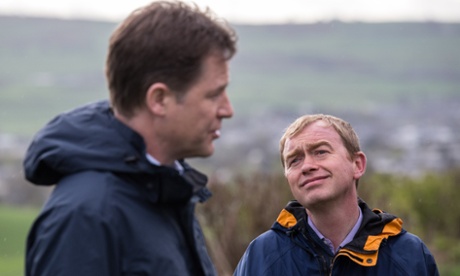
Tim Farron, the frontrunner in the Liberal Democrat leadership race, has said that Nick Clegg should take on a “very high-profile” role in the parliamentary party following the election of a new party leader.
Farron said that the former deputy prime minister, who was one of just eight Lib Dem MPs returned on 7 May, could follow in the footsteps of other party leaders who took prominent frontbench roles after stepping down.
The former Lib Dem president made his remarks in an interview on Pienaar’s Politics on BBC Radio 5 Live. Asked by Kevin Schofield, the incoming editor of the Politics Home website, what role Clegg could play, Farron said: “Largely, it is up to him – but a very high-profile one.
“I kind of envisage Nick Clegg going through the same transition in the public’s eyes that William Hague did after he was defeated as Tory leader in 2001. He was vilified up until that election.
“And shortly afterwards there was a great sense among the public that: ‘hang about, this guy’s been through the mill, he is worth something. This is a man of real substance.’ William Hague is a very decent man but I think Nick Clegg is better still. I think that is how he will be viewed by the electorate.”
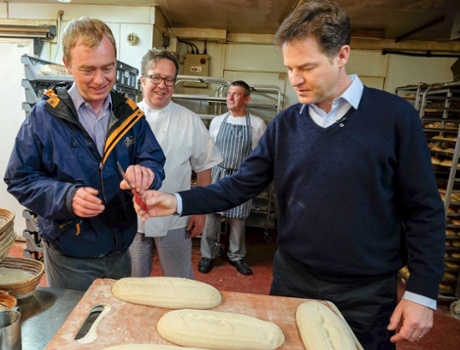
Farron cited the examples of the late Jo Grimond, the Liberal party leader between 1956-67, who served as interim leader for two months in 1976 after Jeremy Thorpe stood down; Lord Steel of Aikwood, who served as foreign affairs spokesman after he stood down in 1988; and Lord Ashdown of Norton-sub-Hambdon, chair of the recent Lib Dem general election campaign.
“Because of our smaller numbers in the past too, when a leader has gone and retired from the past, they have generally speaking not been allowed to go out to grass,” Farron said. “David Steel was foreign affairs spokesperson under Paddy Ashdown, Jo Grimond served under David Steel and obviously Paddy served under Nick Clegg.”
Farron found himself under pressure on Sunday over his apparently equivocal support for gay marriage. In an interview with the Observer, Farron said he regretted having abstained at the third reading of the equal marriage bill because he supported some amendments that were designed to provide “conscience protections” for religious minorities.
He told the Observer: “It is important to be very, very clear that I voted for the legalisation of equal marriage and support it, and will fight very hard against any attempts to water it down – which there might be.”
But Farron, an evangelical Christian, added: “Put simply, there were a couple of amendments that were about the protection of essentially religious minorities, conscience protections, and I kind of voted for those. Me doing something like that, which is about protecting people’s right to conscience, I definitely regret it, if people have misread that and think that means I’m lukewarm on equal marriage.”
Norman Lamb, the former care minister who is Farron’s rival for the Lib Dem leadership, highlighted his voting record when he was challenged by Andrew Neil on Sunday Politics on BBC1 to explain in what way his rival is not liberal.
“There will be differences between us,” Lamb said. “On the whole issue of diversity, I have been very clear and consistent about the absolute importance of same-sex marriage. That, for me, is a fundamental principle of liberalism that you should be able to love and marry whoever you want.
“There were votes where Tim took a different view or abstained. That is up to him. And I respect alternative views. But, for me, this is a really important principle of our party.”