I am standing in front of the Millennium Centre in Cardiff, the venue for this year’s BBC Radio 2 Folk awards. Some months back, I’d been invited to present an award. I have a rule for such situations, which is: never ask, “Why me?”; the answer is always dispiriting. I was once told I’d been invited on a radio programme because someone who worked there knew I lived really near the studio.
So I just said yes straight away. Now, staring up at the Millennium Centre, it occurs to me that I might have asked some supplementary questions: will I have to make a speech? Will it be broadcast live on Radio 2? How many complete strangers can you fit into the Wales Millennium Centre, do you think?
Once inside, the extent of my problem becomes apparent: I don’t really know any folk music folk, but they all seem to know each other. I sit alone at the bar, watching them mingle. I’m presenting the second to last category; I have approximately two hours to work myself into a terrible lather.
I find my seat. Shortly after the ceremony begins, the people on either side of me are whisked away to present awards, until I’m alone in my row. No one comes back. I become obsessed with the Autocue – I’ve never used one, and I’m not even sure how they work. I can’t see any apparatus. Maybe it’s broken, I think, and the other presenters are just winging it.
At the interval, I decide to stay in my seat, studying the programme intently.
“Barry?” someone behind me says.
I flip a page, then another.
Someone starts poking my shoulder insistently.
“Barry!”
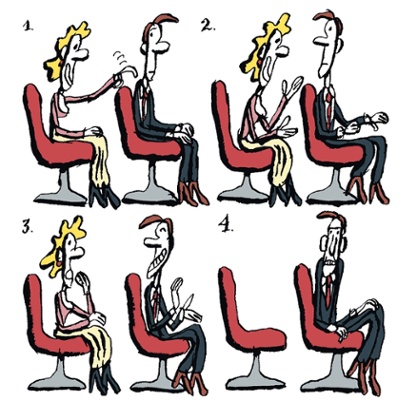
I turn around to see a woman smiling at me.
“Hi,” I say.
“Barry, it’s great to see you here!” she says, leaning forward. I smile.
“Isn’t this a fabulous night?” she asks. I nod noncommittally, as if I haven’t quite decided.
“You’re looking well,” she says. “And isn’t the music absolutely…” She stops and stares at me. “I’m sorry,” she says. “You’re not who I thought you were at all.”
“No,” I say.
An awkward pause follows, during which I realise the precise nature of my faux pas: there was an obvious point at which I should have said, “Actually, I’m not Barry” and I missed it. One could argue about exactly where that point lies, but it certainly should have come before she realised I wasn’t Barry. I’ve made it seem as if I would have allowed her to labour under the misapprehension all night, or longer. I stand up to leave the auditorium.
“If I see Barry, I’ll tell him you said hi,” I say.
At some point in the second half, I realise the woman is no longer sitting behind me. I’d have moved seats, too, if I were her. Who knows what fake Barry might have been planning, once he’d wormed his way into your life?
A moment later, the woman – a woman I now know to be celebrated jazz singer Clare Teal – steps on to the stage. For a brief second I think she’s going to issue a public warning about an impostor in our midst – “He’s not Barry, but don’t wait for him to tell you that” – but instead she presents the award for best album.
I look around me at Britain’s folk community, their colleagues from the wider musical world and the guy next to me, who’s on Casualty, and I begin to feel the full value of my anonymity. It’s not until Clare Teal takes her seat again that I realise it’s only a matter of time before the man she mistook for a well-rested Barry walks out on to the stage with his real name ringing in everyone’s ears.