My Cairngorm plateau snowholing trip starts in a cafe in Aviemore, talking about the possibility of not snowholing – the weather on the plateau is apparently atrocious. At the moment it’s more likely we’ll just hike up, build a snow hole and then, for safety’s sake, descend before nightfall.
“We’ll have to see what the temperature’s like up there,” says Mike Arkley, our guide. “But it will still be a valid experience either way.”
“I agree,” I say, a little too enthusiastically. The idea of sleeping in a bed instead of a house made of snow suddenly seems totally valid to me.
We get into our gear. Most of mine is new and hasn’t even been tried on. The other stuff we’ll need is distributed between our rucksacks. We’re a party of four: me, Mike, Murdo the Guardian photographer and Jack, who is also a photographer and is, like me, looking to improve his mountain skills. Unlike me, he already has some mountain skills to improve upon, and he’s 24. We stop at the ranger station to sign in, and then off we set, from the bottom of the rope tow at the Cairngorm ski centre, into the unknown.
The weather is indeed diabolical: rain mixed with face-lacerating sleet. But it’s the wind that’s the real problem – it’s gusting hard enough to blow me sideways. This, combined with a heavy pack and uneven ground, makes for a slow-going, knackering ascent.
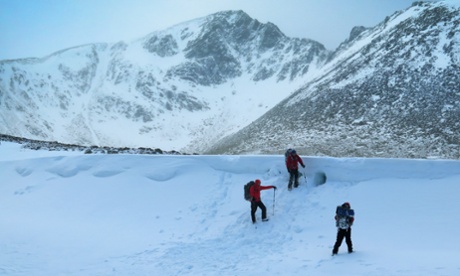
Also, there isn’t any snow at this level. The ski resort is conspicuously shut. There’s snow on the plateau, apparently, but that’s too high for us to go, given the conditions. Mike, however, has a place in mind: a sheltered spot at the base of a sheer cliff. When we get to the top of a ridge I can see it – a triangular field of white.
We come to a spot on the hill where the snow drifts in such a way that it forms a vertical face. This is where our snow hole will be. A snow hole is basically a shelter, hollowed out of accumulated snow rather than constructed like an igloo, and knowing how to make one is an essential survival skill for winter mountaineers. Mike draws the outline of an arch on the wall in front of me, and I start excavating, slicing out blocks with the blade of my shovel. He draws two more arches alongside mine, one for him and one for Jack, and they start digging. It’s not hard – the blocks slide out, more or less, and tumble down the hill behind me – but it’s certainly absorbing.
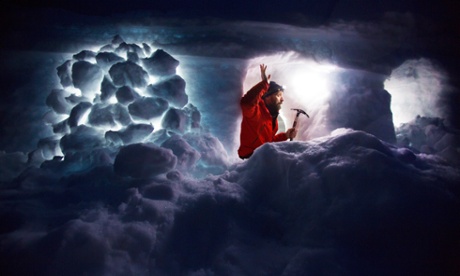
Once we’ve gone in about 2.5 metres, we dig sideways to connect up the arches, ending up with an oblong cave with three doors. We even out the floor, true up the walls and block the leftmost door with the excavated snow. Inside it’s warm and quiet: the howling wind seems a world away. Mike jabs two glowsticks into the ceiling, and there you have it – a cosy snow home for four.
The temperature has dropped, which is good: a melting snow hole sags and drips and infuses everything with damp. Mike decides it’s cold enough to spend the night out here, after all. I don’t know what I think about that, to be honest. I’m giddy with exhaustion and my gloves are too wet to put back on.
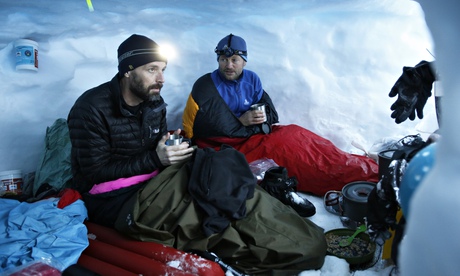
Supper is a boil-in-the-bag curry cooked on a camping stove, and instant coffee made with melted snow. Afterward, I feel restored. Then we begin the delicate choreography of bedding down – rolling out sleeping mats, shoving sleeping bags into bivvy bags, exchanging wet socks for fresh ones – trying to keep dry in a shelter where every architectural feature is made of water. We take it in turns to get ready, a process that consumes the better part of an hour.
Suddenly it’s bedtime – 7pm. I’m warm and dry, but I can’t sleep – of course I can’t sleep. As the breathing either side of my head turns rhythmic, I stare at the glowstick in the ceiling above my head. The night outside the front door is by turns crystal clear and blizzardy white; occasionally a swirl of stray wind gusts in, leaving a light dusting of snow on my exposed forehead.
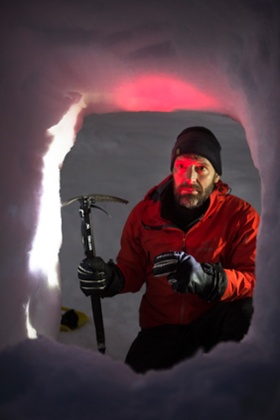
After an hour or so it becomes clear that I’m never going to sleep. The bivvy bag is claustrophobic, the snow floor beneath me tilts. My back aches. I experience boredom, frustration, the first faint symptoms of panic; everything except unconsciousness. The second or third – or perhaps ninth – time I feel the need to sit bolt upright and stare wildly around me, I notice that my boots are covered in an inch of fresh snow, as is nearly everything else. Jack, at the end, is half submerged in a drift. I wonder if I should warn him, but he’s asleep, and I can’t imagine anything crueller than waking someone up in these circumstances.
Eventually, long after I’d given up hope, the darkness outside begins to soften at the edges. Only then do I feel relaxed enough to drift off briefly.
Mike’s alarm goes off at 8am, 13 hours after I first tried to shut my eyes. As long dark nights of the soul go, it was one of the longest.
“A typical night’s sleep in a snow hole,” says Mike. “Fitful at best.” Everybody had a bad night; we only have each other’s snoring as evidence that anyone slept at all. It also turns out that when faced with the prospect of marching down the mountain toward home, one can shove wet-stockinged feet into frozen boots with an anticipation that approaches joy.
The sun comes out just as we crest the first ridge. Fresh snow covers the ground, and a little ice-axe training – how to hold it, how to plant it – comes in handy on the slippery downward slopes. But what I’ve really gained form the experience is experience – not much, but enough to know that a third pair of socks would have made all the difference.
To go on a trip like Tim’s, visit applecross.uk.com/msg/winter-mountaineering-in-scotland
Tim Dowling’s mountaineering kit was provided by Snow + Rock, including Arc’teryx Men’s Beta LT jacket in chipotle, £330; Icebreaker Men’s Tech 260 long sleeve half zip, £84.99; Riggler Lonesome George beanie, £27.99
How to build a snowhole
Important: never go snowholing without winter skills training including avalanche avoidance, ice axe and crampon safety, winter micro-navigation training and alongside experienced friends or professional instructors.
1. Find a safe site in a hollow or on a ridge, where snow has accumulated to a good depth. Often the best snow for digging into is wind-packed slab. Open slopes are an avalanche risk.
2. Check for avalanche risk. The temperature should preferably be below three degrees Celsius - check the forecast for rising temperatures.
3. Use an avalanche probe - a long stick, basically - to make sure the snow is deep enough to accommodate your snowhole, or you might waste time and energy digging in the wrong spot. 2.5 metres horizontally and vertically should be plenty.
4. Dig a rectangular hole into the most vertical part of the windblown snow or, if it’s in a flat area, dig down 2 metres.
5. Depending on group size, dig 2-3 holes in a row. Once you’ve gone about 1.25 metres, turn towards one another to hollow out the snowhole. This is quicker and keeps people warm.
6. When there’s enough room for people to work inside, start shaping the interior: either an upside-down bowl for a round snowhole, or an upside-down rain gutter for an oblong one. These shapes will give you enough headroom and will also resist sagging from either warm air inside or rising temperatures outside.
7. Level the floor for a comfy night and use gloved hands to smooth off any bumps or ridges in the ceiling where drips might form. Overnight, block off a door with snow boulders and the main entry with your rucksacks.
8. Mark the hole with ski poles and glowsticks so no one walks on top of it or falls in. Use a rope to link the hole to the outside so that it can be found easily in bad visibility.
9. Keep shovels inside: entrances can get blocked by windblown snow overnight. And never use cookers with the entrance blocked. Glow sticks stuck in the walls and ceiling will help with orientation and prevent that claustrophobic feeling.
Important: safe snowholing requires additional winter skills training, including avalanche avoidance, ice axe and crampon safety and winter micronavigation. Only go snowholing alongside experienced friends or professional instructors.