It’s my first time in Barcelona. It’s late at night, and I’m standing in a hotel lobby, waiting for a lift to take me up to my room. In front of the lift there is a framed sign on a stand. My name is printed on the sign, above an arrow pointing to the stairs. Below that are some words in Spanish. From the context, it seems obvious to me that the sign says, “Tim Dowling is barred from the lift.” But I’m alone in the lobby, so when the door opens, I get in.
In the morning, after breakfast, I ring my wife.
“I was wondering when I might hear from you,” she says.
“They took me out,” I say. “Sorry.”
“What happens today?” she says.
“Press conference,” I say. “Rueda de prensa. There’s a sign.”
“Who comes to that?” she says.
“I don’t know,” I say.
When I try to put myself in the position of a Spanish reporter invited to put questions to a foreign journalist I’ve never heard of whose book has just been translated into Spanish, I can only imagine balling up the press release and throwing it away.
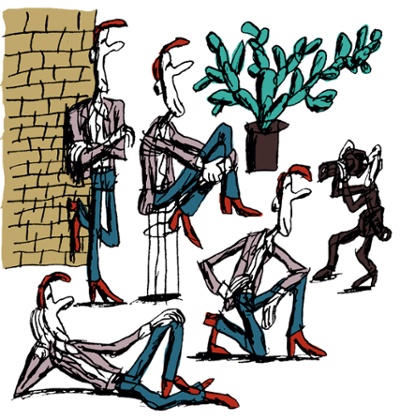
Before the press conference, a hired photographer takes pictures of me in various locations: next to a wall; perched on a chair near a plant; on the pavement outside. I am, as always, eerily compliant.
Afterwards, I follow the arrow on the sign with my name on it up the stairs. At the top there are 40 people milling about wearing name tags on lanyards, drinking coffee and eating free pastries. I find the woman from the publisher’s publicity department standing to one side.
“Are all these people here for me?” I ask.
Her eyes search the crowd as she processes my question into Spanish. “No,” she says. “They’re doctors.”
About eight journalists have turned up for my press conference, which is taking place in a room off the mezzanine where the doctors are. Because I don’t speak any Spanish, an interpreter has been provided. She’s called Janine, and is seated at my right hand with a notepad. When the publisher begins his opening remarks, Janine immediately leans towards me and starts whispering in English. This is a little alarming – two people either side of me, speaking simultaneously. My concentration skips from one voice to the other. Then the talking stops, and everyone looks at me.
“Buenas dias,” I say.
I turn to Janine. “Is that right?” I whisper. Janine makes a face. Uh-oh, I think. Don’t piss off Janine.
A journalist to my left asks a long question. “He is comparing your wife to the Guardia Civil,” Janine whispers. I can’t tell whether what she subsequently says about the Guardia’s historic reputation for brutality is part of the question or just a bit of background for my benefit.
When everybody looks at me again, I begin talking in English. I make a joke that is greeted by complete silence. I glance towards Janine and I see that she is doodling – her pad is full of stick figures, letters and squiggles. Later, I will learn this is an abstract form of shorthand commonly used by interpreters, but at that moment I’m convinced she’s playing hangman to pass the time. Janine’s bored, I think.
Eventually, I run out of breath. Janine starts speaking in rapid Spanish, crossing out stick figures as she goes. At one point, some of the journalists chuckle, but I can’t tell if they’re laughing at me or with me. Perhaps Janine has made a joke at my expense, I think. It occurs to me that I might find it easier to go outside and impersonate a doctor.