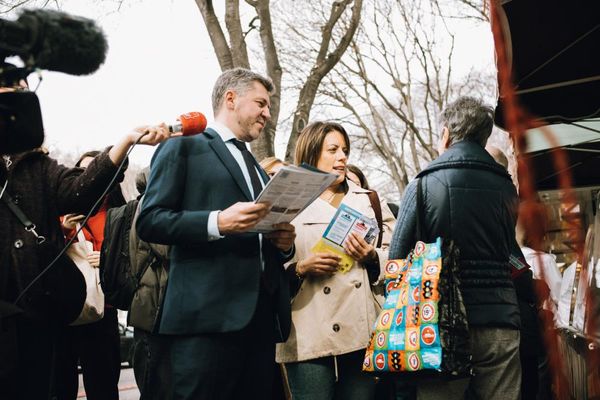
Some years ago, a television crew came to my house to interview me about men and crying. They seemed determined to portray me as someone who thought men shouldn’t cry. I maintained that I’d wept only the night before, while watching a programme about children being sent to boarding school. “Which is weird,” I said, “because I probably wouldn’t cry about sending my own kids to boarding school.” This statement was greeted by a stony silence.
“Well, not in front of them,” I added. “I mean, I would probably cry later, about the money.”
After that, I resolved to refuse all future invitations to appear on TV, but none came. When a French TV journalist contacted me recently about doing an interview, I’d long since forgotten about this resolution. I said I was available, at that point fairly certain it would never happen.
“By the way,” I say to my wife on Friday, “a French journalist is coming to interview me this afternoon.”
“What for?” she asks.
“It’s to do with an article I wrote two months ago,” I say. “Which I ought to reread.”
At 3pm, I am pacing the ground floor, looking alternately at my phone and out the window.
“What are you doing?” the youngest one, who is busy playing Fifa 17, asks.
“French television is coming to interview me,” I say. “But they’re late.”
“Why you?” he says.
“I’m huge in France,” I say.
A taxi pulls up outside.
“Oh, bollocks,” he says, letting in a goal.
The doorbell rings. At the door, I find the journalist and, behind him, a woman laden with equipment.
“Nice to see you,” he says, shaking my hand. “Sorry we are late.”
“That’s OK,” I say.
“Can we do this again?” he asks.
“Do what again?” I say.
He means the handshake: they wish to film me answering the door, before it gets too dark. The camera operator sets up her tripod on the pavement, but decides it would be better for the reconstruction if we shake hands halfway along the garden path. I don’t like how eager this makes me seem, but I agree. We do two takes.
Afterwards, the camera operator sets up some lights at one end of the sitting room and moves an armchair forward.
“I show you my questions,” the journalist says. “So you know what to expect.”
He produces a notebook with three numbered questions neatly written in English. The first restates the premise of the article I wrote, and doesn’t require me to say much beyond “Yes”. The second asks me to sum up my findings. The third contains the phrase “editorial position”.
“This is correct, in English?” he asks.
“Yes,” I say. “Editorial position is fine.”
He turns the page. “Ah, OK,” he says. He reads question 5 aloud. I try to listen, but my eye is snagged on question 4, which he’s skipped. It’s right at the top of the page and it appears to say: “Would you like to touch my banana?”
He moves on to question 6. I blink hard and adjust my glasses. Question 4 still clearly says, “Would you like to touch my banana?” My mind begins to race.
“This is OK?” the journalist says, after reading the last question.
“Yes, although…”
“We’re ready,” the camera operator says. At her bidding, I sit in the armchair. The journalist sits down behind the camera and reads question 1.
“Yes, exactly,” I say. Normally at this stage, I would be worried about my posture or the titles on the bookshelf directly behind my head, but now I can think only of question 4.
At one point, my wife pauses halfway down the stairs and peers in. I raise my eyebrows as if to say “Help!”, but as far as she is concerned, I’m a deer caught in some headlights and she’s just a car passing in the other direction.
“So he didn’t ask if you wanted to touch his banana?” she says after they’ve gone.
“No,” I say. “But I spent the whole interview thinking about my answer.”
“Is it some kind of psychological technique, do you think?”
“The worst thing is,” I say, “I never even brought it up.”