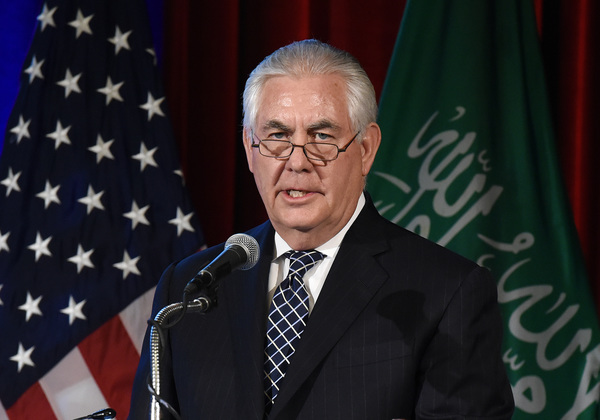
WASHINGTON _ Secretary of State Rex Tillerson said Wednesday that President Trump's fiery words threatening North Korea were intended as a "strong message" in "language Kim Jong Un would understand."
Speaking on his flight home as he wrapped up a diplomatic tour through Southeast Asia, Tillerson said he was hopeful a fortified international front would put pressure on Pyongyang and force it to back down from its own belligerent stance.
Tillerson flew into Guam for a refueling stop, spending about an hour in the U.S. territory that the North Korean leader specifically threatened to attack. The secretary said he did not consider rerouting.
Tillerson and the U.S. ambassador to the United Nations, Nikki Haley, managed to secure unanimous U.N. Security Council approval of a tough new round of sanctions against North Korea over the weekend. Chinese and Russian officials have spent the last 48 hours insisting to their North Korean counterparts that the sanctions be obeyed, Tillerson said.
Despite the escalating tensions and explosive rhetoric, Tillerson urged calm, saying he did not believe that there was "any imminent threat."
"Americans should sleep well at night," Tillerson said.
"What the president is doing is sending a strong message to North Korea in language that Kim Jong Un would understand, because he doesn't seem to understand diplomatic language," Tillerson said. "I think the president just wanted to be clear to the North Korean regime that the U.S. has unquestionable ability to defend itself, will defend itself and its allies."
Trump on Tuesday, from his private golf resort in New Jersey, warned Kim that he "best not" continue threatening to launch nuclear weapons and attack the U.S.
Otherwise, Trump said, "they will be met with fire and fury like the world has never seen."
Tillerson downplayed any speculation that the alarming developments suggested the U.S. was moving closer to a military option to dealing with the crisis over the North's nuclear and ballistic missile programs.
"Nothing that I have seen and nothing that I know of would indicate that the situation has dramatically changed in the last 24 hours," Tillerson said.
Tillerson concluded several days of what he described as successful diplomacy, pressing Asian countries to join efforts against North Korea. He attended the annual meeting of the Association of South Eastern Asian Nations in Manila, became the highest-ranking U.S. official to visit Thailand since the 2014 military coup and met Malaysian leaders in Kuala Lumpur.
The stop in Guam, though a scheduled technical layover, sent a message, coming hours after Kim threatened to attack the island, which houses U.S. military bases and is a common refueling stop for U.S. government aircraft traversing the Pacific Ocean.
"The North Korean missile capability can point in many directions, so Guam is not the only place that would be under threat," Tillerson said, as he sought to downplay any danger.
Tillerson often finds himself in the position of having to explain, and soften, the words that emanate from the White House and, in this case, mute the chances for public panic. Diplomats warn of the danger of miscalculations on either side spiraling out of control and leading to military action that would prove calamitous.
Tillerson said he believed that the U.S. strategy of talking tough while marshaling diplomatic forces behind the scenes was working.
"I think, in fact, the pressure is starting to show," Tillerson said. "I think that's why the rhetoric coming out of Pyongyang has gotten louder and more threatening. Whether we've got them backed into a corner or not is difficult to say, but diplomatically, you never like to have someone in a corner without a way for them to get out."
The U.S. has sought special help from China, North Korea's chief ally and trade partner, demanding Beijing do more to pressure the reclusive nation economically and diplomatically.
Tillerson has also dangled the possibility of talks with North Korea _ but only if Kim's government gives up its nuclear aspirations, starting with an extended pause in missile tests.
"Talks," Tillerson said when asked if North Korea had a way out. "Talks, with the right expectation of what those talks will be about."