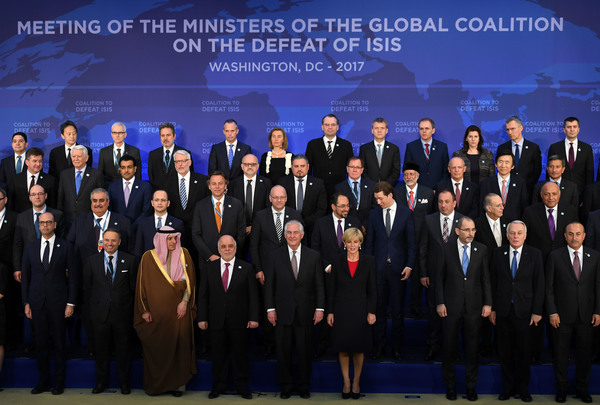
WASHINGTON _ The Trump administration will publicly assess its strategy against the Islamic State for the first time Wednesday in a State Department summit with the 68 nations in the U.S.-led coalition against the militant group.
The meeting, hosted by Secretary of State Rex Tillerson, comes days after visiting Iraqi Prime Minister Haider al-Abadi won assurances from President Donald Trump about more U.S. support in the war against the Islamic State that has been raging for nearly three years.
In his opening remarks, Tillerson said the coalition had managed to reclaim large parts of Iraq and Syria from the militants even as intense fighting continues in some areas.
"Our end goal in this phase is the regional elimination of ISIS through military force," he said, using an acronym for the terror group.
In a speech to Congress last month, Trump said he had asked the Defense Department for a plan to "demolish and defeat" the Islamic State, but he has not rolled out a new strategy.
The Pentagon has about 5,200 troops in Iraq and 1,000 in Syria. They rely on Iraqi security forces and Kurdish guerrillas in Iraq, and U.S.-backed rebel militias in Syria, to carry out combat operations, while the U.S. and its allies provide intelligence, launch airstrikes and fire artillery to support the ground attacks.
Over the last year, the combined attacks have pushed out the Sunni militants from most major cities in Iraq. Despite a five-month U.S.-backed assault, heavy fighting is still underway to retake the group's remaining stronghold in Mosul, Iraq's second-largest city.
The challenge is tougher in Syria, where the Pentagon has backed the Syrian Democratic Forces, a coalition of mostly Kurdish rebel groups that operates chiefly in northern Syria. Preparations are underway for an assault on the Islamic State's self-declared capital of Raqqah.
Long-term challenges will be to rebuild the cities and towns destroyed by Islamic State during their occupation, or by coalition bombardments that sought to dislodge them.
Tillerson will ask other coalition nations to invest in the recaptured areas and to help provide humanitarian aid and other resources for the millions of people displaced in the fighting.
"We will continue to facilitate the return of people to their homes and work with local political leadership," he said Wednesday.
"They will provide stable and fair governance, rebuild infrastructure and provide essential services," he added. "We will use our diplomatic presence on the ground to facilitate channels of dialogue between local leadership and coalition partners."