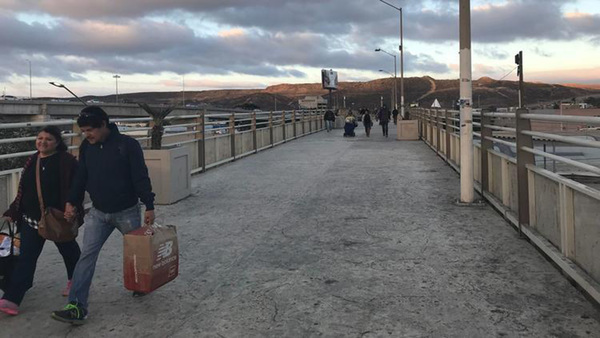
TIJUANA, Mexico _Shuttered storefronts, broken sidewalks, and darkened staircases for years have greeted pedestrians making their way from the border to downtown Tijuana. Now promoters of the city are hoping to change that unsettling first impression.
A $13 million project called Umbral de las Americas, or Threshold of the Americas, envisions a renewed entryway, with plazas, new lighting, wide ramps, and a broad new bridge over the Tijuana River channel to connect the border with Avenida Revolucion, the traditional tourist district.
"It's going to be a place where you want to linger, to be entertained, rather than a place where you just want to walk fast," said Aaron Victorio, executive director of Tijuana's Economic Development Council, a private-sector planning group that has been championing the project.
Just across from San Ysidro, the project covers the three-quarter-mile route from the PedWest pedestrian entrance at the San Ysidro Port of Entry to the giant arch at the northern end of Avenida Revolucion. The path runs through an area in transition, at once booming with activity and new construction, and struggling with urban decay with empty shops, an entrenched homeless population and a persistent stench that rises from the concrete Tijuana River channel.
The aim is to make walking into Tijuana a safer, shorter and more pleasant experience. The changes are part of a larger effort to revitalize the city's historic downtown near the U.S. border, an area slowly being transformed with new living spaces, cultural venues, breweries, restaurants and cafes.
PedWest's opening in 2016 underscored the need for a better pedestrian connection from the border to Tijuana's downtown. U.S. Customs and Border Protection figures show an average 12,000 daily northbound crossers through PedWest_close to 60 percent of the total northbound pedestrian traffic, and a similar number is estimated to cross southbound.
"It should be better," said David Bernal, a Tijuana resident who crosses the border at PedWest to get to and from his job at Northgate market in San Diego. "After dark, I don't go through here," he said.
Funding for the project so far has come from a variety of government sources, including Baja California's state government and the Tijuana municipal government. With roughly a fourth of the necessary money in hand, the first phase is scheduled to begin early in 2018 and be completed by September. It will include rebuilding a pedestrian corridor lined with small shops known as Callejon Articulo 123, putting the electric wiring underground and offering merchants incentives to rebuild their facades.
"Anything that can help downtown Tijuana, anything that makes it easier to get there will be helpful for future development," said Genaro Valladolid, a Tijuana real estate broker who has championed mixed use and condominium developments in the area. "Right now, when you cross, it's a very unpleasant, unwelcoming experience."
The project's centerpiece comes in the second phase, and involves rebuilding the Naciones Unidas pedestrian bridge that spans the Tijuana River, broadening it, and building "cultural plazas" on each end. The structure will include giant steel tubes that hold up a bridge that will form a giant X_an allusion to the "x" in Mexico. The final phase would be a path connecting to PedWest.
"This project will allow us to show that yes, we can improve, we can change, and we can renew all the way from the entrance of Tijuana to other areas," of the city, said Gabriel Camarena, president of the economic development council.
While the timing of the funding to complete the project is uncertain, the council confident that it will come through, said Victorio, the executive director.
And while a redesigned entrance to downtown can't solve all the problems of the area, the Umbral project is an important first step, proponents say. "It is part of the solution, though not the complete solution," said Arturo Echanove, a Tijuana architect who helped select the current design.
The need for such a project was first mentioned in the plan in 2012, Victorio said. In 2014, the council collaborated with a Mexican architecture publication, Arquine, calling for designs to redevelop the area. About 400 proposals were sent from around the world, including Uruguay, France and China, with the winning design submitted by a U.S. team.
"It was a great concept, but it wasn't really doable," Victorio said, adding that the estimated cost of $70 million was too high. "We said 'let's do something that is reachable for us.'"
For Elba Palos, the changes won't come a moment too soon. Her curio shop at the edge of Tijuana's Mercado de Artesanias has seen few customers in recent years. "They don't come any more," she said. "It's a real struggle. We want more people to come."