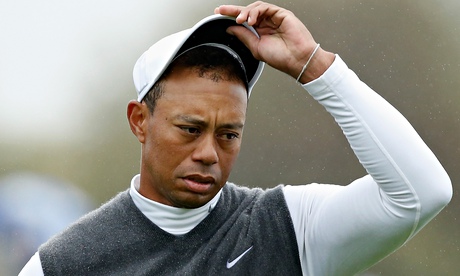
The suspicion that Tiger Woods can never return to a dominant position was not sufficient to blunt the level of shock caused by Friday’s events in Phoenix. In 1,267 tournament rounds as a professional, Woods had never carded as high as 82. Even when he came close, at the 2002 Open Championship, the horrific conditions at Muirfield served as a decent excuse. Perhaps Woods could take solace that his old nemesis Phil Mickelson also missed the cut at the Waste Management Open, rendering this the second time in the pair’s professional history that they had exited, stage left, having missed the cut.
It is the case of Woods, inevitably – and those 82 strokes – that triggered all the debate. He did Mickelson a favour in that regard. With the first major of the season due to begin nine weeks on Thursday, it is harder than ever to make a case for the once peerless Woods adding to his haul of 14. His Phoenix playing partners, Patrick Reed and Jordan Spieth, are part of a fresh generation that clearly does not fear Woods. Being blunt, they have little reason to.
There are two standout reasons for Woods’s problems, which were also evident at his previous tournament appearance in December. First, he is rusty. A back problem, which ultimately required surgery, offers a decent excuse for that, but, in general terms during recent years, there has looked like a lack of willingness from Woods to go the extra mile for tournament appearances when he would have benefited from competing. When Woods is on the course, he is one of the most ferocious competitors sport has seen.
Today’s issue may well be that the 39-year-old lacks the deeper hunger to test himself against the best players more regularly than has become customary: you grow older, priorities change. Perhaps Woods’s relaxed, occasionally joking touch after Friday’s round was tacit admission of that. Alternatively, he will make every appearance possible between now and the Masters to hand himself at least a fighting chance at Augusta National.
The other glaring Woods problem is an inability to do what he was once so supremely talented at: scramble – or, in more basic parlance, chip and putt. Contrary to wider perception, he was never the most accurate player in the game. Woods in his pomp, though, had a quite sensational ability to recover hazardous on-course scenarios.
Despite an assertion of hitting thousands of chips after missing the cut at the Hero Challenge, the same flaw appeared in Arizona. When that becomes mental, veering towards ruinous territory of the yips, any player has a serious problem.
In the United States, discussion is understandably fevered over Woods’s woes. He still has the status to ensure that. When Tiger struggles so badly, shock tends to outweigh explanation.
“It is incomprehensible to see a golfer who had reached so high, fall so low with his game,” said Brandel Chamblee, the Golf Channel analyst. Chamblee can be counted among those who believe Woods’s mind has been muddled by far too many different-swing thoughts. His latest new coach, Chris Como, will receive criticism for events in Phoenix, but he has not been working with Woods for nearly long enough to be cited as a key influence. The reality is that every one of Woods’s instructors has, and will, come under fire.
Notah Begay, who has been close to Woods since college days, admitted “the world of golf has a bit of concern” over his friend’s situation. “Just as Tiger Woods put the world of golf on its heels with his winning performance at the 1997 Masters, this is putting the world of golf back on its heels,” Begay added. “Some players who spoke to me were dumfounded. He is going to have to ask himself a lot of serious questions over the next few days about how he rebuilds this. But there is no quit in Tiger Woods; he don’t go down without a fight.”
One of the most remarkable things about Woods has not been his success, but rather the standards he set even when not playing well. This marks the first time he has missed back-to-back cuts so he is in uncharted territory in needing to launch a fierce response to, somehow, remain a prominent part of a tournament’s narrative. For now, even odds of 20-1 for a Woods Masters triumph do not look remotely appealing.