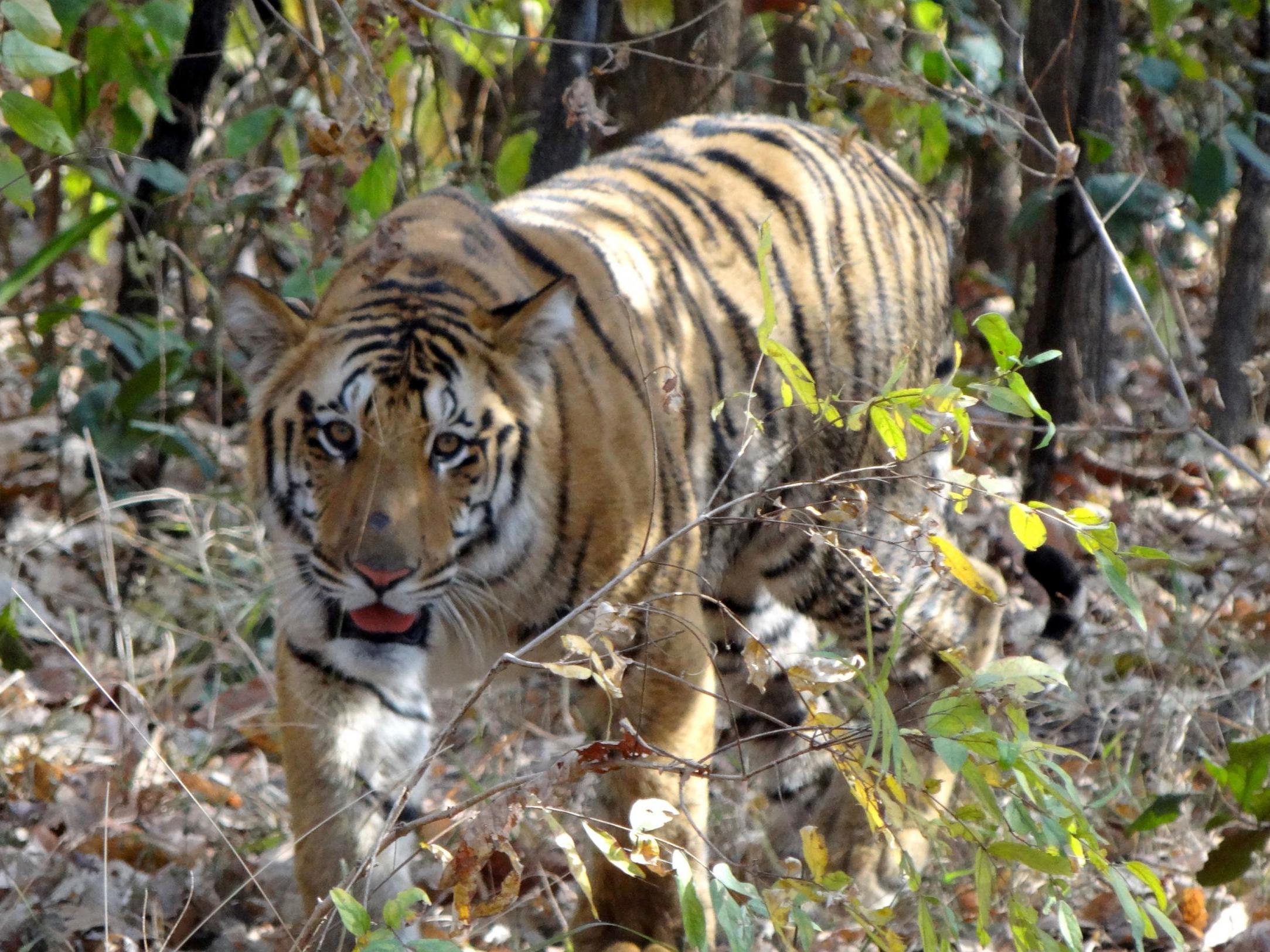
A tiger has undertaken the longest walk ever recorded in India, roaming more than 800 miles in five months, according to researchers.
Experts said the three-year-old big cat set out from its home at a wildlife sanctuary in the western state of Maharashtra in June.
It travelled a meandering 808 miles (1,300km) across forests, farms, roads and hundreds of villages to a neighbouring state before settling at another sanctuary in Maharashtra.
The male tiger probably kept moving in search of territory, prey or a mate, experts said.
The cat, known by researchers as C1, was one of three cubs born to the female T1 in Tipeshwar wildlife sanctuary in late 2016. It was fitted with a radio collar in February and was tracked using GPS.
“The purpose of the study was to monitor the dispersal pattern of sub-adults which are normally in the process of exploring new areas to set up their territory,” said Govekar Ravikiran, field director of Pench tiger reserve.
C1 roamed virtually unseen through seven districts in Maharashtra and neighbouring Telangana before coming to a rest in Dnyanganga sanctuary.
“The tiger is possibly looking for territory, food and a mate. Most of the potential tiger territories are full and new tigers have to explore more,” Bilal Habib, a senior biologist at the Wildlife Institute of India, told the BBC.
Officials said the tiger had “never entered into any conflict with humans except the cattle kills that he made for survival” and “an isolated avoidable incident” in which it attacked a group of men, injuring one. The men were said to have approached the tiger “very closely”.
Mr Ravikiran said the tiger was now expected to spend some time exploring Dnyanganga, where there is plenty of prey.
Hunting and loss of habitat have led to a sharp decline in tiger numbers in India over the last 200 years, but earlier this year the prime minister Narendra Modi announced the country’s wild population of the animal had rebounded by 30 per cent since 2015.
However, scientists have since voiced scepticism about the government’s figures, which Norwegian researchers said last week were based on unreliable methods and “make little sense from an ecological point of view”.