The squiggly little pigtail at the end of the line tells the forensic tale: The hookup was solid, the line was strong and both angler and fish put up a formidable fight. The fish got off, however, due to operator error _ failure of the knot.
Use a poorly selected rod, line, bait or technique and it's still possible to boat a fish or bring it to shore. Use a poorly tied knot and that fish becomes the one that got away, leaving nothing but the weak knot's curly remains.
With three weeks until the opening of Pennsylvania's statewide trout season, there's time for beginners to practice and for veterans to tighten up those knot-tying skills.
"Talk to light tackle and fly fishermen about the biggest fish they've hooked and lost, and most of the time the fish escaped because the knot failed," wrote fishing legend Lefty Kreh in the introduction of his 2007 book "Fishing Knots" (Stackpole). "Anglers will fuss over rods, reels, lures or flies but ignore that most important link _ the knot."
From an engineering perspective, knots are the weakest and most important elements of a fishing rig. Barring structural damage due to a knick or cut, fishing lines are most likely to break at a knot, even when it's well tied.
When line is pulled taut in a straight line, mechanical stress is equally distributed throughout the line. When the line is bent at an angle, the inside of the angle is squeezed while the outside of the angle stretches, increasing the stress. The tighter the angle, the greater the stress.
Think of a knot as a series of acute angles, or sharp bends in the line. At the outside of each tightened bend the stress is increased, further weakening the line's maximum load. At its best, a good knot accomplishes its task with the least possible degradation of line strength. A bad knot screws up the whole equation.
"I think beginners can get intimidated by fishing knots, and people who've been (fishing) for years can take them for granted. Both are mistakes," said Rob Reeder of Wilkins, a member of Trout Unlimited and the Fly Fishing Club of Pittsburgh.
"It doesn't matter what kind of fishing you're doing, fishing is tying knots," he said. "There are dozens of fishing knots, probably more. Right off the bat, you have to know two. These are the knots we teach at the seminar."
The most fundamental fishing activity is attaching a hook to a line. For that and tying on a swivel, Reeder recommends the Clinch Knot. Pass the line through the eye, pull about 6 inches through, double the line against itself and wrap it around five to seven times. Pass the end of the line through the big hole created just above the eye. For the improved assurance of an Improved Clinch Knot, tuck the tag end through the small hole created just below the wraps.
"Friction from drawing a knot tight will weaken the line. A little saliva on the knot _ any knot _ before tightening it will lubricate it," Reeder said.
Tighten by pulling the mainline and the hook and then the tag end and the hook. Nip off the tag end.
A solid line-to-line knot is vital, whether you're connecting lines of equal width or graduating down from a fly leader or spinning line to a thinner tippet. Reeder ties the Surgeon's Knot.
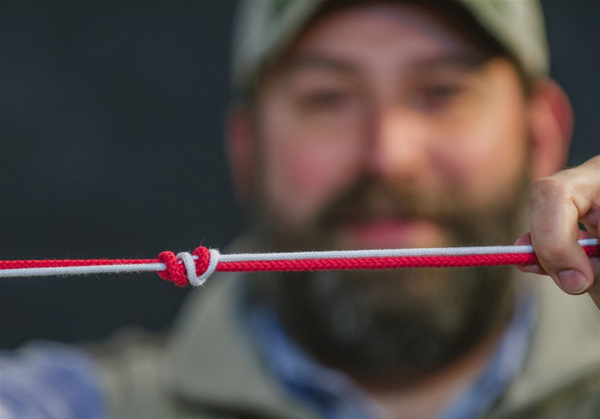
Hold the main line and tippet together. Form a loose overhand knot, passing the long end of the tippet and tag end of the mainline through the loop. Repeat, pulling the same ends again through the loop. Lubricate and tighten by pulling all four ends, and nip the tag ends.
Knot integrity is less consequential when pulling in stocked trout or panfish, but what angler is willing to bet that tug on the line isn't the fish of a lifetime?
"Big fish pull harder. It puts more stress on the knot," Reeder said. "Sometimes you have to muscle the fish to keep it from going into brush or running downstream."
It's not enough to practice a few times with thick lines in your living room. Anglers need to know how to tie basic knots using light lines in freezing weather in the dark, Reeder said.
"It goes back to, you don't want a great fish to get away because of a knot," he said, "because of something you failed to take the time to do right, or to learn in the first place. That's not the fishing story you want to tell."