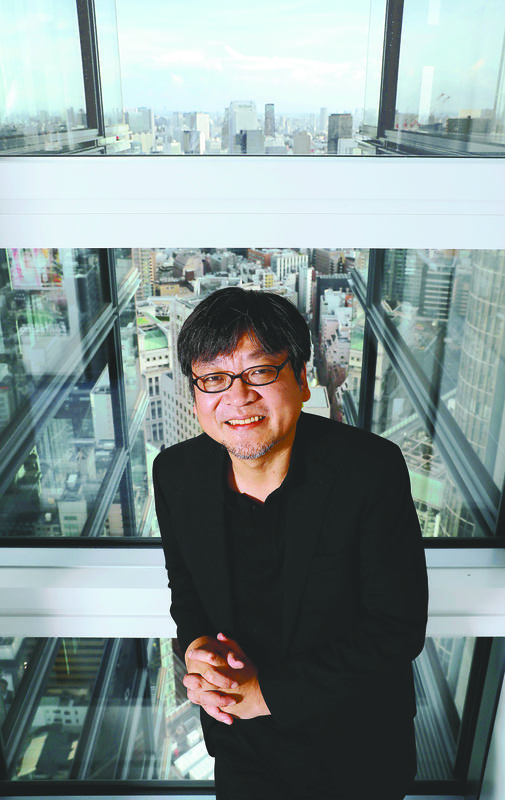
Anime director Mamoru Hosoda's latest film, "Mirai no Mirai" (English title: MIRAI), is currently showing at movie theaters nationwide. Hosoda is widely acknowledged as having been at the forefront of Japan's anime industry for years.
I have been a longtime observer of Hosoda's career, and I can assure you this anime is his most serene, most beautiful and most ambitious work. In "Mirai no Mirai," a 4-year-old boy named Kun and his younger sister Mirai who comes from the future will take the audience to a completely new world.
The main character is Kun. On a winter day, Kun first meets his sister when she is brought home after being born in the hospital. The baby's name is Mirai, and she is held by Kun's mother on her return home. Kun is jealous because the baby now gets most of his parents' love and attention. When he is out weeping in their garden, he finds that his surroundings look somewhat different. He then encounters a mysterious-looking man who introduces himself as a prince. After that, a girl in a school uniform appears and tells Kun she comes from the future. Kun's world starts to expand little by little ...
I interviewed Hosoda to learn about his ideas and approach to this work. The following are excerpts from the interview.
The Yomiuri Shimbun: I've hardly ever heard of a 4-year-old boy as the lead character in an anime.
Mamoru Hosoda: This is probably very rare not only in anime but in global movie history. I got this idea from my own son, who is now 5 years old. At the end of 2015, his younger sister was born and my wife and I spent our energy taking care of the baby. Then, he started to roll around on the floor of our house hysterically. He was like a Shakespearean actor when he cried with his lips trembling. I recognized that although so young, he had already experienced a bitter feeling about being deprived of affection by someone else. As an anime director, not as his father, I calmly observed him and saw how miserable people become when they lose somebody's love.
This experience reminded me of a broken heart when I was young or other memories of love and affection. As a result, I recognized that there may be such a 4-year-old boy living even in the hearts of adults. This is how I got the idea for this anime. Honestly, however, I'd been concerned throughout its production process what anime it would be when completed.
Yomiuri: The young boy has a narrow perspective and a narrow sphere of actions. I suppose it was pretty difficult to depict his world cinematically.
Hosoda: Indeed. In fact, when I submitted this anime production's proposal, I was told something like, "Who do you think would watch this anime?" Those people made some sense. This anime doesn't include dramatic action scenes involving saving the Earth, but just quietly unfolds at a house and its garden. That is an unprecedented type of film to be released during the summer vacation season. It was quite natural the people involved had their doubts about its profitability.
However, I was able to keep motivated because I was encouraged by "Tonari no Totoro" (My Neighbor Totoro) by anime director Hayao Miyazaki. The sister of its lead character Satsuki is Mei, who is a 4-year-old girl. So I thought a 4-year-old boy could be a lead character of a film.
When I first watched "Totoro," I was a university student and didn't feel it was very cinematic. But now, it's an ideal film for me. No dramatic incidents happen. No explanation is given about the existence of Totoro. This film is free from the conventional idea of how movies should be. I hadn't recognized that amazing approach until I started to direct films myself.
A 4-year-old boy, after being puzzled a little, would accept anything that appears before his eyes, no matter how mysterious. Thanks to making this movie, I feel I've been liberated from the sense of what a film should be.
Yomiuri: Kun lives in a small world but he has an enormously large-scale adventure, doesn't he?
Hosoda: I always want to depict the dynamism of human development. I'm interested in what triggers or motivates humans to develop. And humans in their childhood can develop most drastically, so I depict children in my work very often. Many adults regard children as immature humans, but adults can't change as drastically as children. That is why I think they should learn from children.
For example, Kun initially says, "I don't like Mirai at all." But after a while, he starts to give things to his younger sister and smile together with her. I wonder what a great adventure the children take in their inner worlds when the parents don't watch them. They may actually be traveling between the present and the future.
Yomiuri: Kun is guided [in the future world] by Mirai and some other family members, who are, however, different from what they actually are in the present. This plot is very impressive.
Hosoda: In my anime "Summer Wars" (2009), I depicted a large family that has a wide range of members who live, however, in the same era. On the other hand, the theme of this film is the family in different eras. I wanted Kun to meet and interact with his family members who are at various stages of life. His scary mother also has a childhood. I thought about how he would have felt if he encountered her when she was about the same age as him.
Using the method of traveling through time, I realized a wish in this anime. I referred to World War II for the first time in my work. It's just a small episode, but I'm so happy I depicted it.
Yomiuri: This film has also hinted at a new style of modern child-rearing.
Hosoda: Anime conventionally depicts fathers and mothers in "roles." The role of guarding their children and the role of being concerned about their children leaving for adventures. Today, however, such an image of a family with each member's role fixed is no longer realistic. It is time each family should find out their individual form of being a family. Also, that form should be redesigned and redefined each time someone joins or leaves.
It's an illusion to say, "Members of the same family should understand each other without communicating." Gen Hoshino, who provided the voice for Kun's father in this anime, said: "It's your family members who you should try hardest to talk to." I perfectly agree. Children, too, should know what their parents have on their minds, I think. So I hope parents aren't afraid of "disclosing information" to their children. I hope people who watch this anime will be aware of this.
Read more from The Japan News at https://japannews.yomiuri.co.jp/