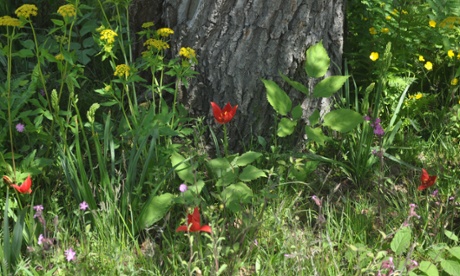
You may not think the Chelsea flower show would have much to offer a true have-a-go gardener like me, but you’d be wrong. Underneath the polished and primped facade of oft-prize winning perfection lurk many ideas that could be recreated at home for next to nothing or indeed (in my case) for free.
First stop for me then had to be Sean Murray’s garden. Murray was the competition winner of BBC2’s The Great Chelsea Garden Challenge, and I found his presence at the show extremely refreshing. Sean’s enthusiasm for gardening design shone through and he’s such a nice chap he was even very forgiving when I rather embarrassingly trampled one of his (thankfully robust) plants as he was showing me about.
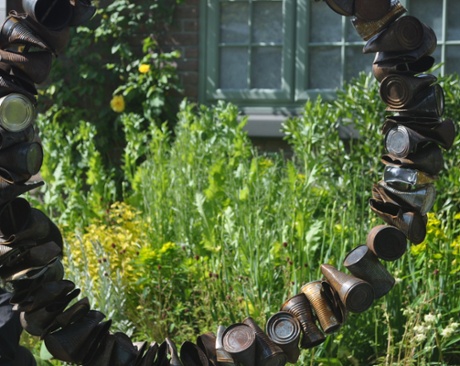
Sean’s garden had some features that really caught my eye: his sculpture made of rusted tin cans was inspired. He experiments with scrap materials on his allotment back home, and some of the cans in this display were dug up from his own patch.
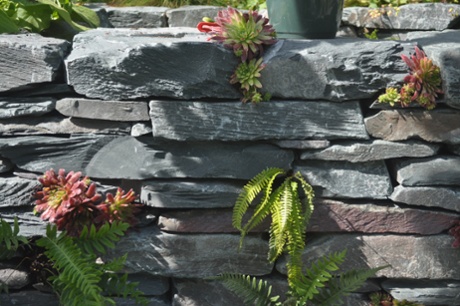
I also love the way he used houseleeks to create a splash of colour among the Cumbrian slate walls in the dry area of the garden. Similar planting would be straightforward to recreate at home. Apparently in Greece houseleeks are used to fill in holes in the roof, so there’s a practical as well as aesthetic element to this practice.
Whenever I’m on the train I always find myself looking at urban wasteland and imagining how it could be transformed. So, daydreaming aside I was pleased to see not one but two community-themed gardens at the show this year, from Adam Frost and Chris Beardshaw.
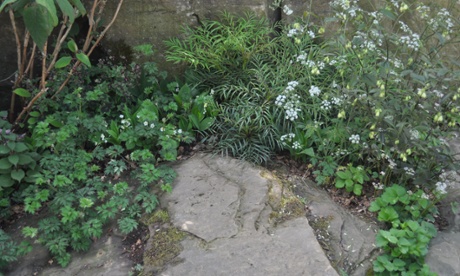
In search of the wilder edges I found myself utterly captivated by Dan Pearson’s garden with his trademark naturalistic planting. I stopped and stared at what seemed like an age at this beautiful recreated segment of Chatsworth House gardens. It made me want to go and play hide and seek among the rocks, but remembering where I was, I homed in on the flowers growing among the grass and between the stone. These were both details I could imagine trying out myself on a smaller scale.
Dan advised me that to recreate this style at home you need plants that are robust enough to compete with the grass, (which will grow all year round), so it’s best to go for flowers that work well in your soil conditions; that way you’re not fighting nature but working with it. So in my case it makes sense to work with the varieties of wildflowers I already have growing about the place, and I like the idea of incorporating this as a feature around some of my more established trees.
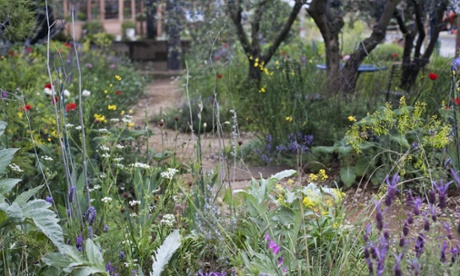
This low maintenance approach was also in evidence in L’Occitane’s perfumer’s garden designed by James Basson, where plants are placed close together and self-seeding varieties chosen. Once established there’s minimal work required, which sounds like just my kind of garden. James’s wife Helen explained that the rosemary and lavender bushes were traditionally used to hang washing. If it stops raining long enough I fancy giving that a try.