Sometimes the people you teach and the events that change their lives can take you to places you weren’t expecting. In 2012, my students had a Hoods Up For Trayvon Martin day in protest against the failure to arrest former neighbourhood watchman George Zimmerman for killing the Florida teenager. They came to class with their hoods up, many carrying bottles of Arizona – an iced tea beloved by US teenagers. They also had bags of Skittles – the only items Trayvon was carrying when he was shot.
That day I abandoned the lesson plan, got my badge maker out and we spent the day making protest art. We made badges from Arizona labels, Skittles wrappers and pictures of Trayvon.
I decided to write a series of lessons around protest art because the urge in my students to address injustice was so powerful. Any parent or teacher of a teenager will tell you how misunderstood and unfairly treated they can feel, but sometimes they have an important point to make. Many injustices featured in my students’ work, such as the stop and frisk laws in New York that are disproportionately applied to black kids. Other ideas explored in their artwork included the high arrest rate and imprisonment of young black men in America and the chilling outcomes of poverty.
In 2013, we returned to school after a summer break during which Zimmerman was found not guilty of Trayvon’s murder. I began the year with protest art again, which I hadn’t planned. I hoped it would help my students process their anger and despair at being reminded all summer about how worthless a young black man’s life is held to be in modern America.
I would like never to have to teach protest art again, but sadly that doesn’t seem likely. After Michael Brown was shot in Ferguson, Missouri, and Eric Garner was choked to death on a street in Staten Island, it looks as if it will be part of my curriculum for a long time to come. In September of this year, I once again introduced a series of lessons about protest art. I dread the future events I might be referencing the next time I have to teach it.
It’s not always possible, but I like to work alongside my students on the challenge I set them – they get to see my art developing with theirs.
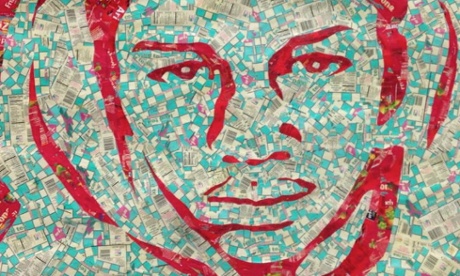
I kept my 4 ft sq work-in-progress – an image of Trayvon – rolled up at the top of my white board. If time allowed I would work on it for a few minutes while my students did independent work. I got most of it done during my lunch or prep times.
When I planned my portrait of Trayvon I remembered the Arizona and Skittles my students had brought in during the Hoods Up day. I began to create his face using red Skittles wrappers for the dark areas and cream and turquoise Arizona labels for the light. The students saw what I was making and began saving labels and wrappers. Some changed the variety of Arizona they drank to fit the portrait. Word spread as the face emerged from the collage. It took a long time – I did it as the materials came in. Students I didn’t know would knock on my door to give me labels and wrappers; sometimes if I wasn’t in they stuck them to my door for me. It was moving to see just how much they wanted to see the finished art.
When it was finally done, I put it on my classroom wall. Now new students like it as much as the ones who saw it taking shape. “Miss, you did that? That’s dope,” they say. I really like having it in my room because it helps offset the impression that I’m just another picky white person going on about rules and regulations. When you are a white person trying to enforce norms that you think are important to a group of black kids, you tend to sound as if you’re bringing back Jim Crow.
I hope that the sight of my 4ft Trayvon sends the message that I’m on their side. President Obama told America that if he’d had a son he would look like Trayvon. Many of my students look like him too.
“Miss, you really should sell that picture,” one of them told me, “You should put ‘Trayvon’ in a gallery, you could be famous.” When a friend sent me news of an art show looking for pieces about the current civil rights outrages in the US I sent them a photo of my portrait and it was accepted. So he did go in a gallery, I took my students to see him. They told me they were proud of me, which was one of the best things I’ve ever heard. “Miss, what will you do if someone wants to buy him?” they ask me, concerned. I tell them I would never sell him, that he belongs to all of us, because we worked together to make him.
Trayvon was just an ordinary kid on the way home from the store, hood up against the rain, carrying Arizona and some Skittles for his little brother. Once he belonged to his mother and his father, and his little brother and his friends. Now he’s another dead black kid, one in a line that’s far too long, in the newspapers, on TV, on a gallery wall.
Trayvon, and the shameful way in which he died, belongs to all of us.
Follow us on Twitter via @GuardianTeach. Join the Guardian Teacher Network for lesson resources, comment and job opportunities, direct to your inbox.