
VISAKHAPATNAM: With a coastline of 974 kilometres, Andhra Pradesh is more vulnerable to cyclonic storms compared to other natural disasters. As per a village-level study by the Andhra Pradesh State Disaster Management Authority, 692 coastal villages have been identified as vulnerable to cyclones and storm surges of varying degrees.
As many as 337 villages on this list are located within two kilometres from the coastline, while the remaining are situated between two to five kilometres from the seashore. About three million people are vulnerable to cyclones as they are living within a five kilometre radius from the sea. The recent very severe storms like ‘Hudhud’ and ‘Titli’ are examples of how the cyclones will leave a trail of destruction behind after the landfall.
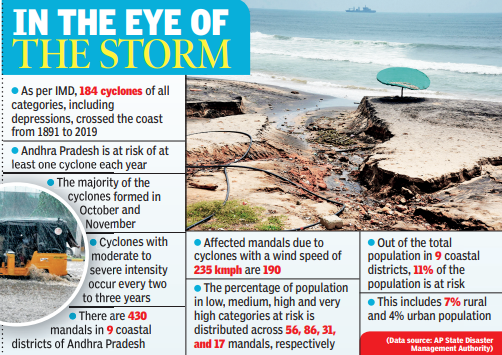
The population of coastal cities in the state is increasing at a rapid pace due to employment and economic opportunities and infrastructural facilities. This further highlights the need of enforcing appropriate zoning regulations in the coastal areas to minimise the impact of intense weather systems. Nearly 60 cyclones hit the coastal areas of Andhra Pradesh in the last five decades, causing damages to the tune of about Rs 87,000 crore.
As per an earlier IMD’s report, which is prepared based on the frequency of cyclones, Nellore, Krishna, and East Godavari have been categorised as districts very highly prone to cyclones. Some of the remaining coastal districts are classified as highly prone districts. There are four major landfall points in the state, from Pulicat in Nellore and Machilipatnam in Krishna to Konaseema in East Godavari and north coastal Andhra Pradesh. Andhra Pradesh coast is the second-most cyclone affected Indian region after Odisha and has the second-largest vulnerable region to floods after Kerala.
Sai Praneeth, a weather blogger who is popularly known as Andhra Pradesh Weatherman on social media, said that the majority of the cyclones originated in the Bay towards the end of September and the first half of October are crossing the coast either in north coastal Andhra Pradesh or South Odisha. “Intense weather systems like cyclones generally do not form in September. But as per the existing data, the cyclones brewing in September are hitting north coastal Andhra Pradesh. After October, the cyclones mostly affect south coastal Andhra Pradesh, Tamil Nadu, etc.,” said Sai Praneeth.