A crippled man made his way into the forest, using his hands to move forward. Officials sent rangers and a helicopter after him. Was it just a rescue mission? Or something far more disturbing?
For those who know Kaeng Krachan's history -- violent evictions, arrests, and the then park chief's involvement in the unresolved death of indigenous land rights defender Porlajee "Billy" Rakchongcharoen -- the answer seems obvious.
Last week, Kaeng Krachan National Park authorities announced a frantic search-and-rescue operation to save a "handicapped Karen man" allegedly abandoned deep inside deep forest by his nephews during heavy storms.
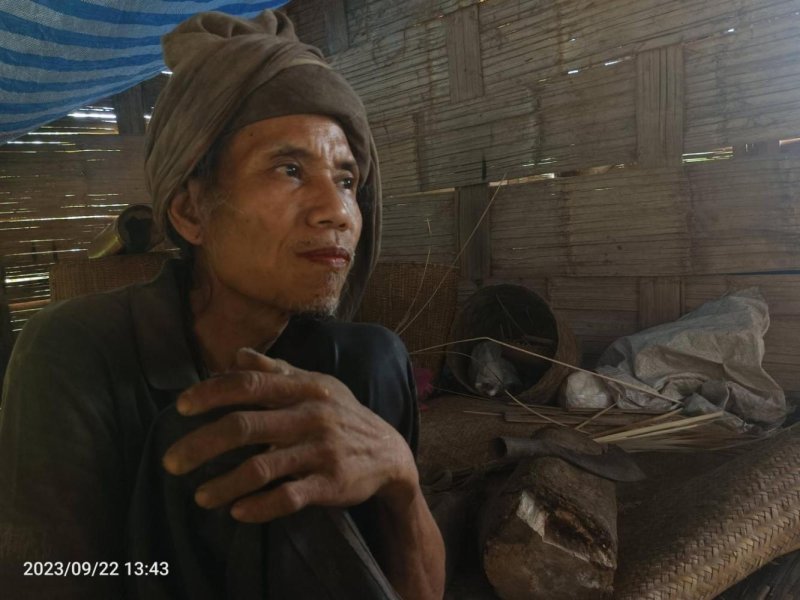
The name of that old man was No-ae Mimee, 64, son of the late Ko-ee Mimee, spiritual leader of the Bang Kloy Karen and an icon of indigenous people's fight for customary land rights.
The fact is No-ae was not abandoned, and nor was he lost. Born in the Kaeng Krachan forest, he knew exactly where he was going: he was going home.
No-ae had been forced out of that home before.
In 2011, park authorities burnt down nearly 100 homes and rice barns belonging to Bang Kloy Bon villagers, accusing them of encroaching on protected forests.
No-ae's family was among those driven downhill to a resettlement village where promises of farmland proved hollow.
Bang Kloy Bon, in an area known as Jai Paen Din -- "Heart of the Land" -- appeared on official maps a century ago, long before Kaeng Krachan was declared a national park.
The village was recognised with a village head, raising questions about the authorities' accusations -- and persecution.
His late father, the Elder Ko-ee's decision to seek legal justice for his people infuriated forest authorities. Never before had their control of the forest been challenged.
The Supreme Administrative Court eventually ruled that officials had acted unlawfully. It recognised the Bang Kloy Karen as indigenous inhabitants, not recent migrants or drug traffickers as they had been portrayed.
The court ordered compensation for the destruction of their homes.
But justice stopped halfway.
The villagers were not allowed to return.
Why? Because they do not have land titles. Yet how could forest people living for generations in remote, rugged terrain be expected to produce documents they had never needed?
I remember seeing No-ae at the resettlement village.
Quiet and unassuming, he was often by his father's side, dressed in traditional Karen clothes and a turban.
I later learnt that this was the same man forest officials had once turned to for help when a group of Border Patrol police officers got lost in Kaeng Krachan.
Yet they later hauled him to court, accusing him of possessing war weapons -- a charge the court dismissed.
By then, years of poverty and uprootedness had taken their toll. The man who once walked had become frail and crippled.
Then Ko-ee died, heartbroken and unable to fulfil his dream of returning home.
But the son never gave up that dream.
Relatives say he never stopped talking about one wish: to return to Jai Paen Din and die where he was born.
He prepared himself for that journey.
He planted rice to ensure he could do so when back in Bang Kloy.
He practised moving with his hands along the route back, for years.
Earlier, he had disappeared once before.
Relatives found him on his way home and brought him back.
Then, early this month, he disappeared again.
His nephews searched for him and found him making his way towards Jai Paen Din. They pleaded with him to return.
He refused.
Moved by No-ae's determination, they carried him deeper into the forest to the place he called home.
The state responded with a frantic search -- and criminal charges. The nephews who helped fulfil an old man's final wish now face prosecution.
No-ae's story explains why the Bang Kloy struggle refuses to die.
Despite hunger, poverty, prejudice, arrests and court cases, they keep trying to return. They refuse to forget where they belong.
In 2021, a group of villagers headed back to Bang Kloy, unable to endure life in what many called a "prison".
They were rounded up and prosecuted under national park laws.
Some of those charged were children.
If No-ae succeeds this time, others may follow. If Bang Kloy succeeds, other displaced communities may ask why they cannot do the same.
Learning from Kaeng Krachan's defiance, national park laws became harsher, allowing officials to demolish homes and impose heavier prison terms.
The message was clear: state authority must not be challenged.
Yet the law also offers opportunities for change.
The National Park Act requires authorities to survey long-established communities in protected areas and recognise their rights under specified conditions.
Bang Kloy Bon fits that definition.
The problem is that officials have refused to conduct the survey.
Meanwhile, the Protection and Promotion of Ethnic Groups' Way of Life Act, which came into force last year, recognises the rights of ethnic communities to maintain their culture, including traditional rotational farming.
Ironically, rights recognised on paper remain elusive in practice. So does justice.
More than a decade after Billy's forced disappearance, his family is still waiting for accountability. Bone fragments found in an oil drum near the national park office shocked the nation.
To public dismay, the courts ruled the evidence was insufficient to rule it belonged to Billy, allowing the then park chief to walk free.
No-ae's story is not merely about a disabled man trying to return to the forest.
It is the story of people who, despite threats to their lives and liberty, have refused to surrender their memory of home.
It is a story of determination to protect one's culture, dignity, and freedom.
That is probably why No-ae's struggle resonates so deeply.
Ko-ee died without returning to Bang Kloy, "Heart of the Land". Billy died without seeing justice done.
No-ae keeps moving forward, using only his hands, refusing to surrender either dream.
That's why he is going home.