For reporters who covered President Donald Trump’s tumultuous first term, the last week has imparted a profound sense of deja vu as more and more information has emerged about a Sept. 2 drone strike against what the president and Secretary of Defense Pete Hegseth allege was a drug-running boat manned by members of the Venezuelan gang Tren de Aragua.
After The Washington Post reported that Hegseth — the ex-Fox News weekend host who Trump tapped as the Pentagon’s top civilian official despite a lack of related experience, a long history of problematic drinking and troubling sexual misconduct allegations — had ordered U.S. Navy SEALS to fire on two survivors of an initial strike on the boat to fulfill his order to “kill everybody” onboard, both the White House and the Defense Department lashed out at the newspaper by accusing reporters of fabricating the story out of whole cloth.
But days later, Trump himself confirmed the Post story of a second missile strike on the boat when he told reporters aboard Air Force One that he "wouldn't have wanted" the second strike while claiming that Hegseth had denied ordering that the two survivors from the first hit be targeted.
"The first strike was very lethal, it was fine," Trump said. He added that he had “great confidence” in Hegseth.
"I'm going to find out about it, but Pete said he did not order the death of those two men,” Trump said.
The denials shifted fully to deflection on Monday as White House Press Secretary Karoline Leavitt told reporters at a press briefing that the second missile strike had been ordered by Admiral Frank M. “Mitch” Bradley, a decorated Navy SEAL commander who at the time led the Joint Special Operations Command, which operates under the U.S. Special Operations Command and typically is responsible for performing classified military operations.
Asked to clarify whether Hegseth had ordered the second strike on the boat, Leavitt told reporters that Bradley — not Hegseth — gave the order and stressed that the veteran naval officer was “well within his authority and the law” when he did.
“He directed the engagement to ensure the boat was destroyed and the threat from narco terrorists was eliminated,” she said.
Leavitt added that the strikes were “conducted in international waters and in accordance with the law of armed conflict.”
The White House’s effort to blame the veteran naval officer rather than the neophyte Pentagon boss stems from the serious nature of the growing questions about the September attack, which was the start of the Trump administration’s deadly campaign against drug cartels it has designated as terrorist organizations.
The strikes, which now number more than 20 — with at least 80 people killed as a result — have drawn allegations that they amount to illegal extrajudicial killings, which law-of-war experts speaking to The Independent have labeled outright murders and war crimes.
According to the Pentagon’s own Law of War Manual, people who are “wounded, sick, or shipwrecked” on the high seas are supposed to be “respected and protected in all circumstances” by U.S. forces, even during hostilities.
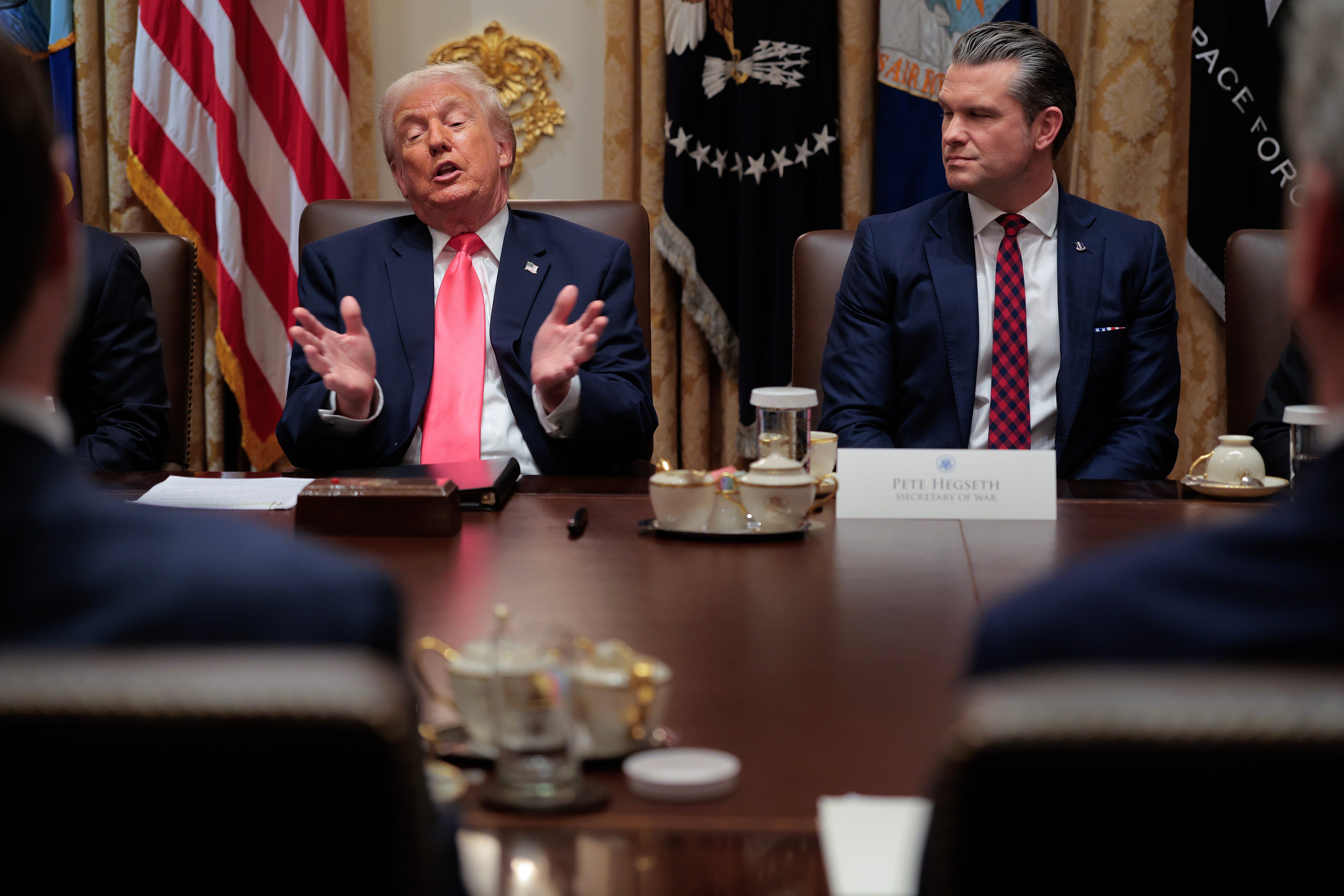
Hegseth himself continued the denials and deflections on Wednesday when asked about the controversy during a cabinet meeting alongside Trump, telling reporters that he had left the room when Bradley allegedly ordered the missile attack against the two survivors of the first strike.
“I watched that first strike live, as you can imagine, at the Department of War, we got a lot of things to do, so I didn't stick around ... a couple of hours later, I learned that that commander had made ... the correct decision to ultimately sink the boat and eliminate the threat,” Hegseth said.
He added that he “did not personally see survivors” after the first missile hit because “the thing was on fire and exploded.”
“This is called the fog of war,” he insisted.
Trump has thus far professed full confidence in his loyal defense boss, who he has dubbed the “Secretary of War,” even as Hegseth has been on thin ice with lawmakers and many of Trump’s closest aides since assuming his post atop America’s massive defense establishment.
By some accounts, the ex-television talking head may not be long for the cavernous office he occupies in the Pentagon’s outer ring.
The possibility that he may have ordered U.S. forces to fire on shipwrecked survivors — a potential war crime for which American prosecutors sought death sentences during post-World War II trials of German officers — has incensed key Republicans who lead the House and Senate armed services committees, both of which have opened investigations into the September 2 boat strike.
Hegseth is also unfavorably described as having endangered the lives of American forces by sharing highly-sensitive information about military operations on a Signal group chat earlier this year.
That scandal, which led Trump to send his then-national security adviser Mike Waltz into what amounts to exile in New York as the U.S. Ambassador to the United Nations, largely left Hegseth unscathed in Trump’s orbit because it came just weeks after the White House expended tremendous political capital to browbeat a bare majority of 51 Republican senators into confirming Hegseth to his current role.
Given all that, one might expect Hegseth to be on the outs.
But administration officials who have spoken privately to The Independent say that isn’t happening — yet —for a few reasons.
For one, Trump is understood to be unnerved by the idea that his ‘Secretary of War’ might have led Navy SEALs to fire on defenseless survivors — even those who his administration has declared to be “narco-terrorists” — but he’s also incredibly sensitive about limiting turnover in his cabinet during his second term.
During his first term, his Secretary of Health and Human Services, Secretary of Veterans Affairs, and Secretary of State were sacked or resigned in a whirlwind six months before he had been office for a year and a half. By the time his second year in office had ended, he’d lose his EPA administrator, Attorney General and Secretary of Defense as well.
After that experience, officials and Trump confidantes say he is desperate to maintain a relative image of stability compared to his first administration, which is why he has stuck by Hegseth and other “problematic” appointees such as FBI Director Kash Patel and Director of National Intelligence Tulsi Gabbard despite each of them causing him and his top aides significant headaches.
Secondly, the president has an almost pathological need to avoid appearing as if he is ever taking action in response to negative reporting on his administration by legitimate news outlets he has dubbed “fake news.”
In one example of this, after MSNOW (formerly MSNBC) reporters inquired about reports that he was considering firing Patel amid reports of the FBI director’s profligate use of a government jet for personal travel, Trump went so far as to stage a photo with him and shout him out at a public event.
And after CNN reported that Trump was considering ditching DHS Secretary Kristi Noem in part because of tensions between the White House and her close adviser Cory Lewandowski, Leavitt issued a caustic statement asserting that Trump’s cabinet was “not changing no matter how much CNN wishes that it would because it thrives off drama.”
One official who spoke to The Independent suggested that Trump could soften on his reluctance to broom Hegseth once his administration passes the one-year mark in January.
But there is a third reason for Trump, by his own line of thinking, to dig in: Multiple aides caution that the House and Senate probes into the strikes might make it less likely that he’ll fire the ex-Fox host.
That’s because in the face of investigations by the House and Senate armed services committees, firing Hegseth could be seen as an implicit acknowledgement that the administration had erred at all.
And with the continued boat strikes taking a prominent place in the Trump administration’s foreign policy, officials don’t want to show any doubt about what they’re doing.
Pentagon sued over press restrictions ‘that attempt to exert control’ on reporting
The ‘gold standard’ Navy SEAL officer at centre of Hegseth boat strike blame game
Ukraine war live: Trump could ‘betray Ukraine’ according to leaked call
Pressure on Hegseth as admiral blamed for boat strike to be grilled by Congress: Live
200,000 children to die this year because of foreign aid cuts
New Epstein island images give ‘harrowing look behind closed doors’