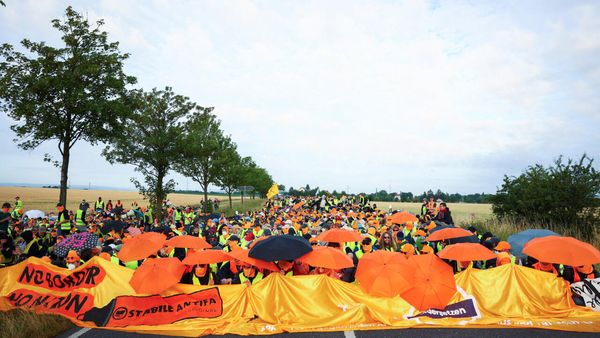

Thousands of demonstrators flooded the German city of Erfurt on Saturday in a bid to shut down the rising far-right Alternative for Germany (AfD) party's annual congress and signalling their concern over echoes from Germany's Nazi past. The congress comes 100 years to the day since the Nazi Party held a conference of its own in nearby Weimar, with AfD critics accusing the party of choosing the date as a deliberate provocation.
About 20,000 people flocked to Erfurt, in Thuringia state, according to police, to protest against the Alternative for Germany (AfD) party that tops national opinion polls.
The protesters, led by an alliance dubbed "Resistance", blocked routes into the city, with some abseiling from a motorway bridge. Several groups staged sit-in blockades around the city centre, according to AFP journalists.
But most AfD delegates managed to reach the conference centre where the congress began on time. Party chiefs Alice Weidel and Tino Chrupalla were both re-elected at the beginning of the congress.
Read moreGermany says far-right ideology behind record 40% rise in politically motivated crimes
"It's important to send a signal against the shift to the right," demonstrator Lene Krug, 19, from Gera, east of Erfurt, told AFP.
"The AfD is an anti-democratic party that spreads hate."
Calls for a ban

Resistance spokesperson Lena Raupach said the group had hoped to block the convention.
“The AfD pursues fascist policies – it wants mass deportations and terror on the streets. At the same time, however, it doesn’t solve a single real problem," she said. “It pursues policies that benefit the rich, not ordinary citizens. And we at [Resistance] want a society in which all people have equal opportunities and equal security. We want a society based on solidarity.”
Another protester, Ella, was among a group who stuck themselves to tram tracks in a city square.
"1933 to 1945 must never happen again," said the 44-year-old, who only gave one name, referring to the period when the Nazis were in power.
"The democratic parties need to understand that they must impose a ban (on the AfD)."
The early protests were largely peaceful. Minor scuffles were reported between protesters and the thousands of police deployed for the congress.
News weekly Der Spiegel quoted internal police documents as saying that up to 2,500 protesters were expected to come prepared for violence.
The AfD's rapid rise has unnerved many Germans, who feel they have a special duty to fight far-right politics given Germany's dark Nazi past.

Some have seen a deliberate provocation in the AfD holding its Erfurt conference on the 100th anniversary of a Nazi conference in nearby Weimar, a charge the AfD denies.
But Tino Chrupalla, one of the AfD's co-leaders, lashed out at the protesters, saying they had been "carted in here from all over the country by the establishment parties in trucks".
"They are protesting against democratic decision‑making. They believe they alone possess democracy," he said in an opening speech at the congress.
Read moreRally against Germany's resurgent far right draws thousands in Berlin
Topping polls
Chancellor Friedrich Merz has made it his mission to reverse the rise of the AfD, which has been locked out of power as all other parties have refused to cooperate with it.
The AfD says it is a conservative force occupying the space once held by Merz's Christian Democrats before former chancellor Angela Merkel a decade ago allowed millions of refugees and asylum seekers into Germany.
But critics point to AfD politicians downplaying Nazi crimes and links to banned right-wing extremist groups.
This year the AfD is eyeing power for the first time as state elections loom in Germany's ex-communist east, its electoral heartland.

Polls indicate it could win an absolute majority in September polls in Saxony-Anhalt state.
Nationwide, the party has been at or near the top of polls since after elections held last year, when the AfD came second with 20 percent of the vote.
"I would never have thought that a radical right party could be the strongest in Germany within my lifetime," said Manfred Guellner, head of polling firm Forsa.
"Lots of people, not necessarily part of the radical right, have gone over to the AfD because of dissatisfaction with the current government," he told AFP.
(FRANCE 24 with AFP and AP)