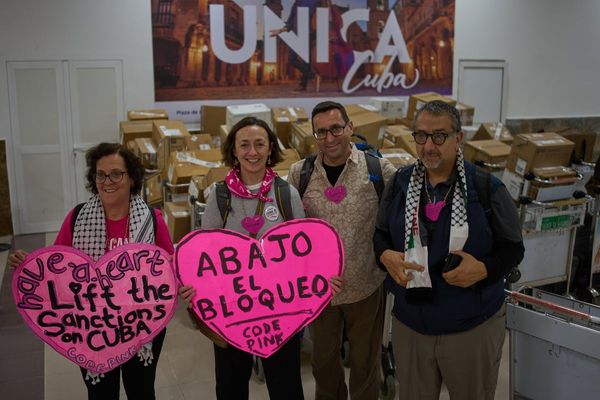
MIAMI _ Day after day, advocates camping outside the Homestead detention center stand on ladders, binoculars in hand, waiting for the detained teens' recess time.
Sometimes, the protesters wave and blow kisses. Other times, they show handmade signs bearing encouraging messages.
Over the weekend, however, there was a sliver of hope that they'd inch closer to communicating with the unaccompanied minors _ children who trekked across Central America, fleeing poverty and violence, then crossed the southern border without their biological parents.
"The kids gave the soccer ball a good kick and over the fence it came," said lead protester Joshua Rubin. "That's when we took a black Sharpie and wrote 'You're not alone' on it, and tossed it back over the fence."
Within minutes security guards confiscated the ball _ an indication that "the federal government will do anything to shield these kids from knowing that people care about them," Rubin said.
"This includes the thousands of handwritten letters that will be delivered to the child prison on Memorial Day," he added.
The national effort to deliver nearly 3,000 letters to the Homestead shelter, a facility that's been shrouded in secrecy since its inception in 2016, is part of a broader campaign calling on the Departments of Health and Human Services (HHS) and the Office of Refugee Resettlement (ORR) to close the detention center and stop using emergency influx facilities.
"Instead ORR should work as quickly as possible to unite children with their sponsors," said Lis-Marie Alvarado, a local organizer, about the petition. "We are also calling on these agencies to stop collaborating with the Department of Homeland Security to criminalize and intimidate sponsors for migrant children."
Advocates from the American Friends Service Committee, the Florida Immigrant Coalition, and We Count _ all immigration nonprofits _ coordinated the collection of letters written by students inside Miami-Dade County classrooms, along with kids from New York and across the country. Leaders planned to attempt to deliver the boxes teeming with emotional notes on Monday morning.
"You think they're gonna allow a whole bunch of letters to get to those kids? We predict not. They refused to allow a signed soccer ball," Rubin said. "However we want to make the gesture. We want the world to see that people care, even if the kids never see it."
That prediction turned out to be correct. The letters were rejected late Monday morning.
About 100 people showed up to deliver the letters. Visiting children read them to security guards and tried to hand them the envelopes.
The guards ignored them and stood with their arms crossed. They said they would call a supervisor. No one came.
Since its opening in 2016, the facility has been shrouded in secrecy and cloaked in controversy. Lawmakers scornful of President Donald Trump's immigration policies have been blocked from visiting. Because it sits on federal land, Florida's child welfare agency is barred from investigating allegations of abuse.
When the Miami Herald took a tour, reporters weren't allowed to take photos, bring in recording devices, or speak to children. When community organizations try to donate services, equipment, clothing or food, they've been rejected because of safety protocols, federal officials have told the Herald.
The center, the largest in the country, is the only facility for migrant children operated by a for-profit corporation, another sore point with critics, since they note that the longer a youth is detained, the better it is for the company.
It's now housing almost 3,000 teens ages 13 to 17, a population that is expected to grow.
"Whether the letters actually reach the teenagers inside of the Homestead detention center" will be "an indicator of the lack of transparency in how the teens are being treated," Alvarado said.
Sometimes written with humor, with references to their own struggles and often colorfully illustrated by hand, the personal letters communicate admiration for the "strength and determination" of their Central American peers, campaign organizers say.
In one letter, one child wrote: "I hope your life gets better. I understand what you guys are going through and it is so unfair," continuing to recount their own families' experiences as newly arrived immigrants.
"Detention traumatizes and harms both children and adults," said Mariana Martinez, an organizer with the American Friends Service Committee and a resident of Homestead. "It funnels money to private corporations and tears apart families and communities. The people of Homestead don't want an economy based in the abuse of children. Instead of investing in suffering and despair, we want investment in jobs that bring sustainability and resources."
Kristin Kumpf, director of Human Migration and Mobility for AFSC, told the Miami Herald that "the Trump administration is manufacturing the need to detain children."
"Children belong in schools and homes, not in prison camps," Kumpf said, noting that not only are children across the country writing to the minors in Homestead, but they are also preparing letters for members of Congress.
Advocates are also hoping that the national exposure of Homestead would propel Congress to pass the Families not Facilities Act, as well as the Shut Down Child Prison Camps Act.