The German navy has rescued almost 400 refugees from a wooden boat on the Mediterranean off the coast of Libya.
DPA, a local news agency, reports that members of the German Navy frigate Schleswig-Holstein rescued the group, who were mostly from Sudan and Eritrea, on Saturday afternoon.
The German navy has two frigates in the southern Mediterranean that have picked up 1,980 people since their mission began in late June.
Thousands of refugees have drowned this year while trying the cross the Mediterranean from Libya and Turkey to Europe, prompting a EU-wide mission to intercept people attempting to make the crossing.
Summary - war of words between European neighbours
Here’s a round-up of the latest movements mid-afternoon:
- Croatia “lied in the face” of Budapest and the EU when it appeared to claim there was an agreement to send almost 1,000 refugees to the border last night, Hungarian foreign minister Peter Szijjarto said. “Instead of honestly making provision for the immigrants, it sent them straight to Hungary. What kind of European solidarity is this?”
- 2,500 people are still in Tovarnik, a Croatian town on the Serbian border, but more are being transported by train and bus to the Hungarian border tonight. Thus far, Hungary has been letting arrivals pass through.

- Earlier, Croatia’s prime minister sent a stark message to Hungary, saying his country will continue forcing its neighbour to accept more refugees by sending them to the border, in direct opposition to the wishes of Hungary. The Hungarian border can only be completely sealed with brutal force, Zoran Milanovic said. “Even if that were possible under the constitution – and it is not – it means killing people,” he said. Last night, Croatia closed seven of its eight border crossings with Serbia.
- Police in Slovenia say 1,500 migrants have entered the country from Croatia today, but hundreds more are waiting at the border as they let in only limited numbers. Refugees are camped out in the town of Harmica and at another crossing a few miles south in Bregana, and there are long queues at the borders. Most are hoping to cross Slovenia into Austria.

- This morning, Austrian police said 6,700 people had arrived since midnight after Hungary started escorting people to the border. That figure is likely to be higher now. Austria has border controls in place and vehicles are being spot-checked by police requesting travel documents. Hungary is bussing refugees who arrive from Croatia to the Austrian border.
- Hungary has completed putting up barbed wire fencing along 41km of its border with Croatia, and is speeding up the building of a more permanent fence, similar to the one built along the border with Serbia.
- Hungary’s harsh new border laws are exposing vulnerable people to violence and trapping thousands of people, Human Rights Watch said.

- More than 2,200 people have been rescued from small boats over the last 24 hours as they tried to cross from Libya to Italy, the Italian coastguard said.
- David Cameron has been attacked for his “dehumanising” approach to the refugee crisis by the Lib Dem leader Tim Farron, as the party prepares for its autumn conference.
Updated


Croatia’s actions over the past 24 hours show it is not ready to join Europe’s free movement agreement, a top advisor to Hungarian prime minister Viktor Orban told local radio.
“If Croatia puts up its hands and says, no, I don’t want to defend the borders, then Hungary can only say that it isn’t ready to join Schengen when the moment comes to decide,” Antal Rogan told InfoRadio.
Orban, a right-winger, has previously said the crackdown on refugees is to defend “Christian Europe”.

David Cameron has been attacked for his “dehumanising” approach to the refugee crisis by the Lib Dem leader Tim Farron, who has been visiting a refugee art project in Poole, Dorset.
Farron condemned the Government’s plan to accept 20,000 refugees from Syria over the next five years.
Cameron’s refusal to participate in a Europe-wide resettlement scheme was “turning our back” countries shouldering the crisis, he said.
It is certainly not right that over a period of five years we end up accepting as many people as Germany is taking in a weekend.
Not only does that mean that we are showing an inhuman face to desperate people who deserve and need help, but we also show a completely uncollegiate face to the rest of Europe.
If you look at what is happening in the Balkans now, that is an example and it’s the outcome of the European Union not having a single approach to all of this.
Updated
This video from AP shows several thousand migrants and refugees finally entering Austria on Saturday, where they are set to be processed ahead of travelling to their final destinations.
The vast majority appeared relieved but exhausted after gruelling journeys across Europe. “Right now, I feel as if I have been born anew,” says Adeeb Jaafari, a Syrian refugee from Damascus.
Croatia lied to our faces, says Hungarian minister

Croatia “lied in the face” of Hungary and the EU when it appeared to claim there was an agreement to send almost 1,000 refugees to the Hungarian border last night, foreign minister Peter Szijjarto said.
Speaking at a press conference, Szijjarto accused Croatia of “violating Hungary’s sovereignty” because the migrants had been sent unannounced and were accompanied by Croatian policemen.
“Instead of honestly making provision for the immigrants, it sent them straight to Hungary. What kind of European solidarity is this?
“Once again, Hungary has been left in the lurch. We will defend the European Union, the borders of the Schengen zone, and we will defend Hungary in accordance with European rules.”
Hungary would speed up the building of a fence “where necessary” along its Croatian border.
Updated
Slovenia: 1,500 have entered the country from Croatia
Slovenian police have released a statement confirming more than 1,500 migrants have entered the country, while 600 more are waiting to get in at border crossings with Croatia.
A third of them are from Syria and another third from Afghanistan, with the others from various African and Middle Eastern countries, mainly Iraq, police said.
The Slovenian interior ministry official Bostjan Sefic said: “Police are fully in control and the security situation is good.”
Around 250 people have decide to cross the small country on foot in order to reach Austria from the refugee centre in the city of Maribor.

Updated
“I love this dog,” says 17-year-old Aslan, from Damascus, arriving on the Greek island of Lesbos. “I need him. I walked 500km with the dog.”
He told the UNHCR, which posted the video on its Facebook page, that he had even drawn a passport for his dog, Rose, who he carried in a small plastic carrier.
Some people will ask - you have only a small bag?” the interviewers asks.
“Yes.”
“And you bring your dog?”
“Yes.”
“Why?”
“I love my dog!”
As the refugee agency points out, many animal lovers around the world would probably feel the same.
Updated
In Harmica, a Croatian border crossing with Slovenia, a trickle of refugees are now being allowed over the border. Last night several dozen refugees were hit with pepper spray as they faced off with a cordon of Slovenian riot police on the frontier.
Police in Slovenia say more than 1,000 migrants have entered the country, but hundreds more are waiting at the border as they let in only limited numbers. Refugees are camped out in Harmica and at another crossing a few miles south in Bregana, where people are hoping to transit at Slovenia’s Obrezje crossing.


Updated
The BBC’s Piers Scholfield reports that refugees arriving from Tovarnik in Croatia at Beremend, the Hungarian border crossing, are being let through without hindrance.
First arrivals of the day at Beremend - men, women, children. Ushered smoothly off Croatian bus and on to Hungarian. pic.twitter.com/NwZzL4xcx8
— Piers Scholfield (@inglesi) September 19, 2015
Convoy of full buses, waiting at Beremend - arrived from Tovarnik. One in, 9 to go. All going smoothly. pic.twitter.com/MvyN793lEW
— Piers Scholfield (@inglesi) September 19, 2015
There are approximately 2,500 people still in Tovarnik, and heavy rain is forecast tonight, but the Croatian government is apparently intending to provide more shelters.
#Croatia update: weather forecast said it should rain in Tovarnik, govmnt setting up tents for #refugees...
— Hrvoje Kresic (@hkresic) September 19, 2015
Updated
The Croatian government has put out the full remarks of the prime minister, Zoran Milanovic, who was speaking in the eastern town of Beli Manastir on Saturday. He is extremely unhappy with the Hungarians, to put it mildly.

The PM called Hungary’s conduct in shutting the borders “incomprehensible because none of the refugees wanted to stay in Hungary”.
The border could be completely sealed only with brutal force, he said.
Even if that were possible under the constitution – and it is not – it means killing people.
Milanovic said refugee taskforces in Croatia had done their job much better than other countries, rejecting the Hungarian government’s accusation yesterday that it had panicked.
He said certain political groups in the country had been whipping up anti-migrant sentiment.
One should not believe hysteria mongers who want to profit politically from it. That’s the ugliest thing I have seen in Croatia since the war.
The situation was “a humanitarian crisis but not a disaster”, he said, reiterating that completely closing the border without a fence, as had been done by Hungary, “is possible only if the army is deployed to the border and shoots at people”.
That is what some wish for. It is physically possible, but impossible in terms of law. One should declare a state of war, or a state of direct threat, and the government should propose it to the parliament. Please do not take this out of context because I am saying this only to illustrate how crazy such proposals are.
Milanovic meant what he said about continuing to force Hungary to take more people over the border. A 10-carriage train is on its way to Tovarnik to pick up refugees who cross from Serbia, and take them to the border, though we’re not sure at this point if that means Hungary or Slovenia.
A train w/ 10 passenger cars is on its way to Tovarnik to pick up more #refugees. It should be there around 4:30pm. #refugeescrisis
— Vlada R. Hrvatske (@VladaRH) September 19, 2015
Updated
Johannes Hahn, the EU’s enlargement commissioner has proposed allocating €1bn to Turkey to help managed the crisis, saying Europe must help countries bearing the brunt of the situation.

Hahn has been touring a refugee camp in Gevgelija, on the southern border with Greece, as part of a two-day tour of Macedonia. Around 5,000 people are in the camp, as they make their way across Serbia via trains, buses and taxis to western Europe.
Macedonian police say more than 83,000 have transited through the small Balkan nation in the last three months but there is now a registration process in place.
The money will “help Turkey to deal with this challenge and give people a perspective to stay in the region in order to return back into their home region, home towns, as soon as this is possible”, said Hahn.
Updated
Hungary’s harsh new border laws are exposing vulnerable people to violence and trapping thousands of people, Human Rights Watch said today.
The NGO said at least 46 people who had tried to enter Hungary via Serbia since the beginning of the week had been prosecuted for illegal entry.
Lydia Gall, HRW’s Eastern Europe and Balkans researcher, said:
It is reprehensible that Budapest is willing to use riot police and the criminal courts to avoid offering protection to people fleeing war and human rights abuse.
Though countries are entitled to protect their borders, Hungary’s new border regime punishes people who ought to be offered protection, and risks encouraging other governments to do the same.
Hungarian authorities have an obligation to ensure that those who flee war and persecution can present their claims in a fair, transparent way.

The government declared a state of emergency on 16 September which means criminal proceedings related to illegal entry, or cutting holes through the new razor wire fencing, take precedent over any other procedure, such as asylum claims.
The new border laws have three key elements:
- Restrict access to asylum in Hungary for those who enter from Serbia and permits quick returns of asylum seekers to Serbia, deemed a “safe country” for asylum seekers.
- Allow national authorities to declare a state of emergency to close border crossing points.
- Make irregular entry now a criminal offence, including up to eight years in prison.
HRW said the new laws “make it nearly impossible for asylum seekers to get protection in Hungary, a violation of the country’s international obligations”.
These aws are the major factor leading refugees to cross into Croatia, leading to the build-up in numbers there.
Updated
Hungary has responded angrily to the Croatian prime minister’s insistence he will keep forcing the country to accept more refugees by sending them to the border.
“Croatia has let down not just Hungary but the EU and has given up on all legal commitments that bind it,” government spokesman Zoltan Kovacs told reporters.
Major violation of intrntl law at the HUN/HR: train with over 1000migrants with 40 armed HR policemen crosses the border without permission
— Zoltan Kovacs (@zoltanspox) September 18, 2015
Croatia collapsed under the pressure in one day;we are standing the flood for the past 9 months. HUN will fully follow EU protocols
— Zoltan Kovacs (@zoltanspox) September 18, 2015
Croatia had sent some 8,000 migrants on Friday, senior security adviser Gyorgy Bakondi said, at the same press conference.
Updated
More than 2,200 people have been rescued from small boats over the last 24 hours as they tried to cross from Libya to Italy, the Italian coastguard said.

At least 750 people were crammed on to three small vessels, and were rescued after they were spotted by a Médecins Sans Frontière ship, the charity reported.
“There are multiple nationalities ... Thankfully, everyone is in good health,” the MSF spokesman Sami al-Subaihi said in a video of the rescue sent to AFP.
He said the charity was now on its way to look for a fourth boat it had spotted earlier. The people onboard were treated for dehydration and taken to reception centres in Italy or Greece, the charity said.
Italy’s coastguard said its vessel Dattilo picked up 1,137 migrants from two boats, while its Corsi vessel rescued 137 people from a deflating dinghy on which the body of a woman was also recovered.
Updated
On the Croatian border with Slovenia, hundreds of refugees waited overnight at the Bregana border to cross over into the small Alpine nation.
A Guardian contributor in Croatia reports local television is showing buses arriving to take people over the border. Reporters tweeting from the scene say the busloads are now on their way across.
Scene this morning at #Bregana crossing between #Croatia and #Slovenia. Few hundred #refugees watching police lines pic.twitter.com/NRQFKm7GLN
— Oliver Varney (@OliverVarney) September 19, 2015
Hundreds of #refugees wait 2get on buses 2take them from #Bregana #Croatia into #Slovenia #refugeecrisis @AJEnglish pic.twitter.com/pEuu9Khy2s
— Mohammed Jamjoom (@MIJamjoom) September 19, 2015
#Bregana A 2ft gap for 2,000 migrants to squeeze through onto buses into Slovenia pic.twitter.com/Qp0KdeKS4C
— Paul Harrison (@SkyNewsEditor) September 19, 2015
Slovenian police said on Saturday that 1,287 had arrived as of midnight Friday, of which 483 were from Afghanistan, 470 from Syria and 126 from Iraq.
Updated
Summary: Croatia vows to keep sending refugees to Hungary
Here’s how things look at midday
- Croatia’s prime minister sent a stark message to Hungary in an interview this morning, saying his country is prepared to continue forcing its neighbour to accept more refugees by sending them to the border. Zoran Milanovic flatly told news reporters at a visit to the border on Saturday “We have in some way compelled them to accept the refugees by sending them [to the Hungarian border] and we’ll keep on doing it.” He had acknowledged the move would be in direct opposition to the wishes of Hungary.
- Austrian police say 6,700 people have arrived since midnight after Hungary started escorting people to the border.
- Hungary announced it has completed placing barbed wire fencing along 41 kilometres of its border with Croatia.

- Croatian police say 20,737 migrants have entered the country since Wednesday. Most have entered the country through Serbia, arriving at the eastern town of Tovarnik, there are currently around 2,500 people still in the town.
- Croatia’s president has said her small country cannot cope with the numbers. With a population of just 4.2 million people, Croatia needs to be realistic about what it can do, Kolinda Grabar Kitarovic told AP.
- A five-year-old Syrian girl has died after a boat she was travelling on sank east of the Greek island of Lesbos. She was retrieved from the sea unconscious but later died in hospital. The Greek coastguard said it rescued 10 other migrants from the same boat, while one managed to swim ashore, and 14 are still missing.
The BBC’s Anna Holligan is following buses from the Croatian-Hungarian border headed for Austria.
Empty buses in #Hungary border town of Beremend - told they're on standby #refugees pic.twitter.com/221gYsbjc7
— anna holligan (@annaholligan) September 19, 2015
#Hungary police tell us 10 buses carrying #refugees from Croatia will arrive 15 mins,carriages await (pix @howmorris) pic.twitter.com/2IvefbKUNK
— anna holligan (@annaholligan) September 19, 2015
On the road to Szentgotthárd following reports #Hungary dropped 4000 #refugees & #migrants on #Austria's doorstep pic.twitter.com/UCmquD9Uzq
— anna holligan (@annaholligan) September 19, 2015

Croatia’s president has Kolinda Grabar Kitarovic told AP her small country cannot cope with the numbers of people wanting to travel through it towards western Europe, and that the EU must do more.
“We need to stop the flow, we need to get reassurances from European Union what happens to these people who are already in Croatia, and those who still want to transit through Croatia further.
“We’re flooded, local communities are flooded, the numbers of refugees in some areas is far greater (than) the number of local residents.”
With a population of 4.2 million people, Croatia needs to be realistic about what it can do, she said.
Croatia itself was a fragile country which has only recently begun to recover from the wars of the 1990s, Kitarovic said, adding that migrants were in more immediate danger of stepping on landmines from the conflict if they did not use official crossings.
“We have to take further measures to ensure stability on the border, and that there are no breaches through the corn fields, or forests or any other areas that are not controlled or cleared.”
Updated
Croatian police: more than 20,000 refugees in three days
Croatian police say 20,737 migrants have entered the country since Wednesday, the vast majority passing through towards western Europe.
Most have entered the country through Serbia, arriving at the eastern town of Tovarnik which is 1km inside Croatia. There are currently around 2,500 people still in the town, after around 1,000 were taken to Hungary last night.
Earlier, the Croatian prime minister vowed he would continue to transport people to the Hungarian border should they wish.

Updated
Our Ireland correspondent writes:
One pound from every ticketholder passing through the turnstiles at a Belfast Irish League football derby on Saturday will be sent to help the refugees arriving in Europe.
Cliftonville Football Club is donating £1 from every £10 adult and £5 child entry fee to the European Club Assocation’s 90 Minutes For Hope charity in support of the ongoing refugee crisis.
The North Belfast side, Ireland’s oldest football club, hopes to raise thousands at its derby clash with East city rivals Glentoran at 3pm.
Cliftonville’s chairman, Gerard Lawlor, said buckets would be passed around the club’s Solitude stadium for fans to boost the fundraising scheme.
“Cliftonville Football Club has absolutely no hesitation in signing up to the 90 Minutes For Hope project and, we will be donating £1 to the initiative on behalf of every paying adult at the game with Glentoran.
“I have no doubt whatsoever that our supporters will make further contributions out of their own pockets as football fans across the continent join forces to take action in support of Europe’s biggest refugee crisis since the second world war,” Lawlor said.
Updated
Many of the people who travelled through the night from Croatia to Hungary and were transported on to Austria are now waiting and resting in the carpark of this former border station near Nickelsdorf.


Updated
The increase in the number of Turkish Airlines flights from African countries could be a major contributing factor to the increasing numbers of people attempting to claim asylum in Europe, the EU’s borders agency has said.
The Telegraph’s Matthew Holehouse draws attention to this part of Frontex’s Western Balkans report from last week.
The increase in detected Africans in the western Balkans could be partly explained by the expansion of Turkish Airlines connection network in Africa.
It already boasts the largest network in the continent among foreign carriers, overtaking Air France and Emirates. By the end of 2015, Turkish Airlines will have at least 45 destinations in its African network across 30 countries.
For comparison, Air France, which has the second largest African network among European carriers, offers flights to 34 destinations. Brussels Airlines has 19 African destinations on offer, British Airways 18 and Lufthansa 13.”
Updated
Hungary has announced it has completed placing barbed wire along 41km of its border with Croatia to stop the passage of refugees on their way through Europe.
“The fence was finished overnight Friday,” Attila Kovacs told AFP.
The remaining 330km of the border runs along the Drava river, which is fast-flowing and difficult to cross. Hundreds of soldiers and police have been deployed to patrol the border fence.
Updated
The Croatian reporter Hrvoje Kresic is following the prime minister’s speech, where he repeated his commitment to help refugees reach Hungary should they wish.
#Croatia PM Milanović: We will continue to help #refugees reach borders of #Hungary and #Slovenia. They don't want to be here.
— Hrvoje Kresic (@hkresic) September 19, 2015
#Croatia PM Milanovic on train issue: There was no deal with #Hungary. #Refugees wanted to go westward, so we forced Hungary to accept them.
— Hrvoje Kresic (@hkresic) September 19, 2015
Meanwhile, on the Slovenia border, a football match is played across two countries …
And this is how #refugees can have fun with #Croatia police while waiting for #Slovenia to let them in :) pic.twitter.com/JHqaIfcCjE
— Hrvoje Kresic (@hkresic) September 19, 2015
Updated
Austria: 6,700 have arrived since midnight
Austrian police say 6,700 people have arrived since midnight after Hungary started escorting people to the border.
Police spokesman Helmut Marban has told AP around 4,200 people crossed the border at Heiligenkreuz, near the southern city of Graz, while the remainder used the Nickelsdorf crossing near Vienna.
Austria has border controls in place and vehicles are being spot-checked by police requesting travel documents.
Updated
We'll force Hungary to keep accepting refugees, says Croatian PM
The Croatian prime minister, Zoran Milanovic, has been speaking this morning about the tense situation with Hungary, during a visit to Beli Manastir near the border.

He said Croatia would continue to redirect people to Hungary, as it did last night, in order to force a response from their north-eastern neighbour.
There has not been an agreement with Hungary. We have in some way compelled them to accept the refugees by sending them [to the Hungarian border] and we will continue to do so.
The Croatian government’s official Twitter account reported early this morning that trains had returned to the Croatian town of Torvanik to pick up more refugees and take them to the Hungarian boarder.
#Refugees were transferred from Tovarnik to Botovo on the HUN border tonight. They arrived at 5:20am. The train went back to pick up more.
— Vlada R. Hrvatske (@VladaRH) September 19, 2015
Updated
EU asylum applications rise by 85% since 2014
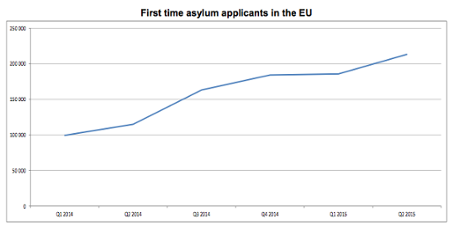
The EU’s data agency has published some detailed figures about asylum seekers in Europe over the first half of the summer, revealing the dramatic rise in the number of people arriving since the start of the refugee crisis:
- There were more than 213,000 first-time asylum seekers in the EU in the second quarter of 2015, between April and June.
- Those numbers are up by 85% compared with the end months of 2014, but it is worth remembering many more refugees would be expected to make the journey in the warmer months.
- The number of Syrians and Afghans rose considerably to reach almost 44,000 and 27,000 respectively.
- Britain is taking very few asylum seekers, though still many more than other EU countries. The UK took 3.5% of asylum seekers in the EU between April and June, while Germany took 38%, one in three of all the people coming.
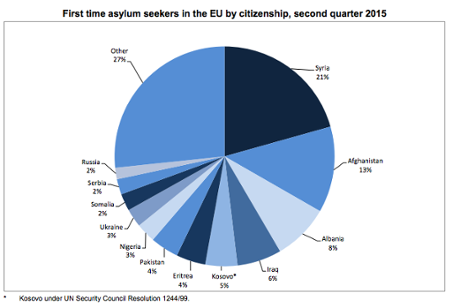
- Hungary, which has responded with the harshest measures to dissuade refugees from reaching its borders, registered 15% of all asylum seekers in the last quarter, a reflection on how routes to Europe have changed.
- Hungary had the highest rate of asylum seekers relative to its population in the whole of Europe, 3,317 per million inhabitants. That compareswith 115 per million inhabitants in the UK, for example, or five per million in Slovakia.
The statistics have made the front page of the Daily Mail this morning, leading on the fact that four out of five asylum seekers are not Syrian.
Today's front page: Four out of five migrants aren't Syrians http://t.co/Bx4VmLeaMG #MailFrontPages pic.twitter.com/HSh7y9theM
— Daily Mail U.K. (@DailyMailUK) September 19, 2015
Updated
Hungarian authorities escort people to border with Austria
Since Croatia, overwhelmed by the large number of people crossing through the country, drove busloads of people to the Hungarian border, Budapest has now organised an escort for those people to the Austria border.


Hungary’s defence minister, Istvan Simicsko, announced that he has called up some volunteer military reservists to help deal with the crisis, the state news agency MTI reported today.
In Slovenia, hundreds of people are camping out in Obrezje, which is just across the Croatian border, with authorities reportedly only allowing families with women and children to continue through the country.

Updated
Some tragic news from Greece this morning, a five-year-old Syrian girl has been found dead and several other refugees are missing after their boat sank, Turkey’s state news agency has reported.

The Greek coastguard said it had rescued 11 people, including a man and a child who were being treated in hospital for hypothermia, and it was looking for other survivors east of Lesbos.
“We were told there were 26 people in the boat in total,” a coastguard spokeswoman told Agence France-Presse.
Since the pictures of three-year-old Alan Kurdi were splashed across newspapers around the world, more children have been found dead on the beaches, with the body of another four-year-old Syrian girl washed up on a beach in western Turkey on Friday.
More than 2,600 people have died in the Mediterranean this year.
Updated
Summary
Good morning, the worsening refugee crisis across Europe continues to draw bordering countries into bitter stand-offs. Here are the main developments overnight:
- Croatia has bused hundreds of migrants to its border with Hungary, while police fired tear gas to drive back several hundred people trying to enter Slovenia. Budapest said more than 4,400 people had crossed from Croatia in 24 hours before it closed the final stretch of a razor wire barrier along the frontier at midnight.
- Budapest has accused Zagreb of inciting refugees to break its tough new laws, which include three-year jail terms for breaching its border fence.
- Slovenia’s prime minister, Miro Cerar, said his country might consider the creation of “corridors” for refugees wanting to reach northern Europe if they continued arriving in large numbers. Slovenia’s ambassador to Germany told the Rheinische Post newspaper his country would accept up to 10,000 refugees.

- More than 210,000 first-time asylum seekers came to the EU in the second quarter of 2015, with a third of them from Syria or Afghanistan, the statistical office of the European Union, Eurostat, has reported. More than a third applied for asylum in Germany.
- The International Organisation for Migration has released figures which say 474,000 people have so far this year journeyed by boat across the Mediterranean to reach Europe.
- There are some stories that bring hope after a week of dire news for refugees in Europe – the Vatican has taken in a family of four refugees from Syria after an appeal by Pope Francis for every religious community across Europe to assist in the migrant crisis.
- And the Syrian refugee family whose plight was made famous when they were tripped up by a Hungarian camerawoman as they fled, were on Friday greeted by the stars of Real Madrid, including Cristiano Ronaldo. Osama Abdul Mohsen and his sons, Muhammad, 18, and Zaid, seven, were taken to Spain on the initiative of Miguel Angel Galan, the director of a football coaching school in the Getafe suburb of Madrid.

Updated