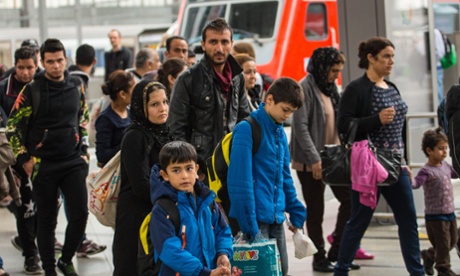
At an E London collection centre for Calais refugees and migrants, a human chain has formed to sort donations https://t.co/9ddirC25DX
— Shiv Malik (@shivmalik) September 6, 2015
Writer Patrick Ness says Philip Pullman, author of His Dark Materials trilogy, has pledged £10,000 to his fundraising campaign for refugees.
Afternoon summary

Here’s a round up of the main events on Sunday as the migration crisis continues to unfold:
- A fundamental review of Britain’s £9bn aid budget will be used to fund Syrian refugees for their first year in the UK and to support Syria’s neighbours hosting camps, George Osborne has said.
- Germany is not asking how many refugees it can afford to shelter, but how it can make the new arrivals feel safe at last, the mayor of Munich said as the city prepared to register thousands of people on Sunday.
- Volunteers and donors for refugees condemned government’s response at charity event in east London.
- Nicola Sturgeon and Yvette Cooper have indicated that they would be prepared to house Syrian refugees as the Scottish government and Labour party intensified pressure on David Cameron to act generously.
- The chancellor, George Osborne, announced that the government would use funds from the UK’s £12bn annual overseas aid budget to help local authorities cover the costs of housing refugees. Guardian reporter provides this analysis of how the UK will pay for refugees the government has pledged to take.
- David Cameron is facing growing pressure to extend RAF air strikes into Syria as the worsening conflict threatened to drive increasing numbers of desperate refugees to seek sanctuary in Europe. The former Archbishop of Canterbury Lord Carey became the latest senior figure to call for a renewed military effort to “crush” Islamic State in its Syrian heartlands.
Violent clashes between riot police and refugees in Greece

The situation has become increasingly explosive on Lesvos, Greece, one of the islands on the frontline of the crisis, as running battles escalate between riot police and refugees desperate to board boats for Athens, our correspondent Helena Smith reports.
Greece’s migration minister Ioannis Mouzalas has rushed to Lesvos after a second day of street fighting on the Aegean isle. Scenes of stone-pelting refugees engaged in hand-to-hand battle with local police has prompted the government to step up security with two extra units of riot police being dispatched to the island earlier today. Amid renewed violence local officials processing newcomers this morning locked themselves in a container as refugees, once again, vented their anger over delays in registration. On Saturday police resorted to using tear gas and stun grenades as around 500 Afghans attempted to seize and board a ferry heading to Athens. At least four were injured, one seriously.

With an estimated 13,000 migrants and refugees on the island – and hundreds arriving every day – the local mayor, Spyros Galanos, described the situation as being “out of control.”
“There is a danger that a spark could trigger a big fire,” he said in a television interview adding that “a state of emergency” should be called on the island. “I have tabled proposals, I even called on mayors in Turkey and Europe and tabled proposals, but no one is listening.”
Galanos said he hoped the migration minister’s visit – which coincided with Athens’ caretaker government also sending in extra coast guard officials and other experts to expedite the processing of refugees - would de-escalate tensions. “We are expecting some commitments [from the government] so that we will see how we can handle the situation,” he told the news portal, newsit.gr.

Racheting up the pressure, the mayor took the unprecedented step of urging islanders to boycott upcoming general elections on 20 September. He said local authorities would refuse to set up ballot boxes at polling stations “if measures aren’t taken immediately to defuse the situation.”
The country, facing its worst economic crisis in modern times, has announced it needs more than 1 billion euros to deal with the refugee crisis.
In a good-will gesture Germany said over the weekend it would double humanitarian aid destined for Greece, dispatching an extra 2.4 million euros’ worth of relief through the Red Cross and UN agency for refugees, the UNHCR.

Germany is not asking how many people it can afford to shelter, but how it can make thousands of refugees feel safe at last, the mayor of Munich said as the town prepared to register thousands of new arrivals on Sunday, Emma Graham-Harrison reports.
The city expects to receive around 10,000 people over this one weekend alone. The new arrivals were greeted by cheering crowds handing out toys and chocolate as they filed off trains and into tents for basic medical checks.
They are then bussed away to conference centres, school halls and other large spaces that have been pressed into service as temporary housing centres, part of a complex system for handling the flood of migrants that was set up almost overnight.
Mayor Dieter Reiter said his own city had surprised him by how effectively it had responded to the crisis, and was
“Of course there are some limits responding given the space we have in Munich but that is not the question I am asking myself,” Reiter told journalists after a news conference.
“Every day I am asking myself how can we accommodate these people, these refugees, how can we give them a feeling that they are safe here in Munich, here in Germany. I am not really thinking about how many people can we afford and can we take here in Munich. That is not the question.”
On Saturday 6,780 people arrived in Munich on trains, many of them from the large group that had set off to walk from Budapest to Austria after days stranded at a train station in the Hungarian capital. After a long day’s march, most were picked up by busses and taken to the border, but many arrived exhausted and sick.
Perhaps the most critical new arrival was a baby born prematurely on the concourse at Keleti station, on Tuesday,” said Stephanie Jacobs, health minister in the local government.
She arrived with her umbilical cord still attached, and needed urgent medical care. “She is now in an incubator, and doing well given the circumstances,” Jacobs said.
Baby born in Keleti was premature, arrived in Munich seriously ill and with umbilical cord still attached. Doing better in incubator here
— Emma Graham-Harrison (@_EmmaGH) September 6, 2015
The city is expecting another 4,000 to arrive on Sunday. The first 1,200 came in the early hours of the morning, but their trains were diverted straight away to other German cities, including Frankfurt, to ease the pressure on Munich.
Men, women and children who have recently crossed the border into Hungary from Serbia are escorted to a new transit camp near the town of Röszke on Sunday.
Regional newspapers and websites are reporting on the activities and actions of people supporting refugees across the country.
A demonstration against the Government’s stance on refugees in Oxford is expected to attract more than 1,500 people, the Oxford Mail reports. The Refugees Welcome protest outside the Sheldonian Theatre from 3pm will see Oxford residents call on the Government take greater humanitarian responsibility for the crisis.
More than 1,500 people are expected at the refugee protest in Oxford later today @AsylumWelcome http://t.co/kwmpUup4AI
— Oxford Mail (@TheOxfordMail) September 6, 2015
A similar event took place in Cambridge on Saturday as hundreds took to the streets to offer support, the Cambridge News says. An estimated 300 people joined the demo on Market Square, which started at King’s Parade and marched up to the steps of the Guildhall.
Hundreds took to the streets as Cambridge responded to the refugee crisis http://t.co/Tsz0Mi0kcl pic.twitter.com/9ffCH0TRcC
— Cambridge News (@CambridgeNewsUK) September 6, 2015
In Cornwall, the Cornish Guardian reports that the Bishop of Truro has added his voice to calls for Britain to do more to help people fleeing war-torn Syria. The Rt Rev Tim Thornton said he thought Britain had been “caught on the back foot” but that public opinion was now leading policy development, after Prime Minister David Cameron promised the UK would take “thousands” of refugees.
Pray for Syrian refugees, says Bishop - Pray for Syrian refugees, says Bishop http://t.co/WQOw6jFVhe
— Cornish Guardian (@CornishGuardian) September 6, 2015
The Shropshire Star has a story about a mother who, moved by the harrowing photo of dead toddler Aylun Kurdi being pulled from the surf in Turkey, launched an appeal to buy life jackets for refugees. Joanna Seabright, from Radbrook Green, Shrewsbury, set up a crowd-funding page and hopes to raise thousands of pounds to buy life jackets for those who are making the dangerous journey.
This mum was so moved by the recent image of a drowning toddler she 'had to do something' http://t.co/d9CQKMi4YV pic.twitter.com/8GGxXjfkHG
— Shropshire Star (@ShropshireStar) September 6, 2015
Musician and campaigner Bob Geldof pledges to accept four refugee families into his Kent and London homes ‘until they can get a purchase on the future’.
Chief political correspondent Nicholas Watt has looked at suggestions Nicola Sturgeon and Yvette Cooper have indicated that they would be prepared to house Syrian refugees. He writes:
Sturgeon told the Murnaghan Programme on Sky News that she would be “absolutely happy” to take a refugee from Syria. This raised the prospect that a refugee could be housed in Bute House, the 18th-century Edinburgh townhouse that serves as the official residence of the Scottish first minister.
Cooper also told Sky News she and her husband, Ed Balls, would be prepared to accept a refugee.
Guardian reporter Sam Jones has taken a look at how the UK will pay for refugees government it has pledged to take.
More than 2,000 Britons offer to house refugees
More than 2,000 people have offered to house refugees in their own homes as ordinary Britons lead the way in responding to the refugee crisis, the Press Association reports.
Zoe Fritz, who has set up an online database of people willing to give a bed to those fleeing conflict and persecution, said she has been moved to tears by the flood of responses.
Dr Fritz, 39, who works as a consultant at Cambridge University Hospital, said she set up the initiative after seeing shocking images of the wave of refugees risking their lives to come to Europe.
My heart has sung at the things people have written. It has been extraordinary the generosity people have had.
From people who clearly have the space to people who have said ‘I don’t have much but I have more than a tent on a beach somewhere’.

The chair of the European Parliament lead committee on migration and refugees in Europe, Claude Moraes MEP, says it is highly unlikely refugees will be able to come to Britain within a reasonable time scale.
Moraes, the Labour MEP for London and former director of the Joint Council for Welfare of Immigrants, says schemes for allowing Syrians into the UK have the “highest level of bureaucracy and proven long time scales”.
It is likely that the UK in choosing to opt for UN ‘gateway style schemes’ and increased aid directly to refugee camps is signalling a critical move away from coordinated EU action. This is a significant blow to the EU’s ability to significantly upgrade and manage a credible policy in the coming week which will not only manage the crisis currently within Europe, and on Europe’s borders, but also anticipating the high numbers who will continue coming to the EU over the coming months.
It is a misunderstanding of the nature of asylum to believe that cherry picking a modest number of asylum seekers from refugee camps while opting out of coordinated actions will help the long term solution to the refugee crisis.
Our migration correspondent Patrick Kingsley continues to provide unique insight into the picture at the Hungary-Serbia border.
1km from the fence is a gas station where you find 5 men with paunches. Every 10 mins a group of Syrians turns up.
— Patrick Kingsley (@PatrickKingsley) September 6, 2015
They haggle over price. €200 each, or €1000 per car if they can squeeze in a few kids. 5 minutes later, the Toyota speeds off to Budapest
— Patrick Kingsley (@PatrickKingsley) September 6, 2015
This is happening several times an hour in an area teeming with police.
— Patrick Kingsley (@PatrickKingsley) September 6, 2015
People said they came “just to help” fill the gap between the refugee crisis and government inaction as donations of blankets, boots, food and tents piled up on a street in east London.
More than 100 volunteers turned up to form a human chain to sort and collate goods dropped into a warehouse in Kingsland Road, Hackney following an appeal by grassroots refugee charity CalAid.
Asked why she came along, school administrator Elsie Inglis said: “Because I’m disgusted by the government’s behaviour.”
"I am disgusted by the government's behaviour" says volunteer Elsie Inglis at CalAid Dalston. pic.twitter.com/LZa0fAPPcP
— lisa o'carroll (@lisaocarroll) September 6, 2015
Hilary Waterfield who arrived just after 11am with £400 worth of boots, socks and walking boots said: “I couldn’t repeat what I have been thinking about the Tories. I just can’t believe the Tories these past few days, but in a way it’s been wonderful too because of the response of the people to the crisis.”
Similar collections have been taking place all over the country, but CalAid organiser James Fisher warned the British public not to drive to Calais following disturbances on Saturday and Friday when Belgian aid trucks showed up at the camps.
CalAid organiser James Fisher says the excess donations will be taken beyond Calais to Kos etc pic.twitter.com/anhpThkK8a
— lisa o'carroll (@lisaocarroll) September 6, 2015
“We want to channel everything through a system. What is not needed in Calais we will get to places like Kos,” he said.
“We have been here since 8am and the most extraordinary sight is the human chain from the street up to here. It is like a well-oiled machine and these people met each other two hours ago,” said Fisher.
Not even 12pm and donations to CalAid filling the street . Another five hours to go ... pic.twitter.com/pauacg4GGj
— lisa o'carroll (@lisaocarroll) September 6, 2015
Nearly 8,000 people arrived in Munich on refugee trains in one day
My colleague Emma Graham-Harrison is at a press conference in Munich on the impact of the refugee crisis.
Munich received nearly 8,000 people on refugee trains yesterday, expects around 4,500 more today
— Emma Graham-Harrison (@_EmmaGH) September 6, 2015
Those numbers are only for Munich, hundreds more sent to other places around Bavaria. Scale of arrivals hard to comprehend
— Emma Graham-Harrison (@_EmmaGH) September 6, 2015
Munich mayor says city not worrying about capacity to process arrivals. "A week ago I would have said couldn't handle these numbers"
— Emma Graham-Harrison (@_EmmaGH) September 6, 2015
Hundreds of people make the long walk from Budapest in Hungary to the Austrian border on Saturday, flanked by local police and chanting ‘we want buses’.
Pope urges Catholic parishes to take in refugees

Pope Francis is asking faithful throughout Europe to shelter refugees fleeing “death from war and hunger.”
Francis said that the Vatican’s two parishes are taking in two families of refugees. He gave no details as he addressed tens of thousands of people in St Peter’s Square.
He said it’s not enough to say “have courage, hang in there” to the hundreds of thousands of refugees who are on the march toward what he called “life’s hope.”
He called on every Catholic parish, convent, monastery and sanctuary in Europe to shelter a family, and asked bishops throughout Europe to urge their dioceses to do the same.

One Direction performer Harry Styles has thrown his support behind the Save the Children refugee appeal.
You might not be a fan, but the influence these boy-banders have shouldn’t be underestimated. Harry Styles alone has 25.5 million Twitter followers and the group’s legions of fans listen keenly to what they have to say. Last month, bankers at Credit Suisse warned that Styles had sparked a surge in negative sentiment towards SeaWorld, the controversial aquatic theme park, after urging fans on stage to boycott the attraction.
Take a stand with us & @savechildrenuk: help make #RefugeesWelcome. http://t.co/pXUymBKqEn
— Harry Styles. (@Harry_Styles) September 5, 2015

A fund-raising campaign set up by children’s writer Patrick Ness to help with the Syrian refugee crisis has reached nearly £500,000 in just three days.
Ness launched the fundraiser on Thursday, explaining he had to do “something to help this refugee crisis” and pledging to match the first £10,000 in donations to a personal appeal for the charity Save the Children.
Australian prime minister Tony Abbott says his government is prepared to accept more refugees amid the ongoing migrant crisis in Europe.
My colleague Emma Graham-Harrison is at Munich station in Germany where hundreds of refugees are arriving. She files this report:
The parkers live in a rural area about 45 minutes on a train from Munich, that has seen an unprecedented outpouring of solidarity.
Annabel Parker (left) is spending her 16th birthday handing out toys to refugee children arriving at Munich station pic.twitter.com/hPHfJhiiaL
— Emma Graham-Harrison (@_EmmaGH) September 6, 2015
Around 80 people have been put up temporarily in a school gym in the village next to theirs.
“There is huge solidarity, there are helper groups in every village trying to help them settle in and deal with processes. Germany is very bureaucratic, there are a lot of forms to fill in,” said mother Jane Parker, a Brit who has lived in the area for nearly 20 years.
“It’s a privilege to help people fleeing a war. We live in a very rich part of Europe.”
The family have come to hand out some of their toys to refugee children arriving on the trains.
Jane is a language teacher and is also thinking of volunteering to help new arrivals learn German.
Here daughter Annabel is spending her 16th birthday in the station. “I saw the reports on the news and wanted to help,” she said.
Updated
There are a range of powerful images pouring into the Guardian picture desk from across Europe. Here is just a small selection of the photos we’re seeing.


Updated
Our chief political correspondent, Nicholas Watt, has filed his take on George Osborne’s appearance on the Andrew Marr show. He writes:
A fundamental review of Britain’s £9bn aid budget will be used to fund Syrian refugees for their first year in the UK and to support Syria’s neighbours hosting camps, George Osborne has said.
As David Cameron prepares to brief MPs on Monday on the government’s plans to admit thousands of extra refugees, the chancellor said the UK would focus on admitting Syrian orphans.
He declined to say how many refugees the government would take, after the Sunday Times reported the figure could be as high as 15,000. He indicated, however, that the government is minded to take several thousand and may even come close to the EU demand of 18,000.
The police officer who discovered the lifeless body of Aylan Kurdi washed up on a Turkish shore said he was “crushed deep down” when he realised the boy was dead.
Mehmet Ciplak was pictured carrying the three-year-old from the beach in Bodrum in a photo which triggered an international outcry over the refugee crisis.
But Mr Ciplak said he had no idea a photographer was taking the image, and was just praying the little boy was still alive as he scooped him up.
Speaking for the first time about the tragedy, he told The Mirror: “When I saw the baby on the beach, I approached the baby and said to myself, ‘Dear God, I hope he’s alive’.”
My colleague Basia Cummings is at a donations drop for charity CalAid in Dalston, east London.
Dalston @JoinCalAid drop is completely inundated with donations. Here are the volunteers sorting pic.twitter.com/5gEzKqfVfc
— Basia L Cummings (@basialcummings) September 6, 2015
Hundreds of bags yet to be sorted. Another big drop of donations expected to fill this room at 1pm @JoinCalAid pic.twitter.com/hNv5iN2OXG
— Basia L Cummings (@basialcummings) September 6, 2015
Steady flow of people dropping off bags. Now so full, here's what's still needed @JoinCalAid pic.twitter.com/6pLHNDohRx
— Basia L Cummings (@basialcummings) September 6, 2015
Cooper and Sturgeon offer to house refugees
A journalistic trend might be emerging from the migration crisis - asking British politicians if they would house a refugee in their own home.
Labour leader contender Yvette Cooper and Nicola Sturgeon, Scotland’s first minister were both asked on Sky News if they’d house a refugee and both said they would do their part.
The questions come after songwriter-turned-activist Bob Geldof offered to take in four families and give them shelter in his homes in Kent and London.
Updated
Germany has been applauded for its apparently more generous approach to the refugee crisis, in comparison to Britain and other countries.
However, the Associated Press reports that there are tensions over the crisis between German Chancellor Angela Merkel and her coalition partners.
The Christian Social Union, the socially-conservative wing of Merkel’s centre-right bloc, has criticised the decision to open Germany’s borders to migrants and refugees stuck in Hungary.
Meanwhile, the centre-left Social Democrats, the third member of Merkel’s three-party coalition, urged swift humanitarian help for those trekking through Europe in search of a better life.
Thousands arrived in Germany by way of Austria by train, bus and car on Saturday. Most went to Munich, the Bavarian capital, where authorities said some 7,000 people were registered and over half received a bed for the night.
Most Germans have been welcoming of the migrants. But far-right groups have protested their arrival, including in Dortmund overnight.
Neo-Nazis mar Germany’s welcome party
Neo-Nazis gathered outside Dortmund’s main train station overnight to protest against the arrival of around 700 refugees by train, marring the otherwise peaceful welcome prepared by locals. The far-right demonstrators called for spontaneous action on social media after hearing that refugees granted passage into Germany from Hungary over the weekend would be sent to Dortmund via Munich.
Police said violent scuffles broke out at 1.30 am when around 30 supporters of the fringe neo-Nazi party Die Rechte were attacked by a similar number of anti-fascists. Four were arrested after throwing bottles and fireworks at officers who used pepper spray to break up the fight. Before the refugee train arrived, police escorted the neo-Nazi group out through the station concourse. Within the hour, police said unidentified would-be arsonists tried to set fire to a nearby building intended for use as a refugee home.
Guardian reporter Emma Graham-Harrison has this piece on eight life stories from Budapest’s Keleti station.
There’s a lot of interest in George Osborne’s comments on the Andrew Marr show about redirecting foreign aid to local councils.
Here’s what he said:
The foreign aid budget we have - and we’ve increased this foreign aid budget - can provide the support in the first year for these refugees, could help local councils for things like housing costs and we will deploy the foreign aid budget to help with the costs of these refugees. People ask about the pressure on public services, we’ll have extra money to help with that.
And here’s some reaction on Twitter:
George Osborne tells #marrshow foreign aid budget can be used to support UK local authorities taking on refugees.
— Joe Watts (@JoeWatts_) September 6, 2015
Clever sleight of hand by Osborne. Use syria crisis to divert foreign aid money to local government, masking deep cuts till next year #marr
— Phil Irving (@irvingphil) September 6, 2015
Foreign aid budget to help local councils look after Syrian refugees , George Osborne says. Curious if this meets OECD definition of aid.
— Patrick Wintour (@patrickwintour) September 6, 2015
.@George_Osborne sums up selfish #Tory attitude on @AndrewMarr9 show @BBCOne says UK overseas aid must benefit Britain's national interests!
— Isobel Freeman (@SocialistGreen) September 6, 2015
#Osborne to use some of foreign aid budget to pay for refugees in UK. Very politically astute move. #Marr
— Captain Darling (@Capt_Darling) September 6, 2015
Osborne - foreign aid budget to be spent in Britain to support refugees
The chancellor, George Osborne, tells the Andrew Marr Show the international aid budget will be diverted to local councils to support refugees in the UK.
Foreign aid budget to help local councils look after Syrian refugees , George Osborne says. Curious if this meets OECD definition of aid.
— Patrick Wintour (@patrickwintour) September 6, 2015
In an interview focusing on the migration crisis, the chancellor also said the vote against bombing Syria two years ago was “one of the worst decisions the House of Commons has ever made”.
He said the government will spend the coming period making an argument to renew military action in Syria.
The image of three-year-old Aylan Kurdi, the Syrian boy whose body was washed up on a beach in Turkey, brought home the “sheer horror” of the migration crisis.
That picture brought home ot the British public the sheer horror of what was going on.
But Osborne insists policy hasn’t changed and Britain has played a leading role. In terms of numbers of refugees granted asylum, the chancellor says the prime minister will set out the approach to the House of Commons tomorrow.
Britain will approach with head as well as heart. We’ll take more refugees but not in a way that encourages them on to these dangerous boats.
Osborne says the challenge for the West starts with the problem in Syria, the Assad regime and Islamic State driving people from their homes.
The Huddersfield Examiner has interviewed two Syrian refugees in the West Yorkshire town, who have given their take on the UK government’s response to migration crisis.
University of Huddersfield student Sleman Shwaish and owner of town centre restaurant Med One, Khalil Khalaf, have urged David Cameron to take refugees who have already made the perilous journey to Europe.
“This is an emergency crisis and we must act urgently”, said Sleman, 28, who has been granted a five-year leave to remain after fleeing Syria in 2012 due to attempts to forcibly enlist him into the Assad regime army.
“Europe is doing well in its response but should do more, especially the British Government, who needs to have proper talks with EU countries.”
Khalaf, who came to Huddersfield in 2003, 25 years after he fled Syria amid fears for his safety. said: “Britain has the power to change the dictatorship and fight against IS by doing more on the ground.
“I believe Britain had a role in bringing the Assad family to power so that’s why I think this Government has a responsibility to do all it can.”
Two of Huddersfield's Syrian refugees speak out about the #refugeecrisis http://t.co/eUaaSCPnHn pic.twitter.com/08dnz95kyO
— Huddersfield News (@Examiner) September 5, 2015
Anthony Gormley’s iron men statues on Crosby Beach in Merseyside have been blindfolded in a symbolic act intended to raise awareness of the current refugee crisis, the Liverpool Echo reports.
Around 80 of the statues had their eyes covered by campaigners hoping to bring attention to the plight of refugees attempting to reach Europe.
'Don't let humanity rust': Iron Men blindfolded in act to raise awareness of refugee crisis http://t.co/QPriCVVvLb pic.twitter.com/P4icJ6wji8
— Liverpool Echo (@LivEchonews) September 5, 2015
Chancellor George Osborne is on the Andrew Marr Show on BBC One. He is expected to discuss growing calls for a renewed military effort in Syria to tackle Islamic State, which some see as a solution-in-part to the migration crisis.
The former Archbishop of Canterbury, Lord Carey, became the latest senior figure to call for a renewed military effort to “crush” Islamic State in its Syrian heartlands.
Writing in the Sunday Telegraph, Lord Carey said: “I do not consider it enough to send aid to refugee camps in the Middle East.”
His comments echoed the growing impatience among some Conservative backbenchers, with the former defence secretary Liam Fox saying “handwringing” about the plight of the refugees was not enough and action was needed to deal with the “root of the problem”.
Cameron remains wary of staging another Commons vote on military action in Syria after his damaging defeat two years ago, unless he can be sure of winning. And with the prospect of left winger Jeremy Corbyn emerging victorious in the Labour leadership contest, parliamentary consensus on action in Syria appear increasingly remote.
Our migration correspondent Patrick Kingsley is at the border of Hungary and Serbia. Follow him on Twitter here @PatrickKingsley for live reports.
This is a dyke that runs between Hungary and Serbia, and is a guide to many Syrians walking into Hungary pic.twitter.com/ts7tsFZc38
— Patrick Kingsley (@PatrickKingsley) September 6, 2015
I walked it back in June. I'm interested to see today whether it's actually blocked
— Patrick Kingsley (@PatrickKingsley) September 6, 2015
Now there is indeed a Hungarian fence. But you can cross it in less than 30 seconds. And here's how: https://t.co/eCL7QlWVN5
— Patrick Kingsley (@PatrickKingsley) September 6, 2015
And that's how thousands are still crossing the Hungarian border.
— Patrick Kingsley (@PatrickKingsley) September 6, 2015
"Oh they come from everywhere," says a Hungarian border-guard. "Here, there, and over there." Many use sleeping bags to blunt the spikes.
— Patrick Kingsley (@PatrickKingsley) September 6, 2015
Morning summary
Welcome to the Guardian’s live coverage of what has been called the worst refugee crisis to have hit Europe since the second world war. As well as rolling news, we will continue to look out for fundraising efforts being made in the UK to help individuals and families who are making the journey, or who are camps across the continent.
Thousands of migrants and refugees have arrived by train and bus in cities across Germany overnight, reports the Association Press. Police say a special train with 570 people on board arrived in the Thuringian town of Saalfeld late on Saturday. More than half of them were taken onward to Dresden, where a school for German army officers has been cleared to provide temporary shelter for 350 newcomers. Trains also took migrants to Hamburg in the north and Dortmund in the west of the country, while buses brought more than 300 people to Berlin. Thousands more people, mainly Syrians, Iraqis and Afghans fleeing war and persecution, are expected to arrive in Germany and Austria from Hungary on Sunday. The refugees were allowed to leave Hungary on Saturday after the country opened its borders with Austria.
The migration crisis dominates the Sunday papers. Here’s a look at what is being reported in some of the papers:
The Observer
The Observer front page, Sunday 6 September: Welby urges MPs: reject right-to-die bill that ‘crosses the Rubicon’ pic.twitter.com/btqo66cOcf
— The Guardian (@guardian) September 5, 2015
The Observer reports that a former president of the European commission has claimed Britain’s failure to live up to its “moral obligation” to accept a fair quota of refugees from Syria will damage David Cameron’s hopes of achieving a successful renegotiation with Brussels. As the first group of what is expected to be some 10,000 people was greeted in Munich, Romano Prodi, a former Italian prime minister and commission president, condemned Britain’s stance on the crisis and warned of dire consequences for Cameron ahead of the UK’s in/out EU referendum.
The Sunday Times
Sunday Times: Britain will take 15,000 refugees - PM wants Syrian airstrikes in a month #tomorrowspaperstoday pic.twitter.com/Gr5jrVfFq8
— Nick Sutton (@suttonnick) September 5, 2015
Quoting “senior sources”, the Sunday Times says David Cameron is prepared to accept 15,000 refugees from Syria and wants military action against Isis militants within a month. George Osborne, the chancellor, said the solution to the crisis required action against the “evil” regime of Bashar al-Assad and Isis, in what the newspaper says is a clear signal that the government is preparing to bomb Syria.
The Mail on Sunday
Mail on Sunday front page - Poll: UK wants to quit Europe #tomorrowspaperstoday #bbcpapers pic.twitter.com/oWLB0jP6x1
— Nick Sutton (@suttonnick) September 5, 2015
The Mail on Sunday has commissioned a Survation poll, which suggests that the majority of British people would vote to leave the EU in the wake of the migrant crisis engulfing the continent. If a referendum were to be held tomorrow on whether to remain a member of the union, 51% of British people would vote no.
Sunday Telegraph
Sunday Telegraph front page: Crush Isil with British strikes, says Archbishop #tomorrowspaperstoday #bbcpapers pic.twitter.com/xSV2yUoozH
— Nick Sutton (@suttonnick) September 5, 2015
The former Archbishop of Canterbury, Lord Carey, has written an article for the Sunday Telegraph in which he says Britain should “crush” Isis by taking part in military action in Syria. Carey says that it is not enough to send aid to Syria and admit thousands of refugees to this country.
Sunday Mirror
Sunday Mirror front page - Smugglers' evil offer: 'kids go free' #tomorrowspaperstoday #bbcpapers pic.twitter.com/tWVXNPtjTk
— Nick Sutton (@suttonnick) September 5, 2015
The Sunday Mirror claims people smugglers are luring refugees aboard their boats by offering desperate families free places for their children. The newspapers’s investigation discovered traffickers have drawn up a “tariff” of prices to tempt migrants on to perilous crossings from Turkey to Greece.
If you are out today and see any collections or fundraising efforts – or if you know of interesting activities people are doing to try to help – don’t hesitate to get in touch. I’m available on Twitter @jamiegrierson and I’ll be keeping an eye on your comments below the line.
Updated