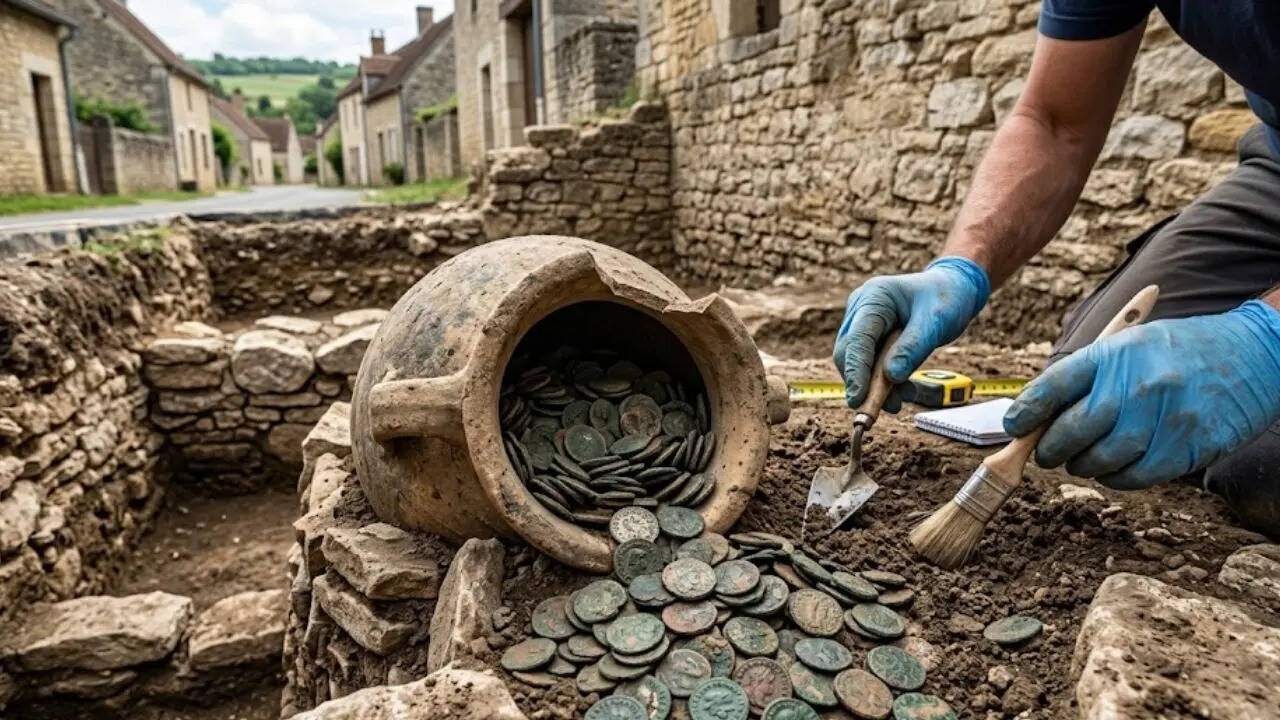
Researchers from the National Institute for Preventative Archaeological Research (INRAP) have made a noteworthy archaeological discovery by discovering three huge coin hoards in the village of Senon, France. When excavating land for a future residential site, thousands of ancient Roman 40,000 coins were found inside ceramic vessels (amphorae) as confirmed by INRAP. The coins seem to have been buried in a planned manner and are dated to the late 3rd and early 4th Century CE. This suggests that there was a more advanced way of storing your money, as opposed to panic hiding it. This new information provides a clear view into how the Gallic people lived and conducted their finances during a time of great upheaval and uncertainty at the northern edge of the Roman Empire.
1,700-year-old Roman coins unearthed in Senon
As noted in a study by Coin Hoards of the Roman Empire, excavations in the village of Senon located in northeastern France have uncovered coin deposits that were a key component of the layout of the ancient settlement's houses. These amphorae containing coin deposits were placed in a pit under the floor of a house, to the level of the ground for easy access to the coins. Numismatists discovered coins were found lodged against the rim of amphorae indicating they were used for repeated deposits and withdrawals rather than a singularly hiding emergency deposit. The coin hoards contain coins made of bronze and copper during the reigns of Victorinus, Tetricus I, and Tetricus II.
The household's savings accounts of Late Antiquity
Before this research, historians had frequently presumed that these substantial amounts of coinage represented ‘treasure’ hoards that were hidden because of wartime or insecure conditions. However, both the organised nature of the storage, such as the placement of packing stones and where the amphorae were placed within typical habitats, speak to the belief that the amphorae were designed to serve as savings accounts for long-term storage for merchants or craftspeople.
The local, which at one time was an active Roman residential neighbourhood or community defined by two interlaced streets and multiple domestic structures, began its decline after a serious fire in the 4th century CE. Subsequent abandonment left the contents of these deposits undisturbed in situ, allowing contemporary archaeologists to study a preserved ‘snapshot’ of the complex economic relationships as well as the degree of financial development within Late Antique communities (i.e., those outside large urban areas).
Beyond storage, evidence of ancient financial activity
As noted in a study by Coin Hoards of the Roman Empire, researchers have found new evidence of a system for managing long-term capital using three amphorae (large clay jars) that were carefully placed vertically within their respective storage pits with stone packing and were still being used for depositing and withdrawing coins at a time when they were only partially buried. These coins, sticking to the exterior surfaces of the jar, indicate that they had been in use for ongoing transactions following their original placement as storage containers. From this, we can conclude that the site served as a ‘household bank’, which was likely used by merchants or administrators with large sums of money.