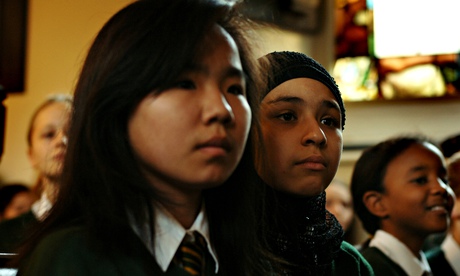
It would be a grave disservice to students “to ditch religious studies in school” (Loose canon, 5 December) and to trivialise multifaith religious education as “mushy relativism” is unjust. Educators from Bosnia visiting our comprehensive school were amazed and envious of the opportunity to explore and appreciate diversity in religion.
A student told our guests that she had “always thought fundamentalists were Muslims. Now I realise that newspapers stereotype people and are prejudiced, as other religions have fundamentalists too. I shall read more carefully now and try and come to my own conclusions.” This is far from Giles Fraser’s “suffocation of curiosity”.
Another student added: “I’m not sure about religion and God but am not really an atheist. I’m still sort of fumbling for a faith. It’s been really good to learn about people of other religions, because the unknown leads to fear and when you know, you can relate. I’ve also realised how fundamentalists are in all religions. The American right has fundamentalists too. I was really surprised to read about their views on evolution.”
Yet another had “always thought of fundamentalists as bad but now I understand more why people become fundamentalists … The Sufis are lovely and yet they are fundamentalists. This course has really made me see and think.”
Maybe it takes guests from countries suffering daily religious strife to realise the inestimable value of multifaith religious education in our schools.
Liz Byrne
Letchworth, Hertfordshire
• The great strength of the 1988 Educational Reform Act which introduced the national curriculum was the emphasis on spiritual and moral development of pupils and of society. I chaired the National Curriculum Council in 1990-92 and regard religious education as a vital part of the curriculum. The act set out that pupils should be introduced to Christianity and all the other major religions of the world, and has been the foundation of British values which underpin our multifaith society.
I have recently stepped down as chairman of a large secondary school in Tower Hamlets which has a Christian foundation with 85% Muslim pupils, none of whom opt out of the broadly Christian act of worship. As a result the pupils are educated in total harmony, with outstanding results.
At a time when religious understanding has never been more important, to call for the abolition of religious education is deeply disturbing.
David Pascall
London
• Giles Fraser is right about religious studies. I have taught the subject in public and state schools, and spent 30 years with Christian Aid, in the course of which I often visited schools to do as he says: “to help children to think, to question, to argue”. A perceptive teacher once asked me how I got away with that. The last thing our present government wants is a generation that does its social analysis and will not be told who to hate and what to buy.
Can we teach students to understand Jesus as a Jewish prophet who taught people not to hate and how to live lightly on the Earth? Can we teach other faiths in the same light? If not, better shut up shop.
Tony Graham
Crawley, Sussex
• I do enjoy Giles Fraser’s columns, and his writing in general, but his suggestion that it’s time to ditch religious studies in school is utter nonsense. The reason some (and I stress some) RS teaching is so poor is because it has been marginalised in schools, and, as Giles points out, ends up being taught by non-specialists. Yet in schools where the subject is valued, where specialists are hired and have access to regular training, it can be hugely enjoyable and encourages pupils to become engaged with, and question, complex and thought-provoking ideas, theories and morals.
I too am concerned about the changes being proposed to GCSE & A-level, but scrapping the subject won’t help anyone. What’s needed is firm support for the subject from senior management in schools, and the promotion of, as Giles himself points out, an opportunity for children to think, to question, to argue. I’m lucky enough to teach in a school where this is the case, and RS has rapidly expanded into one of the most popular choices at both GCSE and A-level. And Giles will be pleased to hear that no colouring in is required at all at key stage 4 and key stage 5.
Richard Meyrick
Coleford, Somerset
• And while we’re about it, can we please abolish the absurd anachronism of “faith schools”? Religious studies is one thing; the notion that any one religion should be solely responsible for all studies has “inevitable partiality” and “future conflict” embedded into its heart.
Fr Alec Mitchell
Manchester