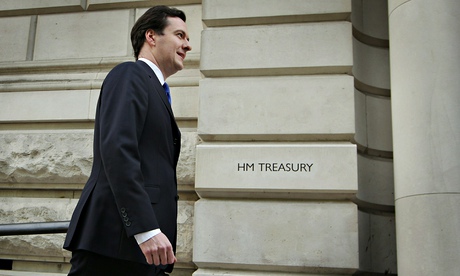
It is all George Osborne’s fault. Lord Adonis pointed out in his book on the coalition negotiations in 2010 that, at the 11th hour, Osborne advocated legislating for a five-year, fixed-term parliament. That is why we are stuck with a government that has run out of steam – but not of hot air – yet must carry on for another four months.
After the tedium of the opening salvos last week, we can now look forward to daily slanging matches right up to the May election. And it is already manifest that these will involve the rewriting of recent history and the reopening of old wounds.
An early start was made by Tony Blair, who could not resist putting the knife into the leader of the opposition in an interview with that well-known leftwing organ the Economist. According to Blair – we can safely dismiss his subsequent clarifications – Labour under the successor he regards as the wrong Miliband will probably lose because Ed Miliband has moved his party away from the centre ground.
Well, you could have fooled me. What has really happened, as the astute shadow chancellor, Ed Balls, later pointed out, is that the Conservative party has moved away from the centre ground and is proposing an extremely rightwing agenda if it wins in May.
Whether the Tories would be able to form a coalition with the Lib Dems, by the way, is highly unlikely: prominent Lib Dems, including present Treasury chief secretary Danny Alexander and his predecessor David Laws, are vehemently opposed to the shrinking of the state, and further assault on the poor, that is proposed by Conservative leadership contender Osborne.
That assumes of course that the Lib Dems survive in their present form. The general impression is that the damage is done, and they will not be forgiven for reneging on the issue of tuition fees, not to say going along with so much of the Conservatives’ misconceived austerity programme.
A prize example of the way the centre ground has shifted is provided by the way that Chancellor Osborne has suddenly become very heated, as it were, about the pricing policies of energy companies. It is not so long since he was castigating Miliband for, er, wanting to interfere with the sacred freedom of energy companies to indulge in naked profiteering.
For examples of the rewriting of history we need look no further than what one might term the Tony Blair Rehabilitation Programme. Blair, we are told, broke all Labour records by winning three elections in a row. Leaving aside the fact that Harold Wilson won four elections – although not in a row – I seem to recall a remark by Kenneth Clarke that the Tories were in such bad shape in 1997 that Labour could have won with a monkey as leader. Certainly, it is highly likely that the late John Smith would have won easily – although, to be fair to Blair, his presentational skills were such that he undoubtedly had an impact on the size of the majority.
There is also no disputing that he, together with Gordon Brown, against the background of what was widely perceived as their initial success with the economy, played a major role in winning in 2001. But when it came to 2005, Blair’s reputation was so sullied by Iraq that he had to bring Brown in from the cold to rescue the campaign.
However, Iraq aside, those Labour governments, for all their faults, achieved many good things with the boost to public spending on health and education. Both Blair and Brown deserve much credit on that score.
Which brings us back to the rewriting of economic history. Having supported, if reluctantly, Labour’s public spending plans when they were in opposition, Cameron and Osborne subsequently embarked on what was, until recently, a remarkably successful campaign, not only to complain about Labour’s spending, but to put all the blame for “the deficit” on the spending they had supported, as opposed to the financial crisis and depression, which were by far and away the largest reasons for the swelling of the deficit.
Nevertheless, one has to admire the barefaced cheek of the prime minister and chancellor for the way they manage to shift their own not-very-centrist ground. Having failed lamentably with their much vaunted plan to eliminate the so-called structural budget deficit within the lifetime of this parliament, they now boast that they have halved it. Even then, they indulge in the age-old practice of what Churchill called “terminological inexactitude”.
They were originally referring to the actual deficit in money terms, which has certainly not been halved. Now they speak in terms of the percentage of gross domestic product. What is more, they like to give the impression that this means they have achieved what they set out to do.
Which brings us to the gravamen of the criticism of their economic strategy and so-called long-term plan. As I wrote in my last column, they were obsessed with the wrong deficit.
It is true, by the way, that successive governments, including the Blair-Brown governments, also neglected our manufacturing base, which, for all the fuss about financial services, still provides the bulk of our export earnings. The current account deficit is now running at 6% of GDP, compared with a mere 0.7% in 1967, and 0.9% in 1976 – both crisis years for Labour governments – and a peak of 4.4% after the 1988 Lawson boom. Wow!