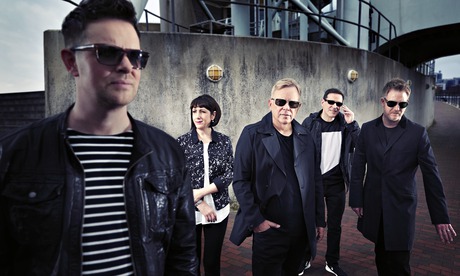
New Order, Manchester
It is hard to imagine a more spirited homecoming than that of New Order to Manchester. But still, the band are not quite the same as last seen in the city. They’re touring an album that, for the first time, does not feature the characterful lead basslines of Joy Division/New Order founder Peter Hook. In other respects, however, Music Complete returns New Order to first principles. The band are once again on a respected independent label (Mute), Sumner is in fine (if possibly Auto-Tuned) voice, while the music is a driving mixture of pounding Giorgio Moroder disco and clanging indie rock, a combination intended, as ever, to stimulate the heart while not forgetting about the soul.
The Warehouse Project, Sat & Sun
JR
JME, Leeds
You get a pretty good idea of JME from a verse on Man Don’t Care, a track from his 2015 album Integrity>. In it, he threatens to punch his challengers with a variety of keys: the key to his big car, the key to his house and, amusingly enough, even the security key to his HSBC online banking account. It’s an interlude that goes some way to explaining the signature style of this enduring British MC: a mixture of gritty talk, basic but effective rhyming and a surprising, occasionally slightly troubling, humour. All round, it’s a combination that has served the performer well. While some artists are participating in a “grime revival” after a flirtation with chart success, JME (unlike his brother Skepta) has never really left the roots of the music. A founder of the north London crew Boy Better Know, JME’s work has been done without much hype, PR, or even a label, but his recent top 20 album illustrates how it’s possible to succeed outside convention.
JR
Ho99o9, On tour

A band on the cusp of hardcore punk and hip-hop, Horror (that’s how you say it) would once have made the US’s moral guardians recoil. These days, the confluence of the two genres doesn’t carry quite the same connotations (despite of the best efforts of Death Grips), but it is still an explosive creative space. On record, the duo make a woozy and disorientating hip-hop that recalls Odd Future, New Kingdom and Gravediggaz, psychedelic in the most terrifyingly experimental way. Live, their dynamic is more physical; it’s about creating the same chaos in the room as their records do in the mind.
JR
LCMF, London
This year’s London contemporary music festival takes place in Ambika P3, a vast, subterranean concrete bunker underneath the University of Westminster. Expanding in both space and time, the festival runs for a week from Friday, with a fist of firsts on the bill. Ethiopian nun and pianist Emahoy Tsegué-Maryam Guèbrou is in the UK for the first time, joined on the lineup by Ellen Fullman, performing a new work for her awesome long-string instrument (13 Dec); a new multi-channel, submarine sound piece by Chris Watson is premiered (14 Dec); London producer Visionist debuts an AV set for his future- grime (Fri); and Morton Subotnick unearths a forgotten composition from the 1960s (12 Dec). Woven around these is contemporary opera, spoken word, an ASMR piece, Russian poetry readings and more.
JA
Loz Speyer’s Inner Space Music, On tour

The late US saxophonist Ornette Coleman’s influence in the jazz world grew from marginal to immense in the 1960s, and his early acoustic bands played a long-lined and conversational kind of mutant bebop that has developed distinctive offshoots wherever jazz is played. British trumpeter and composer Loz Speyer is an underrated but gifted disciple of Coleman’s methods, and as an artist who has worked for long stretches in Cuba as well as his homeland, he makes contemporary jazz from a very individual perspective. Speyer’s writing for this band takes in delectably lazy-sounding horn lines over audacious rhythm-section time-bends, tumbling Ornette-ish sprinters, dirgey laments, childlike tunes and strutting avant-trad marches.
JF
Hymnen, London
If one had to chose a single work from Karlheinz Stockhausen’s sometimes bewilderingly diverse output to illustrate why he was one of the greatest composers of the second half of the 20th century, it might well be his two-hour-long masterpiece of electronic music, Hymnen. The four movements (or “regions”) of this vast sound canvas, which is based upon recordings of 40 national anthems, are most often heard as purely electronic works. But they can be performed with live instrumental soloists and, in 1969, Stockhausen made a version of the third part with a full orchestra, though performances of that have remained rare. That makes this London Sinfonietta’s performance of Region 3 a major event. It’s a shame it won’t be heard in the context of the other three regions, but it is still a tremendous opportunity to hear one of the landmarks of electronic music in a form few will have experienced before.
AC