Carl Slater, Plymouth
Carl Slater’s exhibition exploring the fledgling days of Plymouth’s rave scene is full of literal blasts from the past. The show’s beating heart is a video that uses archive footage of white-gloved revellers waving glowsticks under flickering strobes at venues that ranged from old theatres to the beach. It’s hard to think of rave now without thinking of its mutation into superclubs, a me-culture of easy pleasures and political apathy. Slater, though, revisits its early post-hippy, New Age-y promise of loved-up communal enlightenment, drawing connections between entranced party-goers and religious congregations. It’s an analogy brought home by the Plymouth scene’s key venue, the Warehouse, finding new life today as a Christian TV station. Original flyers provide further glimpses into the subculture’s history, while a sculpture doused in Vicks offers ravers a Proustian moment.
Plymouth Arts Centre, to 12 Sep
SS
Paul Neagu, Leeds
For Paul Neagu, art was as much a matter of metaphysical proposition as of aesthetics. Like his contemporary, the self-styled artist-shaman Joseph Beuys, Neagu invested art with an aura of psycho-spiritual intensity. His Palpable Art Manifesto begins: “The eye is fatigued, perverted, shallow, its culture is degenerate, degraded and obsolete, seduced by photography, film, television.” Yet Neagu fought the dehumanising rot with a more personal agenda than the crusader Beuys. With him, intimate touch is everything. Central to this show is a series of “tactile objects”, which are, indeed, hard to keep your hands off. Full of well-worn surfaces and faded earth tones, they are embodied with highly sensuous, almost fetishistic charm.
Henry Moore Institute, Thu to 8 Nov
RC
El Lissitzky, Dublin
Leading up to the centenary of Ireland’s Easter rising, El Lissitzky: The Artist And The State uses the work of the early 20th-century Russian avant garde artist to tackle the tricky subject of art’s relationship with revolutionary politics. Historical connections are drawn with the Irish nationalist campaigners Alice Milligan and Maud Gonne, and there are updating contributions from contemporary artists, but it’s Lissitzky’s infectious dynamism that forms the central thrust. With a background in architecture and engineering, Lissitzky imbued everything he created with a constructive cultural optimism that now seems hardly imaginable, envisaging a revolutionary state whose social and political composition was inseparable from its artistic innovations.
Irish Museum Of Modern Art, to 18 Oct
RC
John Chamberlain, Edinburgh
Emerging from the New York scene in the 1950s, John Chamberlain first became known for welded metal sculptures that looked like the products of some used-car junkyard, which is exactly what they were. But, as this show demonstrates, his vocabulary extended beyond smashed-up motors into the gentler surfaces of sculpted foam and watercolour on scrunched-up paper. Despite his apparent taste for urban detritus, the lyrical aesthetic here is indicated by works’ titles such as Luna, Luna, Luna and Gondola Walt Whitman.
Inverleith House, to 4 Oct
RC
Angela Ferreira, London
Angela Ferreira’s Talk Tower For Ingrid Jonker is a potent choice for the single work Marlborough Contemporary dedicates its gallery to each August: this monument-cum-sound-sculpture tackling South Africa’s bloody history demands space. Its form is starkly simple: a conical three-metre tower topped by speakers in black, inspired by the jerry-rigged rural radio towers essential to Africa’s wars of liberation, and Gustav Klutsis’s portable kiosks for disseminating brave new cultural forms in 1920s Russia. Ferreira’s tower transmits a single poem by the South African poet Ingrid Jonker, The Child Is Not Dead. This anti-war vision, inspired by Jonker witnessing a black child being shot by soldiers in Nyanga, and dying in its mother’s arms, is scorching. Ferreira complements the sculpture with a single photo of the beach where the poet committed suicide in 1965.
Marlborough Contemporary, W1, to 5 Sep
SS
Robert Mapplethorpe, Aberystwyth
This snapshot of Robert Mapplethorpe’s hugely influential career mixes self-portraits with celebrity portraits, flower imagery and still lifes, all captured in the sultry black and white of earlier modernist masters. It’s big on his interest in celebrity glamour but somewhat more reserved when it comes to the S&M-inflected homoeroticism, which made him one of the 20th century’s distinctive talents. The famous faces include his muse Patti Smith, with whom, as a young hopeful, he explored 1960s and early 70s New York, discovering its art world and gay scene, before creating some of rock’n’roll’s most iconic images with her. There’s a young, pumped Arnold Schwarzenegger, and Grace Jones looking like an Aztec goddess in Keith Haring body paint. A roster of artists including Lichtenstein, De Kooning, Hockney and Mapplethorpe’s mentor Andy Warhol also pose before his lens.
Aberystwyth Arts Centre, to 7 Nov
SS
Bold Tendencies, London
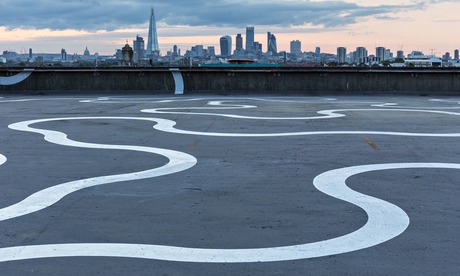
Located in a Peckham car park, gallerist Hannah Barry’s summer regular Bold Tendencies – with its heady mix of sculpture, music, performance and one of the best views of the city – has gone from strength to strength in its nine year existence. The 2015 commissions see big cheese of British sculpture Richard Wentworth rubbing shoulders with the regular lineup of young guns. He has the open-air top floor, which he’s painted with a giant network of snaking lines like a freeform Scalextric track. The live programme is impressive, too. This weekend Christopher Stark conducts the resident Multi-Story Orchestra through French spectral music maverick Gérard Grisey’s Les Espaces Acoustiques.
Peckham Rye Multistorey Car Park, SE15, to 27 Sep
SS