Shona Illingworth, Liverpool
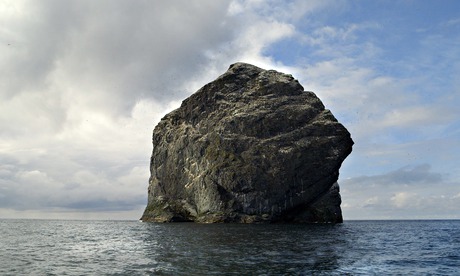
Shona Illingworth’s Lesions In The Landscape reflects the mysterious nature of memory by evoking its loss. Her three-screen and multiple-speaker installation is centered on a subject named Claire, who, following a brain trauma, suffers from amnesia to the extent that her past has vanished and her present disappears almost instantaneously. Claire is filmed on the remote Scottish island of St Kilda, which was evacuated in 1930 by its remaining 36 inhabitants, who felt hopelessly cut off from the reassuring social experiences and communal memories of the outside world. Wistful connections are drawn between Claire’s state of mind and the desolate atmosphere of the landscape: gannets screech overhead and elaborate mazes of dry stone walls enclose nothing but scrubland. The ominous mood is deepened by the fact that St Kilda now serves as a radar tracking site for weapons testing.
FACT, Fri to 22 Nov
RC
The World Goes Pop, London
To most people, pop art means gaudy packaging, movie-star billboards and comic-book illustrations. Yet there are many who used pop’s graphic punch to convey directly political messages. Take Bernard Rancillac, whose paintings include offsetting undie ads with images of torture in Vietnam; or Joan Rabascall, whose suggestive image of red lips and H-bomb smoke plumes gave a feminist take on global politics to disrupt pop’s traditional boy’s club. Romanian artist Cornel Brudascu, meanwhile, lent pop’s icons a personal dimension in paintings that depicted his artist peers, including a dead friend, in hipster poses hijacked from music magazines.
Tate Modern, SE1, Thu to 24 Jan
SS
Joana Hadjithomas & Khalil Joreige, Manchester
Past works by the Beirut-based collaborative artists Joana Hadjithomas and Khalil Joreige have included a filmic account of the Lebanese space race and a road movie featuring Catherine Deneuve wandering around war-damaged Beirut. Despite their Cannes accolades, they are far from run-of-the-mill directors, preferring to build narratives of loss through film fragments. Here, in I Must First Apologise…, they turn their penetrative attention to online spam and scamming, revealing the genealogy of devious ways of conning us out of our money through the exploitation of emotional vulnerabilities and financial fallibilities. References range from confidence tricks such as The Spanish Prisoner, dating back to the 16th century, through to “trophy” photographs snapped by vigilante scam-baiters. Need, greed, desire and despondency are the names of this captivating game.
HOME, Sat to 1 Nov
RC
Going Public, Sheffield
This citywide display has borrowed from collections in London, Paris, Berlin and Turin to offer up a prestigious treat of philanthropic patronage. We can temporarily come across the ubiquitous Marcel Duchamp’s miniature archive at the remarkable art-deco Graves Gallery, and a Jake & Dinos Chapman sculpture of a corpse dripping blood into a bucket at the Cathedral, which Fiona Tan also infiltrates with a video on the intensely concentrated spirit of female Japanese archery contestants.
Various venues, Sat to 12 Dec
RC
Jumana Manna, London
As a Palestinian raised in Israel, it’s perhaps no surprise that Jumana Manna has a particularly acute sense of how politics infiltrates day-to-day life. Her engaging UK debut is a film installation exploring a forgotten pocket of the area’s cultural history, but with no pretence of being a straightforward documentary. Its jumping-off point is one Robert Lachmann, a musicologist who invited eastern Jewish and Palestinian musicians to play on his radio show in 1930s Palestine. However, while crackling archive recordings, letters and photos bring his research into the frame, Manna’s camera is more likely to trail Jerusalem’s present-day musical communities, from Palestinian Bedouins to Kurdish Jews, the city’s landscape and her family’s home life. Whether capturing old songs performed in ad hoc settings, people cooking and discussing housework alongside political troubles, or impassioned graffiti blazing beneath dusty highways, she tracks the intricate currents of politics at ground level.
Chisenhale Gallery, E3, Fri to 13 Dec
SS
What We Call Love, Dublin
An exhibition charting changes in love’s definition during a century of crisis and liberations, and in the ways we relate to one another. Stretching from surrealism’s ideal of “amour fou” (“crazy love”), through the cool-as-they-come pop art sexiness of the 60s to the self-conscious ironies (and inhibitions) of postmodernism, an array of big-name artists put on quite a show here. The influence of Marcel Duchamp, with his inscrutable yet contagious charm, is evident throughout. Although Pablo Picasso gets passionately inspired and willingly disorientated, it’s touching that so many of the artists here, most notably Louise Bourgeois, Rebecca Horn and Michele Ciacciofera, reflect with painful sensitivity on love’s profound illusiveness. Then, Nan Goldin arrives on the scene to shows us present-day love in all its reinvented grace.
Irish Museum of Modern Art, Sat to 7 Feb
RC
Sebastião Salgado: Other Americas, London
Salgado’s epic black-and-white images typically look more like fantasy or science-fiction than documentary. Yet while his creations, made on journeys to the Earth’s hidden corners, are strange and heightened, in using the extreme shadow and silvery light favoured by early 20th-century masters they have a deeply physical quality, more like etchings than photographs. This capsule show focuses on work from his first photobook, Other Americas, which saw the exploratory Brazilian return to Latin America between 1977 and 1984. It captures farmers struggling to survive in the modern world, tending graves on the desert’s fringe or carrying bundles like crosses above oceans of cloud.
The Photographer’s Gallery, WC1, to 1 Nov
SS