Ben Cain, Blackpool
The still-life tradition has always had an element of memento mori about it, an often understated reminder of our ever-present mortality conveyed through the objects that outlive us, and the fact that nobody can take any material possessions with them when they pass on. Intriguingly, the artist Ben Cain appears to view museums as essentially still-life assemblages. So here he uses the Grundy’s collection of paintings, permanently surrounded by an eclectic mix of Victorian furniture, ceramics and trinkets, as source material for the construction of an imaginary museum of arrested time. Detailed features of the paintings, such as an amber necklace worn by a portrait sitter, have been reproduced by local artisans under Cain’s direction and set alongside their painted originals to create a surreal double-take of illusion or reality. Or, of course, both simultaneously.
RC
Radical Disco: Architecture And Nightlife In Italy, 1965-1975, London
This archival exhibition makes the case that there was more to disco than the cliches of overly tight menswear, fake palm trees and shiny balls. At least in Italy, where a number of clubs were designed by avant garde architectural practices, including Gruppo Strum, Superstudio and Gruppo UFO. Yet while the centre of this movement was the Piper club in Rome, where Pink Floyd played in 1968 against a backdrop of works by the likes of Andy Warhol and Piero Manzoni these discotheques weren’t just places for dancing. Space Electronic for example, which opened in Florence in 1969 as the hippy vision of Gruppo 9999, hosted performances by anarchist theatre groups and housed a vegetable garden.
OB
Katrina Palmer: The Necropolitan Line, Leeds
Long before railway stations became repurposed as shopping centres, they were often considered romantic spaces, housing scenes of adventurous anticipation and mournful parting. Accordingly, they provide a fitting stage set for Katrina Palmer’s always evocative imagination. Palmer is almost painfully sensitive to a place’s psychological aura, its ability to summon traces of collective memory. While always grounded in geographical and architectural fact, her sound, sculpture and participatory installations often develop into wayward reveries of dreadful loss. With features sourced from the artist’s research into London’s historic Necropolis railway and Borough’s Cross Bones Graveyard, the galleries here are transformed into a dimly lit platform for trains heading off to the otherworld and, maybe, back.
Henry Moore Institute, Thu to 21 Feb
RC
Simon Starling: Nine Feet Later, Glasgow
Simon Starling combines disparate references to art history to conjure up an enigmatic deja vu. While most artists might select their influences according to some sense of a personally relevant creative trajectory, Starling samples obscure fragments to build up a vocabulary for a wide-ranging imagistic poetry. Here, using the almost 200-year-old photographic technique of daguerreotype, he presents visual memories of previous Modern Institute exhibitions. Set against this backdrop, Starling has constructed an elaborate sculptire; a hybrid of a 9ft-long, 15m-year-old petrified tree trunk, a powerful telescope and a birch branch manufactured by a high-tech 3D printer.
The Modern Institute, to 6 Feb
RC
Follow, Liverpool
Follow, at Liverpool’s FACT centre, is the latest of a steadily increasing number of exhibitions through which curators are beginning to ponder the ubiquitous influence of the internet. This one focuses in particular on the effect that social media – with its Instagram likes, Twitter feeds and Facebook walls – has on our individual sense of belonging and self-worth. So a broad-ranging selection of contemporary artists, including Constant Dullaart, Cécile B Evans and Candice Jacobs, tackle lifestyle ideals, self-branding, pretend friends and micro-celebrity. The fact that this is a show of creative engagement rather than academic analysis means that ironic humour is, thankfully, very prevalent. Joe Orr has a wry giggle at career-minded artists’ cliche-ridden Instagram self-promotion, while Kurdwin Ayub unsuccessfully attempts to ape the mock-erotic roleplay of a Miley Cyrus video. Art, after all, has surely long been largely a matter of creative pretence?
RC
Victor Burgin: UK76, London
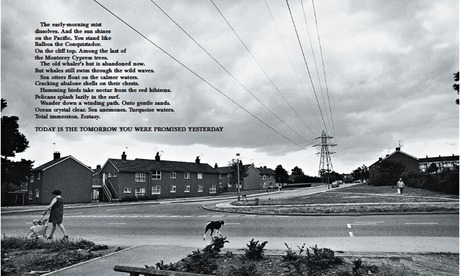
One of the works that makes up Victor Burgin’s 1976 11-part photographic series UK76 shows an unremarkable suburban street. A woman pushes a pram in the foreground; a dog wanders in the otherwise deserted road; electricity pylons stretch out into the horizon. It is a frankly depressing image. Laid over the photo, filling a patch of gloomy sky, is a text describing a very different scene: a Pacific idyll of blue waters and lush vegetation. “Humming birds take nectar from red hibiscus,” reads one poetic line. Similarly incongruous juxtapositions mark the rest of the project, a landmark in the development of British conceptualism which kickstarted Burgin’s investigation into how we perceive and process pictures. In a world, 40 years on, in which our lives and personalities are increasingly mediated, this is a timely moment for the work to be exhibited again.
Richard Saltoun Gallery, W1, to 29 Jan
OB
Heman Chong, London
Heman Chong needs help in making his shows. In Smoke Gets In (Your Eyes) for example, a recent installation-cum-performance made for a show at a South Korean museum, the artist placed two ashtrays in the corner of a gallery and invited visitors to defy the country’s smoking ban and light up, the finished fag butts completing the work. This latest show continues to exploring the questions of exchange, rules and social convention sparked by that work (albeit this time in a more lawful fashion). Monument To The People We’ve Conveniently Forgotten (I Hate You) consists of a million blacked-out business cards discarded on the floor, the promise between giver and receiver broken.
South London Gallery, SE5, Fri to 28 Feb
OB