Making It: Sculpture In Britain: 1977-1986, Coventry
In Tony Cragg’s George And The Dragon, an old table, basket and milk urn are ensnared by a tangled mass of shiny plastic piping. The assemblage stands as a centrepiece of this survey of British sculpture, which covers a period that corresponds, significantly, with the formative years of Thatcher’s reign. It’s the art of social alienation fashioned from domestic and consumer detritus: Bill Woodrow, for example, hacks up and reassembles household gadgetry. Before the YBAs arrived on the scene, this lot took on the zeitgeist with admirable impudence. Subsequently, some would be infected by the lucrative mannerisms of the art establishment, a fate the very special Helen Chadwick was spared by her untimely death. Her plywood school vaulting horse is a poignant memorial to her semi-obscurity.
Warwick Arts Centre, Thu to 29 Nov
RC
British Art Show 8, Leeds
Touring from Leeds to Edinburgh, Norwich and Southampton, this five-yearly exhibition provides one of the most conveniently packaged surveys of art-world goings-on in the UK. Whether there will be any significant discoveries remains to be seen, but many of the 42 chosen artists present work of striking compositional and technical finesse. Highlights include the post-punk feminist Linder’s Diagrams Of Love: Marriage Of Eyes, an artfully woven hallucinatory rug that will be periodically animated by specially choreographed Northern Ballet performances; and the work of Ryan Gander, who proves conceptualism can be as deadpan as it is painstakingly conceived.
Leeds Art Gallery, Fri to 10 Jan
RC
Frank Auerbach, London
Frank Auerbach’s approach to painting can sound like some kind of Sisyphean task. He works every single day in the same north London studio he’s been in since 1954, with the same weekly sitters, painting and repainting the same canvasses, applying pigment, scraping it back, starting again. This can take years. Then, the work surprises him, and it can all be finished in a matter of hours. The hard-won results rank among the meatiest of 20th-century British painting, with semi-abstracted heads and urban landscapes emerging from canvases as thick with paint as they are with thought and feeling.
Tate Britain, SW1, Fri to 13 Mar
SS
Diffusion 2015: Looking For America, Cardiff
The second edition of this biennial photography festival has an epic theme: what does America, its dreams and nightmares, mean for those living within its huge, sharply contrasting states, and throughout the world? The range of work is vast. Some – like Matt Wilson’s oddly lush images channeling the allure and disappointments of the big country and open road – unpick the country’s foundation myths. Others, such as Roger Tiley, whose surprisingly vital black-and-white shots document communities built around now defunct coal camps, tackle industrial decline.
Various venues, to 31 Oct
SS
Eddie Peake, London
It’s a few years since Eddie Peake was first heralded as British art’s bright young hope. Whether he’s making cartoonish sculptures, staging starkers five-a-side matches or choreographing glamorous naked performances to bleeding-edge electronica, his output has been consistently plugged into contemporary culture’s beat. His work has taken in questions of race and inclusivity, but its bass note is sex, with both male and female bodies, dancers and audiences under the spotlight in those nude performances. To tackle the Barbican’s long, crescent-shaped Curve gallery, he’s again highlighting the politics of desire. Beneath a painting spanning the 90-metre gallery wall, and through a labyrinthine structure, a dancer and a roller-skater will perform for the show’s duration. Establishing a loop between their live action and video replay, it’s set to reflect the “unrequited desire, jealousy, love” spiral that keeps relationships spinning.
Barbican Centre: The Curve, EC2, Fri to 10 Jan
SS
Goya: The Portraits, London
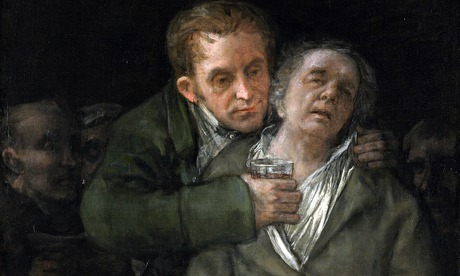
Goya is unrivalled as the definitive artist of human misery, of tortured bodies, of demons that creep in the night. Yet his name was made not through the dark visions of his private albums, but as the king’s painter, depicting the Spanish court’s in-crowd. This survey of 70 portraits is full of dazzling fashionistas, such as the majestic Duchess of Alba, as well as popular heroes like the Duke of Wellington. Goya’s interests as a portraitist were not limited to rich patrons: his treatment of friends and family find new ways to convey their status as Enlightenment-era intellectuals or beloved sons, while his self-portraits veer from promotional early works to stark confrontations of death.
National Gallery, WC2, Wed to 10 Jan
SS
Alan Davie, Falkirk
The Jungian abstractions of Alan Davie return to his native Scotland for the first time since his death last year at the age of 93. For decades, the lavishly bearded Davie, as driven by tenor-sax bebop as by abstract expressionist improvisation, was consigned to beatnik history. His convulsive and highly intuitive mix of swirling mandalas, ankh crosses and rainbow striped, more than slightly phallic, serpents seemed weirdly anachronistic in an art world of pop ironies and conceptual ponderings; after all, archetypes are the oldest cliches going. Then again, this proto-hipster jazzman-shaman just might be long overdue for rediscovery as a knockout free spirit.
The Park Gallery, to 31 Oct
RC

.png?w=600)