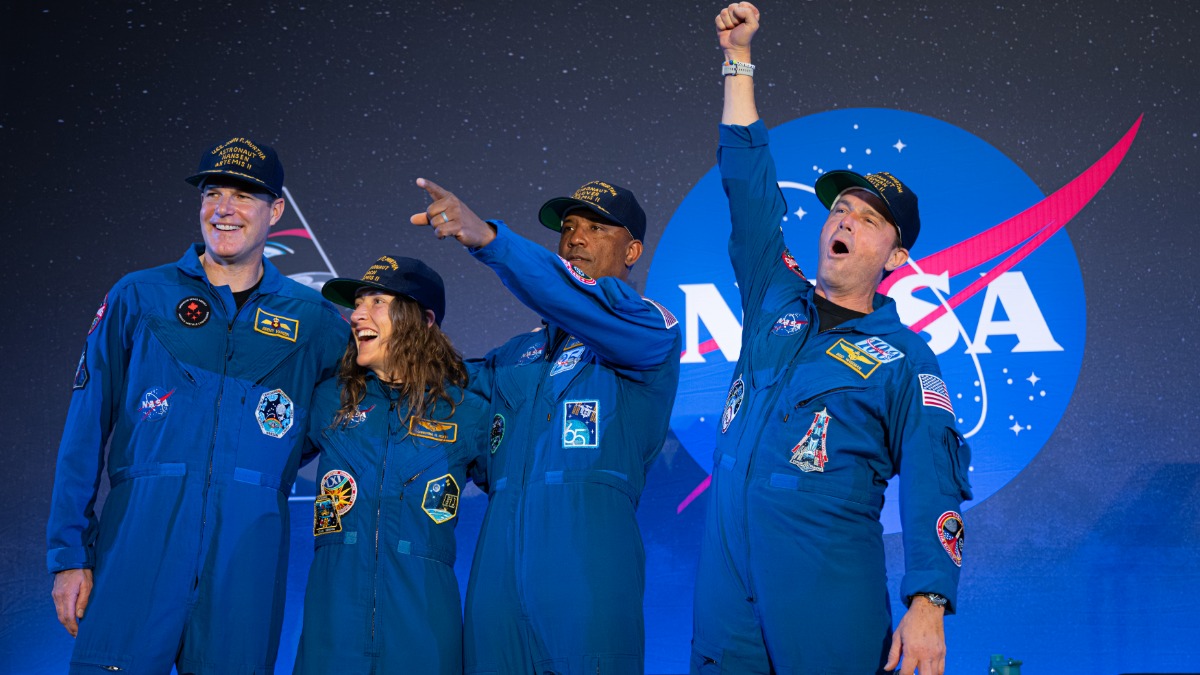
Artemis II commander Reid Wiseman just shared the moment he realized humanity isn’t wired to process the vastness of space. Speaking to reporters after the crew’s safe splashdown in the Pacific Ocean on April 10, Wiseman admitted the mission left him emotionally overwhelmed in ways he still can’t fully explain.
According to LADBible, the astronaut said, “I’m not really a religious person, but there was no other avenue for me to explain anything or experience anything.” The weight of the journey hit him so hard that he asked for the ship’s chaplain to visit, and the sight of the cross on the man’s collar sent him into tears.
The Artemis II mission marked the first human trip around the Moon since Apollo 17 in 1972, and the crew of four astronauts – Wiseman, Victor Glover, Christina Koch, and Jeremy Hansen – spent about 10 days testing life-support systems, communications, and soaking in views no human had seen in over 50 years.
The crew has barely had any time to process their adventure
For Wiseman, the most jarring moment came when the sun eclipsed behind the Moon. He turned to Glover and said, “I don’t think humanity has evolved to the point of being able to comprehend what we are looking at right now.” It’s a sentiment that echoes what astronauts have described for decades as the “Overview Effect” – a sudden, overwhelming sense of Earth’s fragility when seen from the void.
Hansen, the Canadian Space Agency astronaut on the crew, struggled to put the experience into words. “What kept grabbing my attention, when the lighting was right and we were looking out the window, is that I kept seeing this depth to the galaxy,” he said. “That was mind-blowing for me. The sense I had of fragility and feeling infinitesimally small.”
It’s the kind of realization that sticks with you, and the crew has barely had time to process it. Koch even joked that despite the profoundness of the mission, she’s been sleeping great since returning. “Every time I woke up during the first few days, I thought I was floating. I truly thought I was floating and I had to convince myself I wasn’t.”
The mission itself was packed with historic moments
On April 6, the crew broke Apollo 13’s record for the farthest distance humans have ever traveled from Earth, reaching 248,655 miles. But the trip wasn’t without its eerie silences. As the Orion capsule swung around the Moon’s far side, the astronauts lost contact with Earth for about 40 minutes.
Koch broke the radio silence afterward, saying, “It is so great to hear from Earth again. To Asia, Africa, and Oceania, we are looking back at you. We hear you can look up and see the moon right now. We see you, too.” The moment was a reminder of just how isolated they were, even as they carried the hopes of millions with them.
The crew also took time to honor personal and historical milestones. After breaking Apollo 13’s record, they asked Mission Control for permission to name two lunar craters. The first, “Integrity,” was named after their capsule, while the second, “Carroll,” paid tribute to Wiseman’s late wife, who died of cancer in 2020.
The request left Wiseman in tears, and the crew embraced as Hansen radioed, “Such a majestic view out here.” They even managed to capture a single shot of both the Moon and Earth, a rare perspective that put their journey into stark relief.
It was also a chance to carry pieces of history into the future
The Artemis II crew brought along a collection of artifacts, continuing a tradition that dates back to the Apollo era. Among the items was a small piece of muslin fabric from the Wright Brothers’ 1903 Flyer, on loan from the Smithsonian’s National Air and Space Museum. After the mission, it’ll return to the museum alongside other historic swatches from the original flight.
There was also an American flag with an impressive space resume, having flown on the first and last Space Shuttle missions as well as SpaceX’s first crewed Dragon flight. Another flag, originally meant for the canceled Apollo 18 mission, finally made its long-delayed debut, symbolizing NASA’s renewed push toward lunar exploration.
Soil from 10 “Moon Trees” was also on board. These trees grew from seeds flown on the uncrewed Artemis I mission in 2022, which were later planted across 236 locations in the U.S. The soil samples represented the full cycle of exploration – launch, flight, growth, and return.
And if that wasn’t enough, a memory card packed with the names of millions of people who participated in NASA’s “Send Your Name to Space” campaign hitched a ride, making the public part of the journey in a small but meaningful way.
The mission wrapped up with a splashdown off the coast of San Diego, where recovery teams plucked the crew from the Pacific and whisked them aboard the USS John P. Murtha. After post-flight medical checks, they boarded a plane bound for NASA’s Johnson Space Center, where they’ll no doubt spend the coming months unpacking not just the data from the mission, but the emotional weight of what they experienced.
Hansen summed it up best when he radioed from the Orion capsule, “We most importantly choose this moment to challenge this generation and the next to make sure this record is not long-lived.” The next generation of astronauts have big shoes to fill and even bigger perspectives to grapple with.
(Featured image: NASA Kennedy Space Center/NASA/John Kraus)
Have a tip we should know? [email protected]