
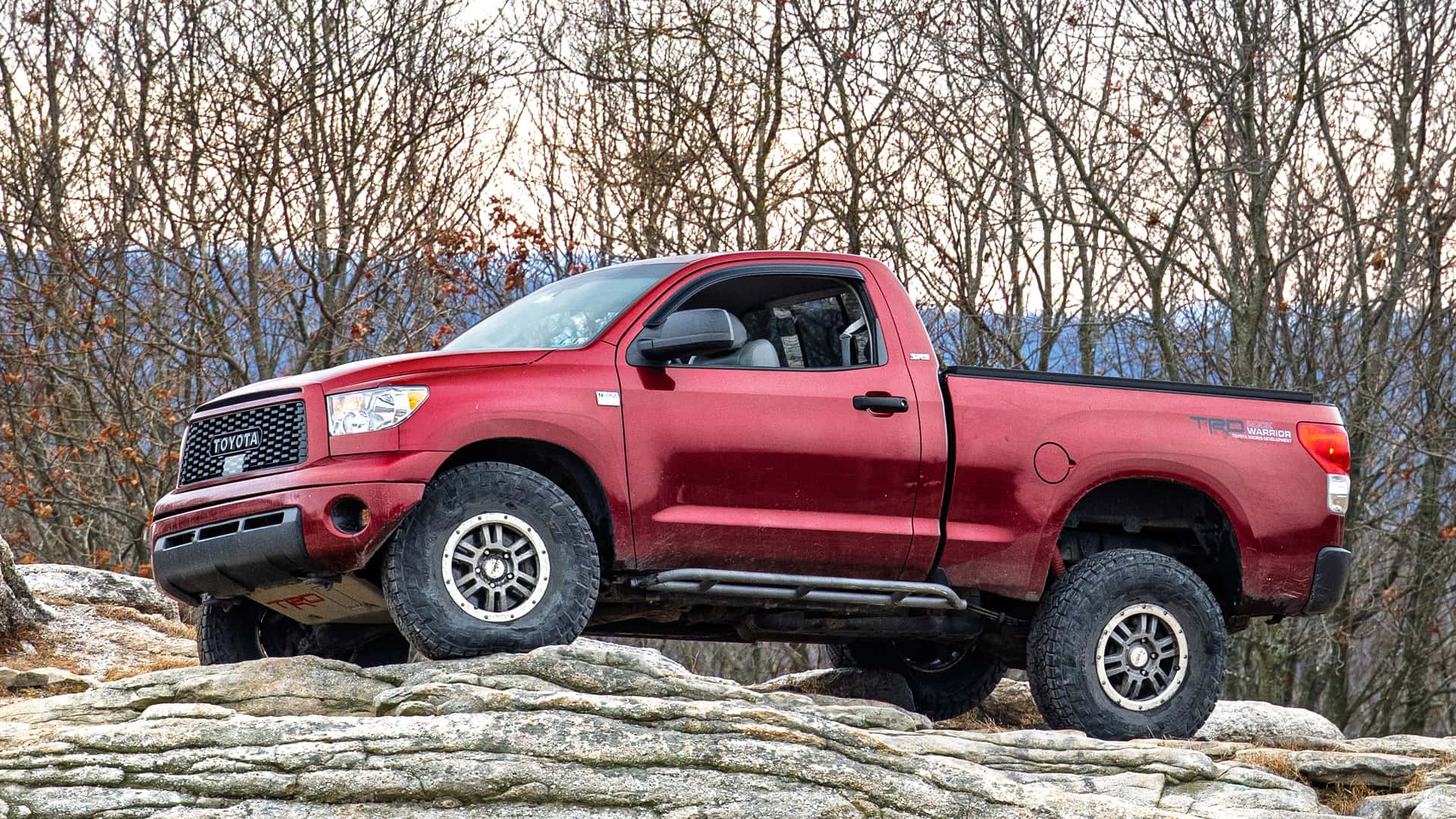
Before Toyota figured out how to print money with its TRD Pro line, dealer lots were blessed with a Tundra dubbed the Rock Warrior. The truck launched in 2009 as an off-road-ready full-size truck wearing some sweet upgrades.
You needed to start with a Double or CrewMax cab to unlock the Rock Warrior parts. Doing so packed on a set of Bilstein shocks, color-matched front bumper and grille, a matte-black rear bumper, and a rather sweet set of TRD-built 17-inch forged alloy wheels wearing BFGoodrich all-terrain tires (which now fetch a hefty premium in the secondary market). Eventually, Toyota replaced the Rock Warrior, but the truck certainly left its mark.
One fan of the Rock Warrior has taken things to a new level, however, by creating his own vision of an OEM-plus version of the truck. Kai is the person behind the YouTube channel Tinkerer’s Adventure. There, he chronicles his projects as a mechanical engineer who loves four-wheeling, overlanding, and messing around in the garage. Kai has taken a 2007 Tundra regular cab short-bed truck and turned it into something rather wonderful.
Toyota never built the Rock Warrior in this configuration. And that’s a shame, because the two-door truck's size is perfect for what Kai aims to do with it. I reached out to Kai to learn more about his build, which he documented for his YouTube channel.

"I'm a sucker for a good set of wheels," Kai tells Motor1. "Years before I even considered owning a Tundra, I got a set of TRD Rock Warrior wheels for my FJ. Toyota actually made a six-lug version for the 4Runner, although they didn't bring the 'rock warrior' branding to the 4Runner. At the same time, slow and steady rock crawling is my favorite type of wheeling, so the concept of a "Rock Warrior" really speaks to me. Also, it being an official package from TRD carries a lot of weight for a Toyota fan like myself. So once I decided to build a Tundra, building a true TRD Rock Warrior simply fell into place."
Doing a build like this while keeping the automaker’s initial vision in mind is key to calling it OEM-plus.
"To me, OEM+ means achieving higher performance, but maintaining the mature engineering and attention to detail as the factory," says Kai. "The bonus point is having on-brand styling with the car maker. The most direct benefit from this principle is high reliability, low maintenance, and greater flexibility for different use cases. Basically, a good, painless daily driver while having better performance."
Gallery: 2007 Toyota Tundra Rock Warrior Custom Build
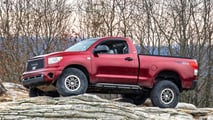
The results of Kai’s efforts are a truck with a great stance, a clean style, and seriously improved capability. You’ve got 37-inch tires, better underbody trail protection, reworked front and rear bumpers, and upgraded suspension components. Kai improved all of the off-road angles, and the level of articulation is quite impressive.
Even better, Kai shows and explains his process for all of this along the way. In fact, he clearly details how he managed to fit those large Nitto Recon tires under the truck. I think I’m even more impressed that he also made sure he could fit a full-size spare in the under-bed storage spot.
'It was less than 10 percent the effort of fitting 35s on my FJ :) That's the beauty of the Tundra. Nevertheless, my setup was threading the needle with the exact combination of wheel offset, tire width and alignment, which I detailed in my how to fit 37s video. Deviating from any of those will require more work so this may not be for everyone. But I wanted to show people the fundamental principles. So even if they went with a different setup from mine, they know what knobs they can turn to achieve the best results.'
So how much did all of this cost? Kai provided a breakdown of the build, and it may have you considering a similar project. The truck itself, which has 130,000 miles on the odometer, was $15,000. All the parts added another $6,104, bringing the grand total to just $21,104.
Now, there’s a caveat to that tally. Kai is talented enough to do all of this work himself, in a home shop that appears to be a true tinkerer’s delight. The DIY mechanic could certainly handle a large portion of these upgrades in their own garage. But cutting, welding, and fabricating takes the difficulty up a notch.
Still, the end result is a great-looking truck that stays true to what Toyota might’ve done with a more aggressive factory-built Tundra.