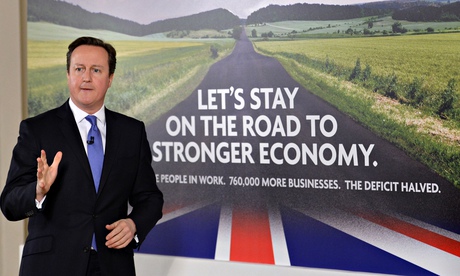
If nothing else, this week’s Conservative manifesto will be better than the 2010 booklet framed as an Invitation to Join the Government of Britain. This positively delphic title entrenched the impression that the party had fallen into the hands of clever schoolboys. It was emblematic of an invertebrate campaign the memory of which still makes David Cameron shudder.
The 2015 manifesto has been compiled by Jo Johnson, head of the No 10 policy unit and a Cabinet Office minister. Like his elder brother, Boris, he is no stranger to the essay crisis (though, unlike the mayor of London, he gained a first at Oxford). In this instance, the document has pinged back and forth between the author and the party leadership as Cameron’s inner circle agonised over tone and content.
How much purple-tinged bait for Ukip waverers to include? How much to reassure the centre-ground voters, who fear precisely that Cameron has chased Nigel Farage too far to the right? From what I hear, it was not principally Johnson’s fault that the manifesto underwent so many revisions and was, as Boris helpfully let slip, still being written last week. In its final form, I gather, it offers something to the voter at every stage of his or her life: a “cradle to grave” suite of proposals that will add substance to the Tories’ claim to a second term.
This has been a very hard election campaign to parse. Its punctuation, its rhythm, its cadences, are difficult to read – excitingly so. Last week’s trio of polls that showed Labour pulling ahead on the same day invited natural comparison with the Tories’ Wobbly Thursday, in 1987. According to the memoirs of David Young, one of Margaret Thatcher’s closest advisers, he grabbed Norman Tebbit, the party chairman, and yelled at him: “Norman, listen to me, we’re about to lose this fucking election.” So worried, in fact, was the Iron Lady on that famous occasion that she gave Sir Tim Bell and Frank Lowe the authority to spend £2.5m on advertising in the last week of the campaign.
There was no such meltdown at campaign headquarters last Thursday, not least because the context is so different. Thatcher panicked because the Tory lead – repeat, lead – fell to a mere four points in a single poll. Cameron would be positively delighted with a consistent gap of that scale between his own party and Labour.
Nobody grabbed Tebbit’s distant successor as chairman, Grant Shapps, last week and swore at him about the risk of defeat, because the Tories do not even have a majority to lose. It is 23 years since the party won one of those: its campaign managers do not have the luxury of tantrums about the sudden risk of defeat. It is a risk with which they are all too familiar. Instead, the PM and his team are working on the basis that the race is neck and neck, but that there is huge churn and indecision beneath the choppy surface of popular opinion.
If they hang on to power, it will be in a manner remote from Thatcher’s victory 28 years ago. Not a single MP, nor the most fervent of activists, expects a majority of 102. What the Tories are seeking is enough voters who, whatever their feelings about Cameron personally or the party generally, believe they have a stake in the recovery and – crucially – what a Conservative-led government would do with it.
If there is a change since last week, it is teleological (bear with me). The mantra “Tory competence versus Labour chaos” gets you only so far. Stripped of purpose, values and motives, competence is about as exciting as a balance sheet. The Tories can never win as the Accountancy Party, any more than Labour can prevail as the Nye Bevan Appreciation Society. There are some Conservatives who are mesmerised by the free market, its exciting “invisible hand” and the collected works of Milton Friedman, but they tend to lead a limited social life.
Remember Gordon Brown’s emphasis on “prudence with a purpose”? The strategic shift – Cameron’s team would insist it is merely a “broadening” – is a declaration of intent and priority. Yes, the cuts will continue (they really do have to come up with a better euphemism than “difficult decisions”). But so too will the shift of resources to spending and to tax breaks that reflect the modern Tory perspective.
So: over the weekend, the party said it would spend an extra £8bn on the NHS, enthusiastically endorsing the five-year plan for the service drawn up by its chief executive in England, Simon Stevens. Labour says the plan is “unfunded”, a question on which the BBC’s Andrew Marr pressed George Osborne on Sunday. The chancellor, at least to my eyes, did not look fazed, referring simply to the government’s record and its “balanced plan”. On this, the Tories’ private research is unequivocal: however much voters dislike the party, they know it can make the sums add up if it wants to.
Next up was the disclosure that, under the Tories, most home-owning families would not have to pay inheritance tax on properties worth up to £1m. A similar promise made by Osborne in October 2007 was significant in Brown’s decision not to risk a snap election. Of course, that was before the crash, before the recession, before austerity. So Cameron and Osborne cannot assume this promise to reward aspiration and providence will be as electorally resonant as it was eight years ago.
What these two proposals and this week’s manifesto will do, however, is clarify the Conservative trajectory and let the voters know that the Tory antennae are indeed twitching in response to reality. When trust is in the gutter, the what and the how are never enough: more than ever, we want to know why.
By coincidence, a book that is in vogue among Conservative intellectuals is Robert D Putnam’s Our Kids: The American Dream in Crisis – a vivid exploration of social decay in the US that has many lessons for Britain, too. In particular, Putnam is struck by “the deep, throbbing, ominous bass line” of “the steady deterioration of the economic circumstances of lower-class families”.
Does Cameron hear that bass line, and others like it? Does he still want to mend the social fabric as he did in 2005? This week, when he unveils his final manifesto, is both his best and last chance to explain why he wanted the job in the first place.