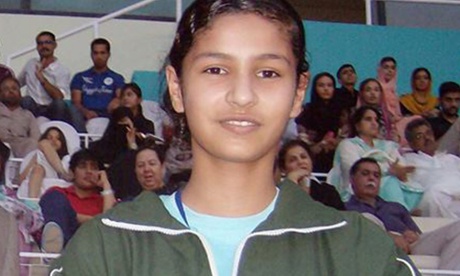
“I remember children crying for their books and toys.”
Along with millions of others in the northwest province of Khyber Pakhtunkhwa, Kainat Khan’s home was destroyed in the 2010 floods.
A result of unprecedented monsoon rain, the flooding was the worst in Pakistani history. Leaving a fifth of the country’s land underwater, the floods killed thousands and damaged over 10,000 schools. In the aftermath, stagnant contaminated floodwaters led to the spread of disease, and countless families were left homeless.
Kainat was just 12 at the time.
“I will never forget that day. The flood destroyed many houses,” Kainat says, before explaining the profound effect it had on her. “I soon had an aim in my mind, and that aim was to help humanity.”
Since then, Kainat has found an unlikely platform to pursue her ambition. For the past four years, she has trained tirelessly to become one of Pakistan’s most recognised young tennis players. She won international acclaim at the age of 14 when she represented Pakistan, and now at 16 she’s hoping to carve out a successful career in the professional game.
But this isn’t just a story about an extraordinary girl overcoming obstacles and achieving international fame. Tennis gives Kainat something most 16-year-olds in Pakistan don’t have: a platform.
“Tennis attracts people to me, but my main agenda is peace and education. There is a big problem with terrorism here. I don’t want to see children with weapons and guns. I am a girl and am working to improve the world for women.”
Nothing is impossible for a girl with dreams
Thanks to the financial backing of a family friend, Kainat and her dad teamed up to create the Kainat Welfare Organisation. They donate bags, books and sports equipment so that other girls can follow in her footsteps, pursue an education and enjoy the benefits of athletics. She also visits schools in Pakistan and Afghanistan to inspire other girls and promote girls’ education.
It takes just a few minutes with Kainat to understand how important universal education in Pakistan is to her. “Representing Pakistan at tennis makes me feel very happy and excited,” says Kainat, “but I want to see a bright future for all girls and women. I want to change the laws that say it’s okay for families to stop sending their girls to school when they reach 12 years old. Education should be equal for all.”
“In many places, it’s impossible to do what I do. I got a lot of attention when I went to play in Iran. I did an interview on morning TV there and talked about my efforts to work for peace around the world. It was important to me to show people in Iran what girls are capable of.”
Inequality isn’t a girls’ issue; it’s a human rights issue
Flooding wasn’t the only challenge Kainat faced growing up.
“In Pakistan, girls face many difficulties compared with boys,” she explains. “I belonged to Pathan’s family (a community of Pashtun people who live in the Punjab region of Pakistan and India), who are very strict about girls.
“It’s normal that when a girl turns 12 she will start to wear the veil. Many parents stop girls going to school and destroy their school bags and books. In tribal areas it’s impossible for girls to play sports.”
Kainat overcame these challenges thanks to the support of her father, who empowered her to explore her passions and talents in a way that many girls in Pakistan are unable to. Kainat’s dad made sure that, for her, it wasn’t impossible to play sport.
“I have faced problems because I am a girl,” says Kainat, the eldest of four sisters. “But I never gave up. With hard work and support from my family, I have made it this far.”
There’s no question that Kainat’s determination is inspiring. But without her father’s unwavering support, the odds that she’d be winning tennis championships, recording TV interviews, or campaigning for girls’ education would be stacked against her. Breaking barriers for girls and creating a more equal world is not just a girls’ and women’s issue – it’s a human rights issue. And to achieve real progress, it needs support and leadership from everyone – male and female alike.
Calling all men: we need your help to end inequality
The need for solidarity was heard loud and clear in New York last week when Emma Watson, on behalf of UN Women, made headlines for launching HeForShe, a new campaign to engage men as advocates for girls’ rights, at the UN General Assembly. “How can we effect change in the world [for girls] when only half are invited to the conversation?” Watson asked.
“The reality is that if we do nothing, it won’t be until 2086 before all rural African girls can have a secondary education … We are struggling. I am inviting [all men] to step forward and ask yourself: if not me, who? If not now, when?”
Kainat’s dad answered that call long ago. But not all girls in Pakistan – or around the globe – have the same support system in place that allowed Kainat to follow her dreams. Campaigns such as HeForShe are a great start for engaging men in the quest for gender equality, but there is still much work to be done. It’s a battle that Kainat and her father will not stop fighting until all girls in Pakistan have the same opportunities she did.
She sums her determination up beautifully: “I don’t waste my time, not a single hour.”
Encourage all the men in your life to join the HeForShe movement, and spread the word using #HeForShe
Content produced and managed by Girl Effect