
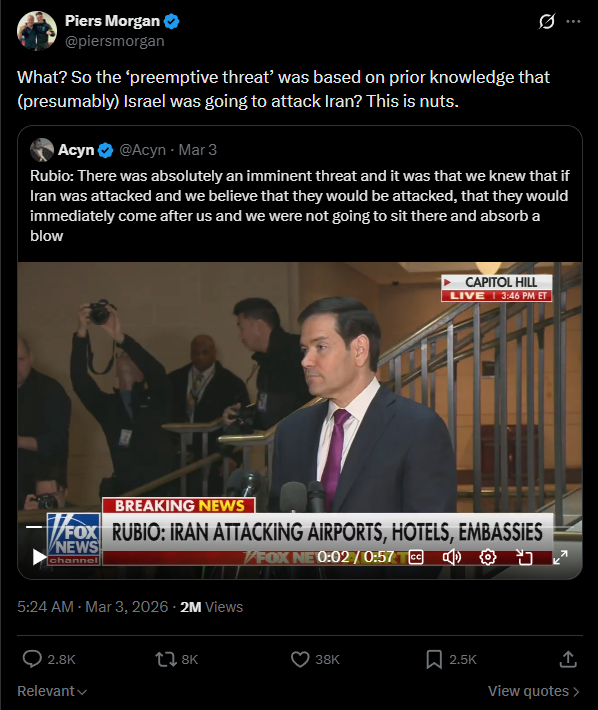
Broadcaster Piers Morgan criticized Secretary of State Marco Rubio over his comments about the United States’ preemptive strikes against Iran. Rubio insists that there was an imminent threat to the United States, but Morgan doesn’t agree.
“Does Congress have to weigh in, and was there an imminent threat?” A reporter asked Rubio at a briefing. Congress did not authorize the attacks against Iran. However, the president can bypass Congress and order military action if there is an imminent threat against the United States. “There absolutely was an imminent threat,” Rubio responded.
He further elaborated, “We knew that if Iran were attacked, and we believed they would be attacked, they would immediately come after us, and we were not going to sit there and absorb a blow before we responded.”
“The Department of War assessed that if we did that, if we waited for them to hit us first after they had been attacked by someone else… Israel attacked them first, and we waited for them to hit us? We would suffer more casualties and deaths.”
Essentially, if Rubio’s words are to be followed, the threat against the United States is conditional upon Israel attacking Iran. After Israel attacked Iran, Trump’s cabinet assumed that the United States would be attacked next.
Piers Morgan remarked on Rubio’s flawed reasoning. He wrote on X, “What? So the ‘preemptive threat’ was based on prior knowledge that (presumably) Israel was going to attack Iran? This is nuts.”
Was the United States’ attack justified?
Rubio’s explanation wasn’t straightforward. But it seems that the attack seems to be contingent upon Israel attacking Iran first, which would have triggered Iran’s retaliation against other U.S. allies. If this is what constitutes an ‘imminent threat’ against the United States in Rubio’s reasoning, then the word must have taken on a new meaning.
Assuming that only Israel were to attack Iran, why would Iran prioritize attacking the United States over Israel—the aggressor state? The term ‘imminent threat,’ if used correctly in this circumstance, would only apply to Israel—the country that decided to bomb with impunity. But what about ‘preemptive’ measures, an argument the Trump administration has brought up to repeatedly justify the attack?
Preemptive action is supposed to mitigate damages. But in the Trump administration’s playbook, “preemptive” action is supporting an ally state’s intention to bomb another country. It means agreeing to launch a joint attack on a country whose nuclear facilities were supposedly “obliterated” by the United States in 2025.
The United States has been allocating $3.8 billion per year in military assistance to Israel. The funding has been ongoing since 2019 because of a ten-year MOU. If Israel, theoretically, had been planning to strike Iran first, then that only means they can absorb the fallout. Americans shouldn’t be paying the price.
Have a tip we should know? [email protected]