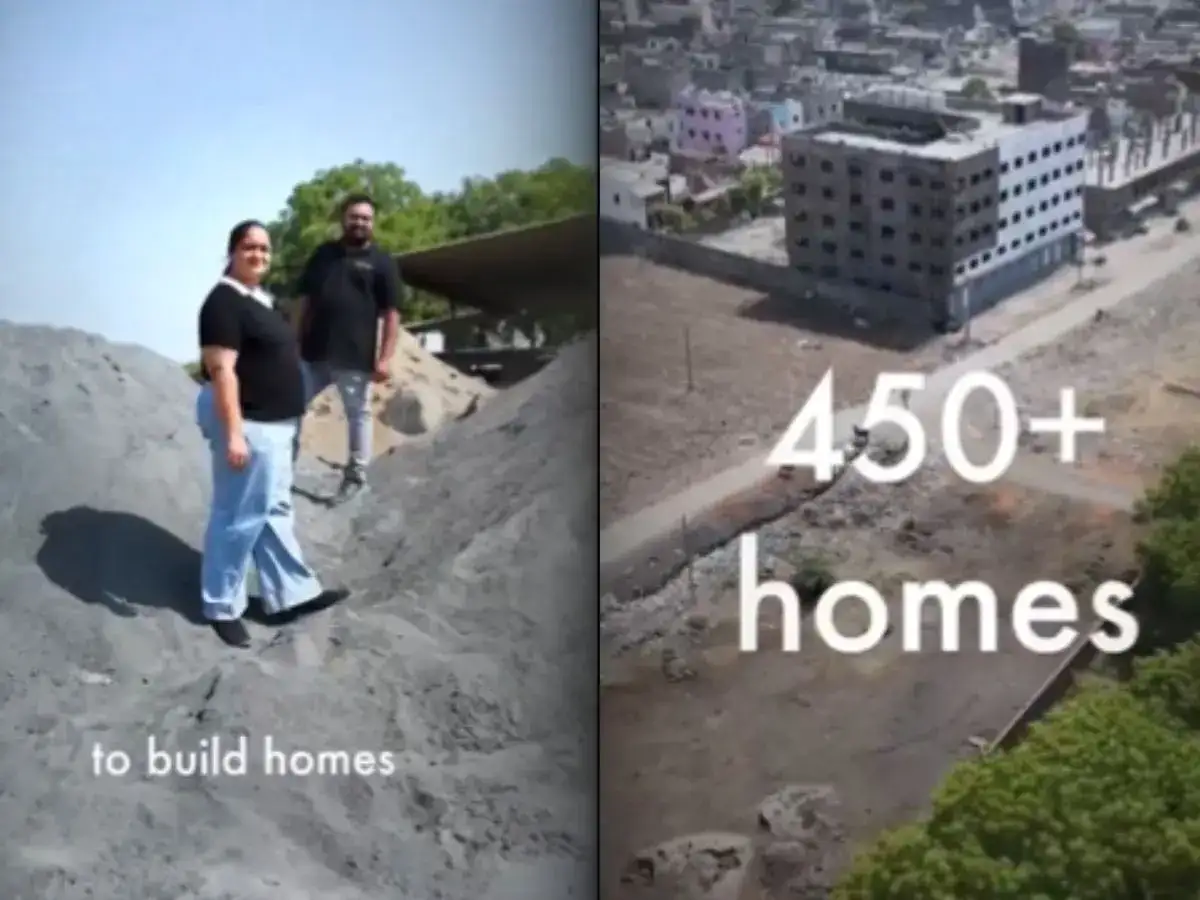
In Gujarat’s industrial town of Ankleshwar, a young couple has found an unusual answer to two of India’s biggest problems, rising construction costs and growing industrial waste. Vedant and Aditi, founders of startup Co2ncrete, are building prefabricated homes using fly ash, silica sludge and other factory byproducts that usually end up in landfills. Their cement-free technology is now helping families get homes built in nearly a month, while also reducing environmental damage.
A Startup Born In The Middle Of Industrial Waste
Vedant and Aditi grew up around Ankleshwar’s massive industrial belt, where factory waste is a common sight. Instead of seeing it only as pollution, they began exploring whether the discarded material could become a useful construction resource. That idea eventually became Co2ncrete.
The startup creates bricks, blocks and prefabricated housing components by reusing industrial residue and construction debris. Unlike conventional construction, the process does not depend on cement. The company instead uses Pre-Engineered Building (PEB) technology to assemble structures quickly and at lower cost. The model is designed to cut down both waste and emissions at the same time.
Homes That Rise Faster And Cost Less
Traditional house construction in India often stretches for several months because of labour shortages, weather delays and material costs. Co2ncrete claims its prefab model can complete houses in nearly 30 days. The homes are already being used by families across Gujarat. According to the startup, more than 450 houses have been enabled so far through its technology.
The lightweight structures also reduce maintenance costs and require fewer raw materials compared to regular construction methods. Instead of waiting months for walls, roofing and finishing work, entire structures can be assembled much faster using factory-made components.
Turning Pollution Into Building Material
Fly ash-based products are not entirely new in India, but Co2ncrete’s approach combines multiple ideas together, waste recycling, prefab construction and carbon capture. The startup says its manufacturing process helps trap carbon during production, making the materials more environment-friendly than conventional cement-heavy construction.
Industrial byproducts like silica sludge and fly ash, which are often difficult to dispose of safely, are converted into usable building blocks instead of being dumped into the ground. This also supports the idea of a circular economy, where waste from one sector becomes raw material for another.
Why The Story Is Getting Attention
The couple’s work recently gained wider attention on social media, where many users praised the innovation and called for stronger support for such “Made in India” solutions.
Supporters believe startups like Co2ncrete fit naturally into India’s larger push towards affordable housing and sustainable development. The model also aligns with efforts to reduce dependence on virgin construction materials while lowering carbon emissions.
A Bigger Question For India’s Future
India continues to face a large housing shortage, while the construction sector remains one of the biggest contributors to pollution and carbon emissions. At the same time, industrial regions generate huge volumes of waste every year.
Vedant and Aditi’s experiment shows how both challenges could potentially be addressed together. If scaled further, such models may encourage local manufacturing clusters around industrial zones and create cheaper building alternatives for both rural and urban areas.