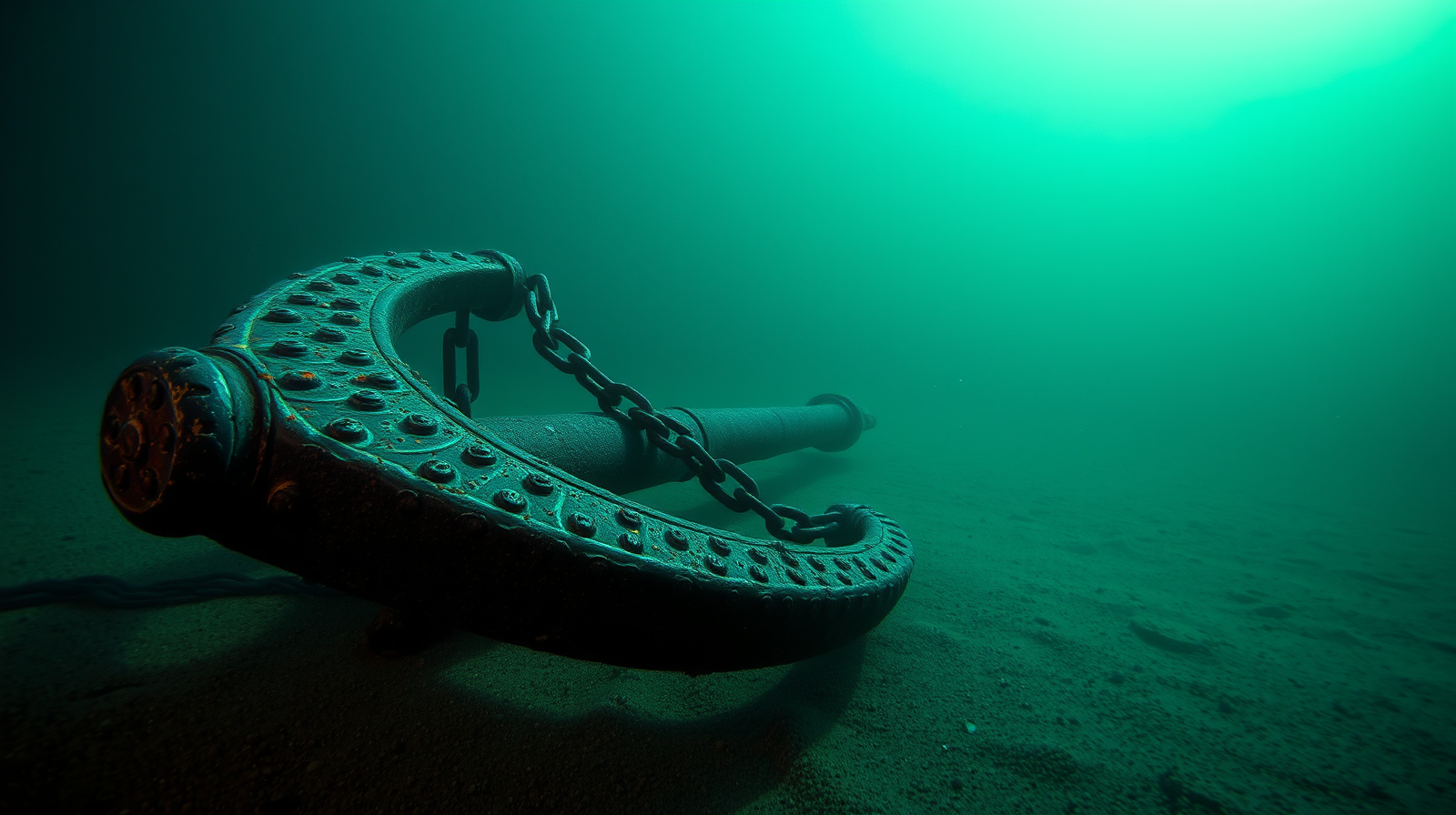
A massive iron anchor, more than 6.6 feet long and weighing around 220 pounds, was recovered off the Suffolk coast of England after spending centuries buried under compacted North Sea sand. Found during surveys for an offshore wind farm, the object initially appeared to be one of Britain's most remarkable Roman maritime finds, with its shape, proportions, and robust wrought-iron construction pointing to a date as far back as the first or second century AD. But new research using non-destructive X-ray computed tomography (CT) has now overturned that early verdict entirely, and the revised story it tells is, in many ways, even more important to the history of seafaring.
North Sea wind farm survey unearths rare iron anchor off Suffolk coast
The anchor was first detected in 2018 during pre-construction seabed surveys for the East Anglia ONE offshore wind farm, developed by ScottishPower Renewables, approximately 60 kilometres off the Suffolk coast at a depth of around 40 metres. It was initially flagged by a remotely operated vehicle investigating unexploded wartime ordnance, but closer inspection revealed not a bomb but an unusually large and well-preserved iron anchor buried beneath the sand. Due to its possible archaeological importance, a conservation plan was agreed upon with Historic England, and in June 2021, the anchor was carefully recovered aboard the vessel Glomar Wave and brought ashore at Great Yarmouth for analysis. Its emergence from the seabed was considered a significant moment for British maritime archaeology it is rare for objects of this scale and apparent age to surface in such complete condition.
Wrought-iron construction and pointed crown initially suggested a Roman or Late Iron Age date
Early examination of the anchor fuelled considerable excitement. Its pointed crown, straight arms sweeping upward at the ends, and the absence of flukes, a feature commonly missing in pre-Viking anchors, all bore a strong resemblance to examples from the Roman period and the late Iron Age. The anchor was compared to the Bulbury Camp anchor found in Dorset in the 19th century, a first-century AD piece attributed to the Celtic Veneti tribe. Maritime archaeologist Brandon Mason noted that external features were consistent with anchors in use roughly two thousand years ago. Yet dating iron objects is, as researchers know, notoriously difficult; chemical analysis and metallography require physical samples, and since the anchor was destined for public display, the team chose a fully non-destructive route instead.
X-ray CT scanning overturns the Roman origin theory
CT scanning was carried out at Nikon Metrology UK's centre in Tring in January 2023, using a 450 kV microfocus X-ray system alongside the firm's proprietary Curved Linear Diode Array detector, which eliminates much of the X-ray scattering that would otherwise obscure fine internal detail in large iron objects. The results changed everything. As the published study in the journal Heritage confirms, the CLDA scans revealed that the anchor's shank is composed of eight individual bars, six with a square cross-section of approximately 27 × 27 mm and two rectangular ones measuring roughly 15 × 36 mm, forged together simultaneously, with gaps where welds failed to form properly running substantial lengths of the shaft. That pattern is the key to dating the object.
Bar size and uniformity point to post-medieval European ironworking, not ancient Rome
In the Roman period, iron blooms, the raw product of early smelting, typically weighed no more than 8 kg, and refined bars were often lighter still. Producing eight bars of the size and uniformity revealed by the scans would have been extremely difficult with Roman-era technology. The study points out that the post-medieval period, from roughly the 16th century onward, saw rapid advances in European ironworking: blast furnaces, waterpower-driven hammers, and a thriving standardised bar trade across the continent. Bars matching the dimensions found inside the anchor closely correspond to iron cargo recovered from known 16th- and 17th-century wrecks, including the Gresham Ship of around 1574 and the Dutch vessel Aanloop Molengat. The research concludes that the anchor most likely dates to the late 16th or early 17th century CE, post-medieval, not Roman.
The anchor may represent a missing step in history
What makes this anchor particularly valuable is not just its revised date but what that date implies about the development of anchor-making technology. By the late 17th and early 18th centuries, documentary sources describe smiths sledge-forging bundles of bars together using waterpower, an efficient, well-documented method. Earlier anchors were assembled incrementally, one joint at a time. The East Anglia ONE anchor sits between these two approaches: eight bars forged together in a single operation, but without the full efficiency of mature bundle forging. The study notes that researchers had previously lacked a concrete archaeological example of this transitional stage. This anchor may now fill that gap, making it significant regardless of whether it is Roman.
Conservation work is ongoing, with a public display at Ipswich Museum planned
Conservation of the anchor remains a painstaking process. Iron that has spent centuries in seawater absorbs large quantities of chloride ions, which continue to corrode the metal from within even after recovery. The anchor has been undergoing desalination treatment and repeated washing in sodium hydroxide solution to reduce chloride concentrations to a stable level. Once treatment is complete, mechanical cleaning, passivation with dilute tannic acid, and a final wax coating will prepare it for long-term storage and display. The anchor is expected to go on permanent public display at Ipswich Museum, where it will represent a genuinely rare chapter in post-medieval maritime history and stand as proof that a corrected story can be every bit as compelling as the one it replaces.
"The anchor was not what anyone first thought it was, and it turned out to be more interesting for that. A mistaken identity, a CT scanner, and a revised date later, it had become something rarer than a Roman relic: a missing piece of a story nobody knew was incomplete.