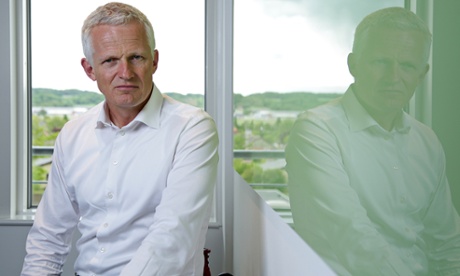
Mads Nipper is very excited about pumps. To the uninitiated, this might suggest that the man needs to get out more.
At least, it might until you come across the startling statistic that pumps account for 10% of the world’s electricity consumption . Add to this the fact that most are desperately inefficient, sending around half that power sometimes literally down the drain, and pumps start to become really rather interesting.
Nipper is CEO at Grundfos, the Danish pump company which is one of the leading players in the sector. He joined from Lego in 2014, where, as he freely admits, “I was happily unaware of the sheer scale of the water-energy nexus, let alone how to tackle it.”
Pumps offer a tool for that job. “Pumps are everywhere. They’re in water supply and treatment works, they’re in factories, they’re in offices, they’re in your home… Virtually any place where you’re moving water or other liquids around, or you’re wanting heating or cooling, you’ll find a pump.”
And there too, he adds, you’ll find some staggering levels of waste. “Take any system where you want a liquid under pressure to be immediately available - for a shower, say – and until recently at least, this is how you achieve it: you have a pump which is permanently on, and when you don’t want the water, the flow is stopped by closing a valve. But the pump keeps running. That’s understandable – you don’t want to have to run down into the basement and turn the pump on and off every time you want a shower. But it’s incredibly wasteful.”
Grundfos’ solution was to combine an intelligent sensor with a frequency converter on the motor, which means the pump only kicks into life when needed – when you turn on the shower for instance. The rest of the time it’s either off, or idling. At a stroke, this cuts energy consumption by around 50%.
With 10% of the global pump market, this means Grundfos is making a small but significant dent in world power demand. And, Nipper adds, “since the technology isn’t easy to patent, most of our competitors have picked it up. Which as a business person annoys me, but as someone who wants to see a more sustainable world, it’s undeniably a good thing.”

Needless to say, there’s a fly in the ointment. “Intelligent pumps are more expensive than ‘stupid’ ones.” They will save money in the long run – with payback times of up to five years – but the capital costs can be off-putting. “People don’t think about pumps. If you’re a plant manager or a householder, you don’t go around wondering, ‘Hmmm, I wonder how efficiently my pump is running today?’. And even when it stops working and you have to replace it, you can easily buy a pump that will seemingly do the same job, for half the price of an ‘intelligent’ one.” With that price gap, it’s not surprising that many people choose the cheaper option.
It sounds like a classic case for a shift from product to service. So what about offering a pumping service, rather than the pump itself? “We’re starting on that”, Nipper responds. “It’s early days, but we’re exploring alternative business models, whether it’s leasing a pump, or selling a service like water supply.”
Meanwhile, Grundfos offers potential customers energy audits, showing how much they are spending on pumping, and how much an intelligent model could cut costs, along with all the sustainability benefits such as CO2 savings. “We’re giving them both the financial motive and the feel good factor.”
But however impressive the power savings, they won’t amount to a huge hill of beans if power prices are kept artificially low. And that’s the case across a wide range of Grundfos’ markets in emerging economies, where energy subsidies are seen as a political necessity. Nipper readily acknowledges the issue. “No matter how efficient a pump you invent, if you don’t incentivise people to choose it, then no amount of intelligent technology will help [cut energy use].”
This must lead Grundfos into politically sensitive territory, surely? “We do say publicly that how politicians decide to price energy and water is incredibly important. But this is something we can only tackle by working with governments, trying to influence them [to adopt] more intelligent energy and water prices… We’re talking about it to Chinese city mayors, to ministers in the Indian government, and others.”
Politically, it’s a “big paradox”, says Nipper. “It’s very difficult to change something which has historically been very cheap. But if you don’t do something about it, the problem will just keep growing.”
Meanwhile, he remains optimistic about the potential of intelligent pumps to make dramatic sustainability gains. “Grundfos can’t do this alone, but if we can work with governments and water authorities [to address some of the policy barriers], and if we can rely on our competitors to copy our best applications and really take them to scale, then together we can make it happen.”
Content on this page is paid for and produced to a brief agreed with Grundfos, sponsor of the water hub


.png?w=600)