In her recent review of the Bridge Project's The Winter's Tale in the Times Literary Supplement, Juliet Fleming argued that the 30-year-old Morven Christie, as Mamillius, was "much better as a 10-year-old boy than any 10-year-old boy would be". It's a fascinating claim (not least for the implication that Fleming knows the full capabilities of all 10-year-old actors) and prompts the question: if adults can play children so well, why use child actors at all?
The difficulties with using children on stage are well-documented. As well as the necessary legal constraints on rehearsal time and the frequency of performances, resulting in the need to rotate the children playing a role, the basic requirements of performance such as audibility and diction have to be learned, and the self-consciousness of precocious youngsters must be overcome. It's perhaps no wonder that some directors would rather choose a young, professionally-trained adult actor who can assume responsibility for their own performance. Many productions factor in the adult-as-child and use it to the play's advantage; for example, the cast of Blood Brothers growing to adulthood as the play progresses.
I'm not convinced, however, that an adult can satisfactorily replace a good child performance. Whatever the strengths of the grownup, the physical vulnerability of a child on a stage full of adult bodies is impossible to recreate, and can be hugely powerful. It's one of the reasons why Prince Arthur in Shakespeare's King John is nearly always played by an actual child; his death and his mother's grief are rendered more traumatic by the powerful visual effect of a young body lying on the stage.
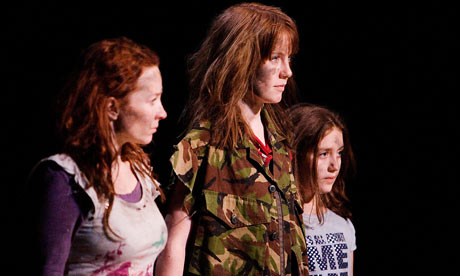
The Royal Exchange's current production of Macbeth provides a perfect illustration in its three witches, reimagined as children: two played by young adults, one by a child. The two older girls give excellent performances, but the truly chilling moments are those when sneering predictions come from the voice of the youngest child: evil in a sing-song lilt. In a brave move, rather than being led around by the older witches, the youngest is actually the most dominant, speaking on her sisters' behalf and initiating the trio's various rituals. The performance is unsettling, the child bringing a directness and apparent innocence to the lines that belies the horror of the bloodletting and curses. An adult-as-child requires a safe suspension of disbelief; the child actor seems raw and authentic.
There are some fantastic child actors out there, and some fantastic parts for children. Last week, I watched the amateur boys of King Edward VI School in Stratford tackle the challenging A Mad World, My Masters and Endymion with wit and skill, as part of an experiment to revive the spirit of the original Elizabethan and Jacobean boy companies. Most impressive were the spot-on caricatures of adults and satirical portraits of grownup folly. So let's give children the opportunity to make parts their own: what a 10-year-old boy lacks in classical training, he makes up for in actually being a 10-year-old boy.