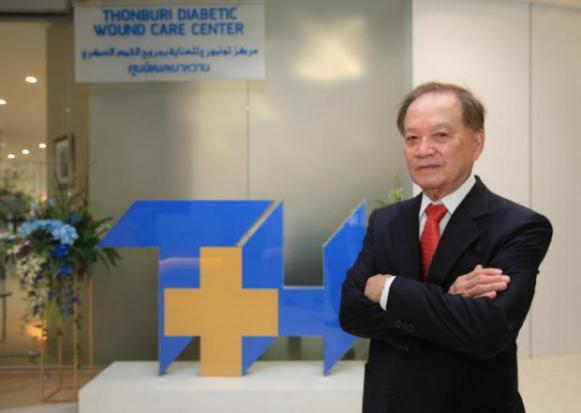
General hospitals are a good way to lose a lot of money, says Boon Vanasin, founder of Thonburi Healthcare Group (THG), one of Thailand's largest private hospital operators.
"With general hospitals you're going to lose a lot of money, and it takes a while to make it back," Dr Boon says. "These new hospitals won't break even for at least 10 years, while half of their departments are losing money. Like paediatrics, where kids come with a fever and the treatment is paracetamol and a bath, while the costs at your end are 6,000 baht a day."
Despite this pessimism, Dr Boon is leading the charge to greatly expand his hospital group, but with a focus on more financially lucrative specialised care as opposed to general care.
THG opened what it claims is a "six star" hospital on Bamrung Muang Road about a month ago, focusing on diabetes, in vitro fertilisation, cosmetic surgery and 3D-printed dental implants, among other niche medical services. The group also plans to open another hospital in Nakhon Si Thammarat in July.
The Bamrung Muang facility was set up in an existing building, with THG taking over a 21-year lease from the company Power Line for 2.1 billion baht, then spending 1.5 billion on renovations and paying 100 million baht to the Red Cross, the building owner.
To pay for the costs, THG took out a 1.6-billion-baht loan and paid for the rest in equity. The company expects to break even on the hospital in 5-8 years.
HOLIDAY AT THE HOSPITAL
Dr Boon wants to see Thonburi Bamrungmuang Hospital compete with Bumrungrad Hospital in the medical tourism sector. Bumrungrad is internationally recognised as a destination for foreign patients and has been instrumental in building Thailand's reputation as a hub for medical tourism.
The new hospital is building up its reputation with foreigners, especially those from the Middle East, by taking extra steps to accommodate both language and culture, such as setting up meeting and prayer rooms to cater to this clientele. Some 90% of the hospital's patients are foreigners, with 60% from the Middle East. Myanmar and the Philippines are the next most common patient nationalities.
The Middle East, especially the Gulf States, is an especially lucrative market for medical tourism, as these countries have a hard time attracting good doctors and the prices for medical care are almost as expensive as the US, while the quality is relatively low.
Despite Thailand's foothold as a top-of-mind medical tourism destination, Dr Boon says the country faces stiff competition from Malaysia and Singapore.
"Malaysia has a really good medical system, the same quality as Thailand with a price that's much lower," he said. "But Thailand has an advantage because we are a world destination for tourists and people come here to eat, go to the beach and enjoy the city, while Malaysia is quite bland."
He also warns that if Thailand's prices rise above Singapore's, Thailand will quickly lose much of its medical tourists to Singapore. But even among pricey private hospitals like Bumrungrad, prices are currently about 30% lower than in Singapore.
"I believe in the free market," Dr Boon said. "It's already too competitive in Bangkok. Leave [private hospitals] alone. If Bumrungrad wants to charge more than Singapore, they'll be out of business.
"The government has to be sure that the poor people and the middle class have a good hospital to go to, but for the ones that can afford the expensive hospitals, leave them alone."
Thailand's healthcare industry is also suffering from a lack of quality specialists, according to Dr Boon.
"We have a hard time finding good, 'superstar' doctors for our specialised programmes," he said. "We had to start bringing in doctors from Myanmar to train and build up into great doctors."
AUTOMATING CARE
"We are spending a lot of money on artificial intelligence (AI) and high-tech equipment," Dr Boon said, adding that the company has spent about 100 million baht over the last five years on IT infrastructure alone.
For example, the new hospital has X-ray machines that use AI to identify and diagnose illnesses. A human can only remember about 500 diseases, while the computer can remember hundreds of thousands, Dr Boon says. But a human must double-check the work of the computer to make sure there are no errors in the diagnosis.
"I don't see computers taking over the job of doctors 100%, but it could be as much as 80%," Dr Boon said. "An expert from the US told me it could happen in as little as six years, but in Thailand it depends on how much we invest in it."
The hospital uses cutting-edge technology in the dentistry wing as well. Instead of using moulds to fashion new fake teeth and crowns, a scanner creates a 3D computer model of the patient's mouth. New teeth can then be 3D-printed in as little as two hours, drastically cutting down the time from traditional methods.
PASSING THE TORCH
Dr Boon, now 81, says he wants to retire but needs to set up his company for success once he's gone.
"I want to retire, but it's hard to find someone to replace me," he said. "In China, if I'm not there, the chairman of the company we're working with won't talk to my managing director, it's not like in the West where everything's more straightforward. I will retire once everything is settled, hopefully in a few years."
His replacement, however, will not be one of his children. Citing research that only one in 10 family businesses survive to the third generation, Dr Boon says he's encouraged his kids not to worry about money and to volunteer instead of working hard in business.
"I want to break for one generation and not talk about money," he said. "Let them take care of their children and do some charity thing. I told my children, 'Don't think about money, you do whatever you want as long as you take care of your children.' "
For his own employees, Dr Boon understands that money does talk and he makes sure to give plenty of bonuses to keep them happy and working at his hospitals.
"I tell my managers that if within one year you don't give bonuses to employees, I will fire you," he said. "Your employees need to make money, otherwise why would they want to work for you?"