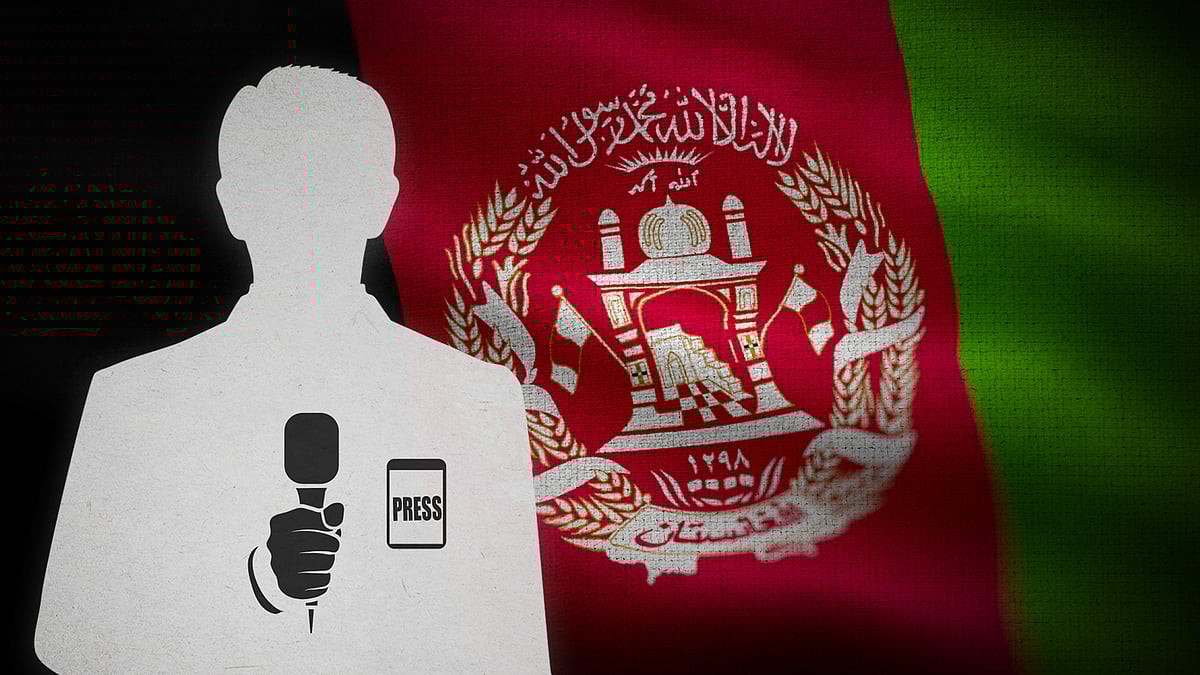
As the devastation in Afghanistan bleeds into another day, the plight of its people, including journalists reporting from the area, is dangerously uncertain.
On August 5, Foreign Policy wrote that journalists had begun “fleeing for their lives, terrified the insurgents will make good on threats to kill them and their families unless they start pumping out favorable copy”. Local news outlets reported in the last four months alone, 51 media outlets have closed and hundreds of news professionals have left their jobs.
On its landing page, the Committee to Protect Journalists has spotlighted how an “entire generation of Afghan reporters” is at risk. In an oped in Washington Post, the organisation’s executive director, Joel Simon, wrote that unless the US government intervenes to bring these journalists to safety, an entire generation of reporters will be lost.
“Over the past 20 years,” Simon wrote, “independent media has proliferated in Afghanistan, producing national outlets as well as top-flight Afghan journalists who do the lion’s share of the reporting for international news organisations, which have shrunk their bureaus as the American presence has diminished.”
On August 16, the New York Times, Washington Post and Wall Street Journal sent a group statement to US president Joe Biden, urging the government to provide “safe passage” and “facilitated air movement” for their “brave Afghan colleagues” in the region.
Group statement sent to President Biden on behalf of The New York Times, The Wall Street Journal and The Washington Post. https://t.co/VGZOZ6ZTWp pic.twitter.com/6zxQQtonUo
— NYTimes Communications (@NYTimesPR) August 16, 2021
For now, journalists in Afghanistan have taken to social media platforms like Twitter to talk about the unfolding situation and the fear that grips them.
Independent journalist Kanika Gupta, who is based in Kabul, managed to return to India this morning. Before she left, she had tweeted about how the government was “not taking any accountability”.
No. We are just hoping that this passes and there is smooth transition of power. But there is a lot of panic in the city and the govt is not taking any accountability. So basically we are one our own. @IndianEmbKabul
— Kanika Gupta| خبرنگار (@kanika0509) August 15, 2021
A senior advisor to a government ministry responded that “ignoring advisories and fibbing is an old, tired trope”.
Wow.. one does not expect this language from a senior govt official. Thank you maam, we know how to find our way out. https://t.co/tZ5tagPIIR
— Kanika Gupta| خبرنگار (@kanika0509) August 15, 2021
Mustafa Kazemi, director of the counternarcotics reporting unit at Radio Free Europe/ Radio Liberty, took to Twitter to express his concerns about how he, along with hundreds of other journalists, was stuck in Kabul with his wife and 11-month-old daughter.
While journalists got in touch with him for interview requests, he wrote, only “a handful...showed solidarity with my situation”.
Asking for an interview is part of our job and there is nothing wrong with it. But it becomes a bit insensitive when you ignore someone is trying with life to protect his infant daughter and wife against Taliban.
— Mustafa 47 (@CombatJourno) August 16, 2021
That interview can line him up for execution.
Be human.
As of this morning, Kazemi is still in Kabul.
Several journalists posted about how television channels have now taken their female anchors off screen. Earlier today, however, Miraqa Popal, head of news at Tolo News, tweeted that the channel had resumed its broadcast today with female anchors.
We resumed our broadcast with female anchors today.@TOLOnews #Afghanistan pic.twitter.com/YLqtJEYceL
— Miraqa Popal (@MiraqaPopal) August 17, 2021
Some channels have also reportedly moderated their content to be “more Islamic” and “less liberal”.
Despite the drastic change in the shape and type of media broadcast in Afghanistan, one private TV channel still had a woman anchor the news — without the full Islamic Hijab. pic.twitter.com/MW3LxFQ2oW
— Mustafa 47 (@CombatJourno) August 16, 2021
Pakistan Embassy has announced that they're issuing emergency special visas for journalists & other people at immediate life risk as the Taliban enter Kabul.
— Mustafa 47 (@CombatJourno) August 15, 2021
The Press Secretary of Pakistan Embassy is arranging the visa issue.
The visas are issued on walk—in basis. No waiting.
Among non-Afghan journalists on the ground is CNN’s chief international correspondent Clarissa Ward. While some Twitter users claimed Ward had begun wearing a burqa for reporting once the Taliban entered Kabul, Ward herself clarified that this was not entirely correct.
This meme is inaccurate. The top photo is inside a private compound. The bottom is on the streets of Taliban held Kabul. I always wore a head scarf on the street in Kabul previously, though not w/ hair fully covered and abbaya. So there is a difference but not quite this stark. pic.twitter.com/BmIRFFSdSE
— Clarissa Ward (@clarissaward) August 16, 2021

Maryam Mehtar, a Kabul-based reporter with Salam Watandar, a national radio service, tweeted that if she “came out of Kabul alive”, she would write about “how they left us alone in the 21st century”.
اگر روزی از کابل زنده برآمدم، آنچه را که امروز و روزهای بعد میبینم را خواهم نوشت.
— MarYam MeHtar (Nabavi) (@MaryamMehtar) August 15, 2021
برای جهانیان مینویسم تا بخوانند که در قرن ۲۱ ما را چگونه تنها گذاشتند.
Rukhshana Media, an Afghan women's media organisation formed in November 2020, tweeted that a number of Taliban armed forces entered the compound of Afghanistan's Tolo News in Kabul on Monday. Tolo News posted on Twitter that the forces collected government-issued weapons before leaving with the “assurance” of keeping the premises “safe”.
Fuller Project, a media group, spoke to several unnamed journalists about their experiences.
A journalist, whom we won't name for security reasons, left her home in Kabul for the international airport. On her journey, her taxi was stopped and robbed at gunpoint, she tells our editor @Amie_FR. Her passport, money and documents are now gone. She has made it to the airport
— The Fuller Project (@FullerProject) August 15, 2021
Another female journalist says she's crying for Afghanistan, wandering in between hopelessness and more hopelessness. We're not naming any of these journalists for security reasons.
— The Fuller Project (@FullerProject) August 15, 2021
CBS News journalist Ahmad Mukhtar tweeted about how this is the second time he’s witnessing a “Taliban takeover of my country”. “Nothing has changed,” he wrote.
For the second time witnessing a Taliban takeover of my country. In 96 I was in 3rd grade when they come to Kabul and now 25 years later I'm reporting their historic, tragic, rapid, and unpredictable advance. Nothing has changed & all lives were lost in 2 decades for noting.
— Ahmad Mukhtar (@AhMukhtar) August 14, 2021
A journalist with Enikass TV tweeted that the Taliban had “invaded the homes of at least two female journalists in Kabul” on August 16, which another journalist had tweeted about as well. In another tweet, she called what’s happening in Afghanistan today “a new reality”.
After 4 nights of sleep deprivation, I took sleeping pills (for the 1st time)last night to get some rest. I just woke up & immediately checked my phone, hoping I had a bad dream, but it isn't. It's a new reality.
— Nadia Momand (@NadiaMomand) August 16, 2021
From now on, it won't be easy.I wish never woke up. @NadiaMomand
Charlotte Bellis, a reporter with Al Jazeera based in Afghanistan, wrote about what the new Kabul looked like. She said, “Returned to my hotel to find hotel security replaced by Taliban members with AKs. They had parked their US-made humvees outside. They said good evening. They looked startled. And I walked into the lobby and ordered room service.”
NBC News’s chief foreign correspondent, Richard Engel, also shed light on what he saw. “People are not just sad, but angry, blaming the US for abandoning the country to war, chaos, and the Taliban.”
Frud Bezhan, a journalist covering Afghanistan for Radio Free Europe/Radio Liberty, tweeted about how history was “repeating itself”.
Taliban fighters beating musicians and destroying their instruments as they go door-to-door searching peoples’ homes in #Kabul, several residents told me.
— Frud Bezhan فرود بيژن (@FrudBezhan) August 16, 2021
History repeating itself.
Taliban banned music during its brutal former regime.
Fahim Abed, a reporter for The New York Times based in Kabul, tweeted, “Being an Afghan journalist in Afghanistan is like writing a story about different fires in your house and reporting the burning of each part, despite your family members being stuck there and you can’t help them. Just in case you don’t know how it feels.”
The Global Investigative Journalism Network wrote on Twitter that it’s working with various groups to get their colleagues out of Afghanistan. International Media Support, a non-profit organisation, also sought funds to bring journalists to safety and keep independent media outlets operational.
#Afghanistan : The global community has a duty to acknowledge the vital work of journalists, media workers and other human rights defenders and do the utmost to protect them. We urge world governments to act and provide support to media workers and those who have fled https://t.co/R2ua7RDiyW
— IFJ (@IFJGlobal) August 16, 2021
Newslaundry is a reader-supported, ad-free, independent news outlet based out of New Delhi. Support their journalism, here.