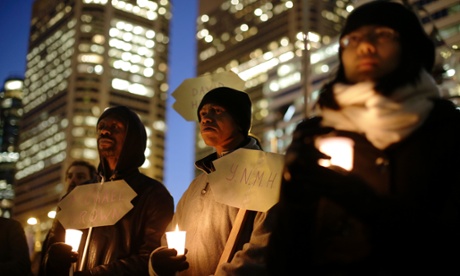
On a cold night each January, the Department of Housing and Urban Development (HUD) takes a count of the number of people who live on the street and in shelters. On the chosen night this year, 49,993 veterans were homeless. It’s a 33% drop since 2010.
But that’s not the whole story. The HUD’s statistic for several years did not include Bobby, a former paratrooper who joined the army out of high school in 2001 and retired on honorable discharge in 2006, after serving three tours and making, he says, numerous jumps in Iraq and Afghanistan.
Bobby doesn’t like to be pressed for details about the war. His voice turns gruff, and his speech slows down as he explains: “I don’t like to talk about that part. I’m done. I’ve been over there. I won’t go back. I won’t wish that on my worst enemy.”
After leaving the army, Bobby was homeless but slept on friends’ couches in Houston, Texas. He overstayed his welcome. Having suffered post-traumatic stress disorder (PTSD), severe back injuries as well as traumatic brain injury from his time in the war drove him to substance abuse.
“When you’re experimenting on drugs it’ll feel like la-la land,” says Bobby over the phone borrowed from a worker belonging to the National Veterans Foundation (NVF), a Los Angeles–based nonprofit. “You asked me to remember my age,” repeats Bobby, who will not share his last name. “I got a little TBI [traumatic brain injury] too. I remember some parts. I have blackouts sometimes. My speech is not that well.”
Bobby is one of the many who are chronically undercounted by the Department of Veterans Affairs’ (VA) renewed efforts to end veteran homelessness.
Shad Meshad, a retired army medical officer, is also the founder of the National Veterans Foundation. Meshad says that the VA’s estimate of homeless veterans may be a mere fraction of the actual numbers – he speculates that veteran homelessness may be five times the problem that the VA acknowledges.
Meshad’s teams go out scouting for homeless veterans in the Los Angeles area twice a week. “Being in this work for 43 years, I have a pretty good idea of where they would go.” He adds quietly: “ ... where I would go.”
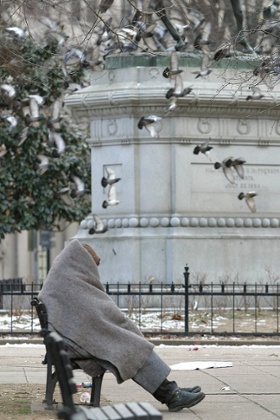
Veteran homelessness should end by 2015, according to a 2009 plan from the Obama administration. The fallout from VA’s recent healthcare scandals – culminating in the resignation of former secretary Eric Shinseki – was followed by the administration pumping in an additional $270m in October to anti-homelessness efforts.
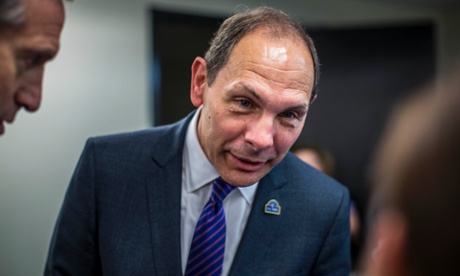
On Monday, the new VA chief, Robert McDonald, a veteran himself, announced that he will soon fire 40 high-ranking employees at the Department of Veterans Affairs. He promised that the number may climb to 1,000. This retribution for “the people who violated our values” is the VA’s biggest overhaul yet.
When the scandal broke in May this year, severe shortages were unearthed at VA hospitals, with many veterans dying while on the wait list.
As part of McDonald’s reconfiguration, plans are afoot to hire 28,000 new medical professionals, including 2,500 mental health experts to make up for the severe paucity of manpower in VA hospitals.
McDonald has been in the news ever since he took office, travelling around the country, dramatically offering his cellphone number to the public at a congressional hearing, offering high salaries and loan waivers to students at top medical schools to come help at the VA.
But these changes will take time, if they happen at all.
‘He said he became invisible’
“I would say yes, it is a lofty goal,” agrees Jason Hansman about the VA’s target of ending homelessness by 2015.
Hansman is the director of external program relations at the Iraq and Afghanistan Veterans of America, or IAVA. The VA has started new programs like cash assistance for housing to veterans under the Supportive Services for Veteran Families program. Hansman and IAVA are innovative and have gotten the VA finally thinking out of the box. But it may not be enough to solve the problem as soon as the VA hopes, given its scale, he says.
Hansman explains that there are thousands of resources offered by the departments of Defense and Veterans Affairs, but these are complicated and exist in silos, and vets are expected to navigate them on their own.
The bloated VA functions like a large fortress, Meshad says, and it can’t expect homeless veterans to come knocking on its doors. If the VA really wants to fix itself, it will have to aggressively go out and bring the homeless veterans in, says Meshad, pointing to his street teams.
Even before the overhaul was announced, Meshad demanded far more radical changes to the system than McDonald has planned. “It doesn’t work and it hasn’t worked for 50 or 60 years,” he says of the VA, agreeing with commentators who say the US’s second-largest bureaucracy needs to be scrapped. “They keep dumping hundreds of billions of dollars into it,” he says.
‘You’re ill-fed, ill-clothed, you smell like a dead bear’
Even if McDonald has claimed that the long waits at VA hospitals have reduced, they are still beyond the tolerance of most veterans.
Meshad says benefit applications take several months and are often denied, slowly cutting off any aid veterans can get, pushing them out of their homes and families to the perimeters of cities.
Bobby never gets through when he calls the VA. “In some places, they give you a recorded message. You tell them you want to commit suicide, they call 911” – this, despite the staggering statistic that 22 veterans take their own lives each day.
Instead Bobby prefers to call the NVF helpline. “I’m glad it’s toll-free. [You] call VA, [you] get through: recorded message. No one calls you back,” he says. Bobby is still waiting for the VA’s help, even after the NVF’s veterans service officer has connected him with for his benefits.
“They don’t care,” he says. “How long does it take to sign a piece of paper?”
Meshad likes to illustrate the problem of veteran homelessness with the story of a destitute soldier he worked with. “Every time he was begging or hustling for money, people ignored him and walked by,” Meshad says. “He said he became invisible.”
“You’re ill-fed, ill-clothed, you smell like a dead bear. You look raggedy, nobody wants to be around you,” the very system that should be helping vets return to their lives pushing them away. “You get more and more distanced from the society that you want to integrate back into.”
‘I need a cigarette, they buy me a cigarette’
Each war creates a different generation of difficulties for some veterans. The backlash against the Vietnam war had people confusing “the war with the warrior”. Iraq and Afghanistan vets came back to a terrible economy and the housing crisis, eventually losing their homes and families.
After being rejected from his friends’ couches, Bobby decamped to sunny California. “That’s how I ended up in Long Beach.” Bobby lived under a bridge in the Lincoln Park section of the sunny town, with a community of veterans. They received regular visits from men in white National Veterans Foundation vans who came by.
They offered food, socks and warm clothing, as well as small indulgences to make a hard life more bearable. “I need a cigarette, they buy me a cigarette,” Bobby recalls.
Life was tough, he explains. Long Beach brought in trucks to drive the settlement of homeless veterans off the streets and into shelters, Bobby says, but NVF’s workers kept returning looking to help.
“These guys were persistent, they kept coming around and giving everyone pamphlets. And I finally called them up. They helped me get my benefits from the VA.” The foundation also gives him therapy for his PTSD, he says.
Several veterans battle chronic pain as a consequence of their time at war.
“My back hurts. They gave me some pain medication. Just to kind of cope with it, till I get my benefits,” Bobby says.
The only other succor for his pain is marijuana. He says it calms him down and he eats more. “I would do that any day,” he says, imploring a reporter to try weed.
For now, Bobby makes a living from recycling plastic and fixing old computers. “When I work on my computer, that kind of helps me,” he says. “Repair work, I see things get done. That’s kind of like therapy too.”
Bobby refuses to regret working in the military. “I wanted to serve my country and do my part. I want to say I’m proud for what I did,” he says, only wishing for better circumstances: “I need a little bit more stability.”
Editor’s Note: we have asked Bobby for comment on the number of jumps he recalls in Iraq and Afghanistan, which some readers have contested.