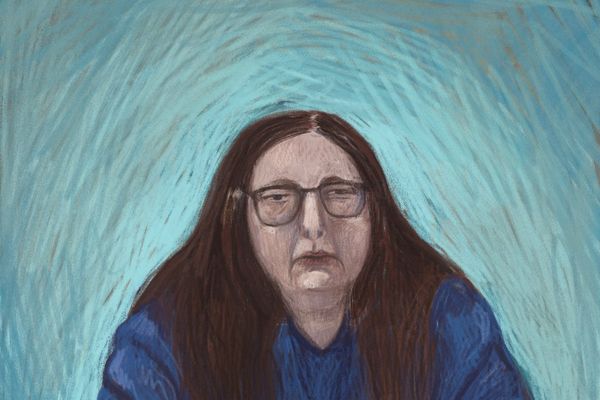
When Hannah Belanszky arrived at Midjuburi Youth Resource Centre in Marrickville in early 2023, she brought drama games and conversation starters, and a keen desire to know more about the young people – particularly at-risk teens – for whom it was a second home. Instead, the 28-year-old Yuwaalaraay playwright was plunged into a chaotic, boisterous environment, with loud music and “balls flying everywhere”.
“It’s really funny, because we had all these plans – and within minutes it was very clear that all that was going out the window.” Instead, she and the teens ate pizza and hung out and chatted.
It was a pivotal revelation about the young people she would meet and spend time with over the ensuing year she spent researching the experience of young people navigating the Australian justice system. “They just want to have fun. They want to hang out with their friends. They don’t want to talk about what they’ve been through. They have the same wants and needs and cares of any other young person.”
This became the foundation stone for Belanszky’s play Saplings, opening at Sydney Opera House this week ahead of a national tour. Commissioned by Australian Theatre for Young People (ATYP), where it premiered in 2024 and won the Sydney Theatre award for youth theatre, the play is a collage of brief scenes showing the different ways young people come into conflict with the law, become ensnared, and grapple with its systems. It draws on the real-life stories of people Belanszky and ATYP producer George Kemp met through workshops in youth centres and juvenile detention facilities in New South Wales, including Miyay Birray Youth Services in Moree and the controversial Reiby Youth Justice Centre in south-western Sydney.
A lot of the young people Belanszky met were Indigenous: about 60% of young people aged 10 to 17 in detention are First Nations – an increase on recent years – and First Nations youth are also far more likely to come into conflict with the law. “I think it’s important, just based on the statistics, that the play was written by a First Nations playwright,” she says. The production is helmed by the Kalkadoon actor and director Abbie-lee Lewis too.
“[It’s about] making sure that the stories are handled with care … and understanding about where these young people have come from, and the long history and context of their relationship with police and the law,” says Belanszky.
Over the play’s 80 minutes, we meet teen pals Kai and Jonty, who just want to make music together, but need money to buy an iPhone to record on; siblings Shanika and Isaiah, waiting nervously at the train station for their mum, who’s just out of prison; and Alinta and Sandon, trying to make head or tail of the Kafkaesque children’s court process as they wait for their five-minute hearing and wonder if their respective lawyers will bother turning up.
Then there’s Lachy, a hungry teen who has breached his house arrest and lifetime ban from Woolworths to buy a packet of Mi Goreng instant noodles for dinner, because his stepbrother ate the last food in the house.
Lachy’s story was inspired by something Belanszky heard from youth workers in Moree, “about a young boy who had a lifetime ban from Woolworths, and he really needed food, so he went into Woolworths with money and bought something – and then when he walked out, the cops were waiting to arrest him”.
Another story that stayed with her involved a young boy who was under house arrest while also having an AVO out against someone he was living with. “So 24 hours a day he had to be within the house, but he couldn’t be in the same room as [this person]. How does that even work? And why is that allowed?”
A lot of the time, the young people she met wouldn’t talk directly about what had happened to them. “I would often learn those contexts from the adults that were working with them, or the case workers,” Belanszky says. “And then through the young people themselves, I’d get an idea of who they are as people, what they want, what their life is like.”
Saplings honours both these perspectives. “Most of the young people I met were so nice, so polite, really funny, really curious,” Belanszky tells me. “[I wanted to] show their playfulness and their loyalty and love for each other.”
At Saplings’ opening night in 2024, boys from the Midjuburi youth centre came. “It was the most amazing thing seeing all these young boys in the front row,” says Belanszky. “And they were all like, ‘That’s just so relatable’.”
Cast member Danny Howard, a Barrd, Yamatji, Noongar, Bunuba and Ngadju man, has also taken the play back into the six youth justice centres in NSW this year, performing monologues and inviting the boys to get up and have a go themselves.
“Every workshop started the same way. Danny would invite the room to perform alongside him, and there’d be a beat of silence. Then one hand. Then another,” says Hayden Tonazzi, ATYP’s artistic director. “At one centre we had nearly 10 young people perform a scene, one after the other, some dragging their friends up with them.”
For Belanszky, this is the highest praise. “For my writing to speak to them is more of a compliment than anything. I feel like I’ve done my job.”
Saplings runs at Sydney Opera House from 13-17 May, ahead of a national tour