YORBA LINDA, Calif. _ When Tim De Mint started to have bouts of clumsiness as a teen, he knew something was wrong.
"I played football and I couldn't really catch the ball," De Mint, 33, an Esperanza High alumni, said.
It took four years and numerous doctors to diagnose De Mint's condition as ataxia, a rare genetic neurological disorder.
"The balance center is affected," said Dr. Susan Perlman, a clinical professor of neurology at UCLA.
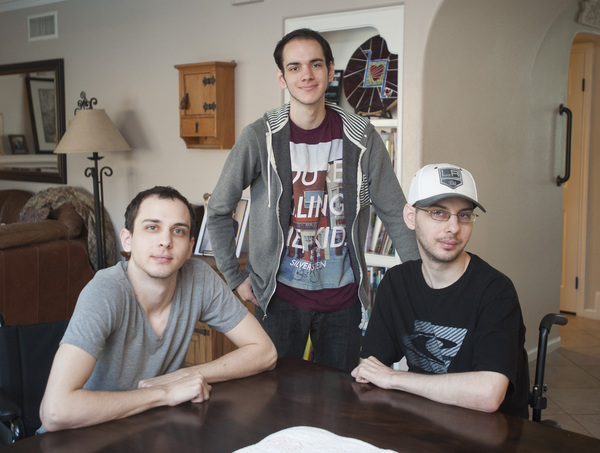
De Mint's younger brothers, Peter, 25, and J.T., 23, eventually developed the same debilitating condition.
"The sad thing for them is that they see where they are going to be in 10 years," said Cindy De Mint, who is now the full-time caregiver for her three sons. "They can see their older brother and see how they are going to progress."
The De Mint brothers' ataxia is caused by a genetic mutation that attacks the cerebellum and affects balance and coordination, including activities such as walking, speaking and swallowing. Cindy and Gerald De Mint learned they each carried the recessive gene that ended up affecting three of their four children.
"There would be nights I'd just sit in bed and cry just because you didn't know how to handle it," Gerald De Mint said. "You never really envision your kids not having a normal life, not being able to get married and have kids."
Perlman, who sees the DeMint brothers every six months, said the eldest's ataxia progressed very quickly. What started with balance issues and a debilitating tremor now requires the use of a wheelchair and help with eating, and his speech is slurred.
"It's hard as you start to lose different functions," Amanda Grace said about her brothers' struggle with ataxia. "My oldest brother can barely write his name. That's hard."
Growing up, the brothers played baseball, soccer and basketball. Now they spend most days at home playing video games, and Peter and J.T. DeMint have dabbled in online dating.
"The internet has basically become where I live," said J.T. De Mint said. He said he struggles with social anxiety as a result of his condition.
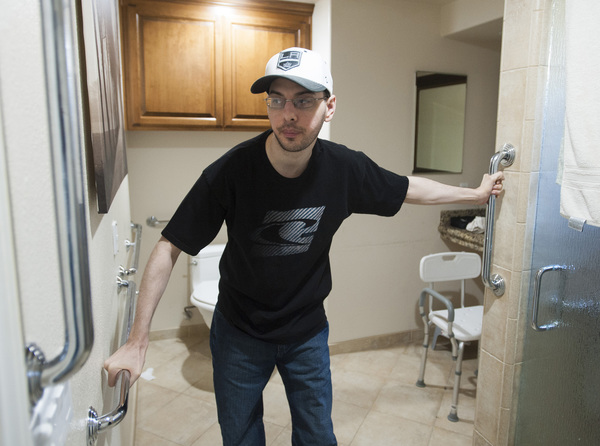
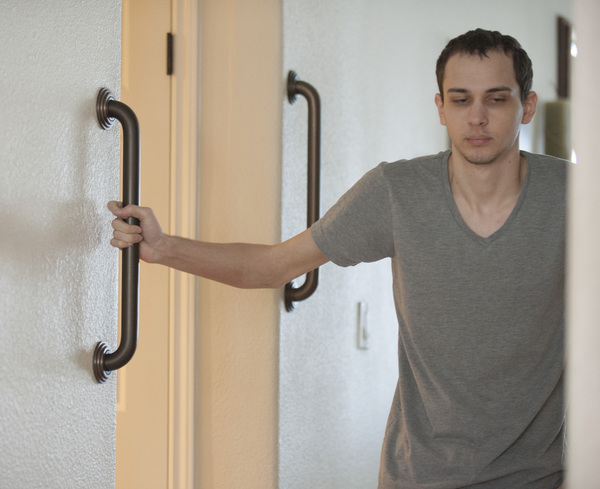
Peter and J.T. De Mint can get around at home holding on to furniture, but they use wheelchairs when they leave the house. Peter De Mint goes to the gym with a friend twice a week, and J.T. De Mint works out at home. Tim De Mint works out twice a week at the Goodwill Fitness Center in Santa Ana, Calif., to maintain his core strength.
"Anything that strengthens the core is helpful," Perlman said.
Though there is no cure for ataxia, research is offering hope for potential treatments, and the De Mint brothers are part of research at UCLA Medical Center.
"My laboratory is continuing to study this disease, and hopefully the work we are doing will help develop future treatments," said Dr. Brent Fogel, director of the neurogenetics clinic at UCLA, adding that ataxia affects about one in 5,000 people worldwide and genetic forms of the disorder affect about one in 10,000 people worldwide.
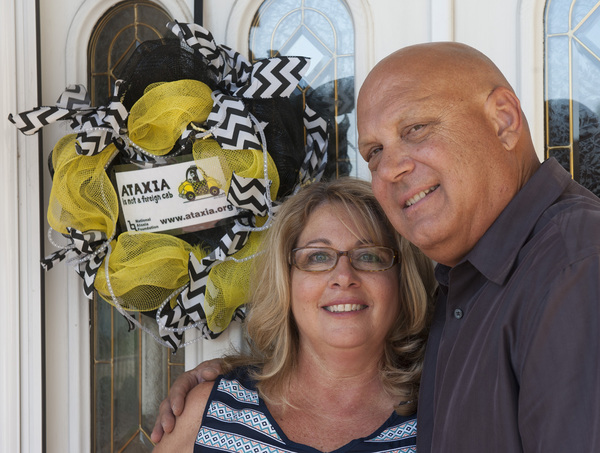
The De Mints are dedicated to raising funds and awareness through the annual Walk n' Roll for Ataxia event. This year's walk will take place Saturday at the East Lake Village Clubhouse in Yorba Linda.
Cindy De Mint leads the Orange County Ataxia Support Group affiliated with the National Ataxia Foundation. "Hopefully, with awareness then the money will come that we can use for research to find a cure."
In the meantime, Peter De Mint says: "Keep your head up. Keep going. Don't give up."