Afternoon summary
-
Labour has confirmed that it is also in favour of reform to the EU’s free movement of labour rules. Responding to reports, which David Cameron has not denied, that he intends to demand the power to stop some migrants from the EU from coming to the UK, David Hanson, the shadow immigration minister, cast doubt on whether Cameron could deliver this. But he did not criticise the proposal directly. He said:
Labour is in favour of reform to free movement rules. But why should anyone believe the prime minister’s briefings? This is a prime minister who has previously pledged “no ifs, no buts” he would get net migration down to the ‘tens of thousands’ and had no practical policies to deliver it. That target is now in tatters.
We will examine any real proposals the government comes forward with to manage immigration with interest.
We do need reforms to the free movement rules - which is why Labour has already put forward practical plans to stop people travelling to claim benefits, deport people who commit crimes, and stop employers undercutting local jobs and wages with cheap migrant labour. We want to see fair movement not free movement.
But instead of practical plans, David Cameron is briefing vague promises to stave off panic and revolt from his Eurosceptic backbenchers when instead real action is required.
-
Gordon Brown has renewed his attack on Conservative plans for “English votes for English laws”. In a speech in the Commons, he said that they were anti-Scottish and anti-British and that they were threatening a “constitutional crisis”.
That’s all from me for today.
Thanks for the comments.
Updated
Alistair Carmichael, the Scottish secretary, is responding to Gordon Brown. He starts by paying tribute to the role Brown played in the Better Together campaign.
Brown says the “English votes for English laws” proposal would also contradict what the Conservatives’ devolution commission report said about the need to retain one class of MP in the Commons.
He concludes backing Ed Miliband’s call for a constitutional convention.
There is a way forward that listens to more sensible voices, a way forward that starts with a balanced programme of devolution that maintains income tax as a shared tax, is built upon a sensible accommodation on exclusively English bills and is open not only to devolution within England, including more powerful cities and regions but also to a wider debate about what kind of constitution our country needs – quasi-federal or otherwise.
What Scotland has shown is that it is possible to engage the public in a debate about the distribution of power in their own country. So as the debate about English cities and regions and the future of the British constitution gathers pace, the constitutional convention Ed Miliband has proposed makes a great deal of sense.
Brown returns to his speech.
It would be strange indeed if this house, known as the mother of parliaments, a worldwide beacon for fairness and equality before the law, became the first law-making body in the world to decree two classes, a first and second class, of representation.
If this were only about the rights of MPs, it might remain an insider’s issue among the political elite.
But the designation of elected representatives as first and second class citizens is, in fact, not about the sensitivities of a cadre of politicians but about the status of each nation in what has hitherto been one United Kingdom. According a first-class status to England within Westminster but a second-class status to Scotland and, possibly to Wales and Northern Ireland, is bad enough. But the effect is that the government of the day would also become a servant of two masters, not sure whether its continuation depended from one day to the next on English votes or on the votes of the whole of the United Kingdom.
Dominic Raab, a Conservative, intervenes. What would Brown say to pensioners in Raab’s constituency who complain that the Barnett formula is unfair to them because it guarantees extra money for Scotland.
Brown says it was not him who guaranteed the Barnett formula during the referendum campaign. It was the prime minister, he says.
Brown says balancing the interests of the English against those of the other nations in the UK has always been an issue.
The English predominance is such that every generation has had to balance the power of the majority nation to impose its will with some protection for the interests of the minority nations.
America, Australia, Spain, Switzerland, Mexico, Brazil, Germany and many other countries have in their constitutions found ways of managing the gross inequalities in the size of their regions, provinces and nations. The provisions that they make for minority states or regions shows that a blanket, uniformity of provision – such as English votes for English laws mimicking Scottish votes for Scottish laws – does not ensure fairness of treatment.
In a previous debate I mentioned that in America, the state of Wyoming, with half a million people, has the same number of senators – two - as California, with 38 million people. In Australia, Tasmania, with 700,000 people, has the same senate representation – 12 – as New South Wales, with seven million people. It is as true of the Spanish senate, the Swiss council of states, the South African national council of provinces, and the Brazilian, Nigerian and Mexican senates. And in Germany, the state of North Rhine Westphalia has about 30 times the population of the state of Bremen but only double the number of Bundesrat seats.
Brown says there is a “constitutional crisis in the making” because of what David Cameron said after the referendum about English votes for English laws.
The proposal, in practice, turned out not to be any new English rights of representation, but a reduction in Scottish rights of representation in the House of Commons. This was clearly an issue material to the vote in the referendum and the failure to tell people beforehand of the proposed change in Scottish representation has fuelled the demonstrations, petitions and allegations of betrayal, bad faith and breach of promise that have dominated much of Scottish political debate over the past month.
But the Conservative plans for the constitution did not end there. When combined with their proposals to devolve all income tax to the Scottish Parliament, Scottish MPs would be removed not just from ordinary lawmaking on English matters but from the most decisive votes a parliament can make - votes on income tax rates and thus on passing the budget ...
This proposal to devolve 100 per cent of income tax and then exclude Scottish MPs from voting on income tax at Westminster is anti-Scottish because by excluding Scots from voting on key matters it makes them second class citizens in the house. But it is also anti-British, because by abandoning income tax as a shared tax it threatens to end the pooling and sharing of risks and resources that underpins the unity of the UK. And it looks like the Trojan horse for fiscal autonomy, which would split the union and enable the SNP to get through the back door what they cannot get through the front door.
Brown says his fourth-demand would be for a wider public debate on further changes to the constitution.
And, fifth, the parties should focus not just on the powers Scotland gets, but on what it does with those powers to create jobs, preserve the NHS and fight poverty.
Brown says all parties should also agree that the status of Scotland, Wales and Northern Ireland in the Commons will not be downgraded.
I have always said we should be prepared to consider a change in committee procedures on English-only bills under which English MPs form the committee that debates them.
But we should insist that when any bill comes to the floor of this house in report stage or on second and third reading that the whole house and nothing but the whole house votes.
Brown says he is also making suggestions on tax.
There is general agreement that we should first devolve a wider power to set an income tax rate in Scotland and second, a power to set rates of tax at the top, too.
I suggest, however, that we reject 100 per cent devolution of income tax and I will explain why. We should instead agree to retain income tax as a shared tax, with 75 per cent of it being devolved to the Scottish Parliament alongside devolving 50 per cent of VAT revenues. This will ensure that the test of accountability is met, with the Scottish parliament responsible for raising at least 54 per cent of its spending in 2016, the year of implementation.
Brown says, in an attempt to be constructive, he is putting forward five proposals to avoid “a constitutional impasse”.
First, I believe we can all agree 16 new powers for the Scottish parliament, from the devolution of attendance allowance and housing benefit to the conduct of elections.
There are areas where we are asking the Conservatives to accept Labour and Liberal Democrat proposals: including the entrenchment of the Scottish Parliament in our constitution and new powers over the work programme, the Crown Estates, the rail franchise, borrowing for infrastructure and the executive authority for UK employment, health and safety and equalities laws.
There are also areas where we are asking Labour and the Liberal Democrats to accept the Conservative proposals for a fiscal commission and for an annual statement for taxpayers of how Scottish parliament money is spent and where. Given what has been said by each party since their submissions, there is scope for agreement on all of these new powers and I hope the secretary of state can agree.
Gordon Brown's speech
Gordon Brown is speaking now.
He is presenting a petition signed by 120,000 people in Scotland demanding that the “vow” made by the three main UK party leaders before the referendum is kept.
He says this is even more important because the government is proposing a reduction in the rights of Scottish representation at Westminster.
Gordon Brown's adjournment debate on Scotland
Gordon Brown’s adjournment debate on Scotland will start in about five minutes.
It will just be a half-hour debate.
Here is a summary of what Brown said when he spoke on this issue in the debate on Tuesday.
Saira Grant from the Joint Council for the Welfare of Immigrants has strongly criticised David Cameron following the reports (which Cameron has not denied) that he is going to demand the right to block some migrants from the EU coming to the UK. She told BBC News:
Instead of challenging Ukip, he’s adopting their policies. As a result, he’s going to legitimise what Ukip feel, and therefore Ukip will be a larger threat to the Conservatives and to any mainstream party. It is quite disgraceful that this is what the prime minister has chosen to do.
Here’s a short afternoon reading list.
-
James Kirkup at the Telegraph says David Cameron’s decision to harden his line on Europe won’t work.
By that, I don’t mean that the policy won’t work. If you ask European diplomats, they’ll tell you it is pretty unlikely that the rest of the EU will bend so far as to compromise freedom of movement just to accommodate Britain and Mr Cameron’s domestic political needs, but they always say that: it is just possible that he’ll get some sort of concession out the hardball approach. Nor do I mean that winning limits on freedom of movement rules could have some unforeseen consequences for hundreds of thousands of British expats in Spain and France, though it’s a second-order consequence well worth pondering.
What I mean is, the politics won’t work. The sort of people who are moving to Ukip over immigration/Europe are doing so because they feel that things happen in this country despite their wishes and despite the promises of politicians to stop those things happening. They feel powerless over their own country’s destiny, and they feel that politicians either cannot or will not exercise power on their behalf.
Here’s the Guardian’s Politics Weekly podcast.
It features Rafael Behr, Polly Toynbee, Toby Helm and Tom Clark talking about Lord Freud, leaders’ debates and devolution.
All four policies polled were popular, but the one with the highest approval rating was increasing the basic rate personal allowance.
Here are the figures.
Increasing the personal allowance to £12,500 (Lib Dems and Conservatives)
Support: 85%
Oppose: 9%
Net approval: 76%
Increasing the 40% tax threshold to £50,000 (Conservatives)
Support: 64%
Oppose: 22%
Net approval: 42%
Mansion tax on homes worth more than £2m (Lib Dems and Labour)
Support: 63%
Oppose: 26%
Net approval: 37%
Increasing the top rate of tax to 50% (Labour)
Support: 61%
Oppose: 30%
Net approval: 31%
It should be noted that in some respects an exact comparison is unfair. The first two measures are tax cuts. The last two are tax rises.
Ipsos MORI also found that all four policies became less popular when respondents were told about the party or parties supporting them.
Glenis Willmott, the leader of Labour’s MEP, has issued this statement about the collapse of Ukip’s EFDD group in the European parliament.
While a massive blow to Nigel Farage, this news makes little difference for Britain. Ukip’s group may have given Nigel Farage a front-seat soapbox from which he could preen for the cameras, but it has never helped advance British interests. The EFDD comprised people with extreme views - and to resurrect his group, Mr Farage will probably have to turn to even more racist, homophobic and anti-Semitic allies.
The Local Government Association has said that it is “disappointing” that Labour’s plan to encourage house building do not include removing the cap on what local authorities can borrow to fund building. This is from Peter Box, a Labour councillor who chairs the LGA’s environment, economy, housing and transport board.
We are pleased the Lyons Review recognises the central role councils need to be given in ending the housing crisis, but it is disappointing it has not recommended removing the housing borrowing cap, which is the single biggest obstacle to delivering the thousands of homes the country desperately needs.
The housing borrowing cap is fundamentally flawed and places unnecessary restrictions on the amount of money councils can invest in housing. Until this is removed councils will continue to be hampered in our efforts to provide the homes residents need.
It is positive that the Lyons review has also recognised the importance of giving councils a lead role in speeding up building and making sure increased land values benefit communities through investment in schools and roads. We are pleased the review has listened to our calls and proposed reforms to Right To Buy.
The LGA has set out plans which, if adopted by the next government, would see half a million extra new homes built over the next parliament, transforming the lives of hundreds of thousands of families. But to do this, we need an immediate removal of the housing borrowing cap, as well as changes to Right To Buy, the creation of council-led local land trusts and a meaningful incentives scheme to encourage developers to speed up building.
Lunchtime summary
- David Cameron has given his strongest hint yet that he would back Britain leaving the EU if he doesn’t get what he wants in his renegotiation by saying he will have ‘one last go” at getting a satisfactory deal. He was speaking in Rochester, where the Conservatives face the prospect of losing a byelection to Ukip next month. He refused to deny reports that, as part of his renegotiation, he will demand the power to stop some migrants coming to the UK from countries already in the EU.
- One of the two Conservative candidates hoping to stand in the Rochester and Strood byelection says she supports a points-based system of EU immigration that would exclude unskilled workers like “a fruit picker in Romania”. As Rowena Mason reports, Anna Firth, a Tory councillor in nearby Sevenoaks, Kent, told a hustings on Wednesday night that Britain was a small island and needed a “sensible immigration system” modelled on the Australian-style system proposed by Ukip, which would only allow in people with a certain level of skills.
-
Theresa May, the home secretary, has defended the bulk collection of communications data (metadata) by GCHQ. Giving evidence to the intelligence and security committee said said:
The description of the haystack is a good one, because if you’re searching for the needle in the haystack you have to have the haystack in the first place in order to look for that needle ...
It’s hugely important, this ability to have a large amount of communications data. We can not emphasise enough that the collection of bulk data is not mass surveillance. Precisely because what happens is this targeted process, which means this is not about just some sort of mass look at everybody’s data. Most of the data will not be looked at all, will not be touched.
-
Clegg has described Lord Freud’s claim that some disabled people are not worth the minimum wage as “deeply distressing and offensive to people”. In an attempt to maintain pressure on Freud, who apologised yesterday but retained his post as welfare minister, Rachel Reeves, the shadow work and pensions secretary, wrote to Cameron asking for the publication of government papers relating to disabled workers’ right to the minimum wage. In a letter she said:
If you cannot agree to this people will only conclude that your government has something to hide, that you cannot publicly defend your position in relation to disabled people’s entitlement to the minimum wage, and your inaction will haunt you.
But Jackie Doyle-Price, the Conservative MP for Thurrock, gave a partial defence of Freud on Twitter.
Anyone who denies that the minimum wage is a barrier to employment for the less able is living in cloud cuckoo land.
— Jackie Doyle-Price (@JackieDP) October 16, 2014
- The political group set up by Ukip in the European parliament has been dissolved after the departure of a member. As the Press Association reports, the move will be a blow to Ukip as group status guarantees extra funds, seats on committees and more speaking time for its 24 MEPs. European parliament rules require groups to have at least 25 MEPs from at least seven of the EU’s 28 member states. Until today, the Europe of Freedom and Direct Democracy group qualified with 48 MEPs from seven countries. Latvian MEP Iveta Grigule was the grouping’s only Latvian MEP and her decision to quit the EFDD brought the number of nationalities represented down to six.
-
Housing experts have welcomed the publication of Labour plans to encourage house building and to give councils the right to prioritise homes for local first-time buyers. Jan Crosby, UK head of housing at KPMG, said:
The Lyons review is the first political review that actually looks at comprehensive policies rather than piecemeal sound bites. Better connecting infrastructure and housing is key and can help to get buy in from local communities for new developments.
And Liz Peace, chief executive of the British Property Federation, said:
We were told that the Lyons Review would be meaty, and it has certainly proved to be so. The sensible review is extremely comprehensive and pinpoints exactly where problems in the planning system are and comes up with thoughtful solutions. While some proposals, for example those surrounding ‘use it or lose it’, may be difficult to implement, on the whole the review shows a clear understanding of the major problems of the planning system, and how these impact on development in the UK.
I’ve taken the quotes from this Inside Housing blog, which has a good round-up of industry reaction.
- HM Revenue and Customs has said the gap between the amount of tax collected and the sum owed has grown to £34bn. As the Press Association reports, some 6.8% of tax that was due was not collected in 2012/13, compared to 6.6% in 2011/12, resulting in an increase of £1bn in the gap. Ministers insisted that the gap was lower now than under Labour but the opposition seized on the figure to claim the government was failing to tackle tax avoidance and evasion.
-
Douglas Alexander, the shadow foreign secretary, has accused the government of being “somewhat complacent” about the military campaign in Iraq after Islamic State (Isis) forces attacked within 15 miles of Baghdad’s international airport. Speaking in the Commons he said:
What did feature was the foreign secretary’s assessment the coalition air campaign has stabilised the strategic picture. I have to say, this seems to be a somewhat complacent assessment, given the air strikes initiated in recent weeks have so far failed to prevent Isil from conquering almost all of Anbar province, coming close to overrunning the Syrian town of Kobani. Indeed, it is reported Isil also drew to within 15 miles of Baghdad’s international airport only last weekend.
The backdrop to the authorisation granted by this parliament for UK air strikes in Iraq was the expectation that the Iraqi military and the Kurds would provide resistance on the ground, while the US have directed significant resources to supporting he Free Syrian Army within Syria - yet only one of these forces, the Kurdish Peshmerga, have so far resisted Isil effectively.
Philip Hammond, the foreign secretary, told MPs: “There will be tactical ebb and flow but the coalition air campaign has stabilised the strategic picture and the assessment of our experts is Baghdad is not at immediate danger.”
Here’s the full quote David Cameron gave in Rochester this morning when he was talking about taking further action to restrict migration from the EU.
That full Cameron quote on immigration. Does he mean an emergency brake? An Australian points system? Something else? pic.twitter.com/4YhViGeuvl
— Laura Pitel (@laurapitel) October 16, 2014
And here is some more reaction to the reports that the Conservatives are planning to demand the right to impose controls on EU migrants coming to the UK.
From Matthew Elliott, chief executive of Business for Britain, a Eurosceptic group campaigning for EU reform
The PM has to secure changes to freedom of movement as he knows otherwise the public will simply vote ‘Out’ come what may in an EU referendum.
From Mats Persson, director of the Open Europe thinktank
David Cameron needs to be careful not to talk up what he can achieve on EU migration in Europe, not least since Ukip can always move the goalposts.
An emergency brake on numbers will be very hard and risky but may just be possible to achieve if that’s the only thing Cameron goes for, given that there are precedents for other areas in the EU treaties.
A points-based system would be an extremely difficult task, involving fundamentally rewriting the EU treaties. Cameron should also point out that EU free movement does come with benefits.
Here’s Steven Woolfe, Ukip’s migration spokesman, commenting on the reports (see 8.59am and 1.13pm) that David Cameron is going to demand the right to impose controls on EU migrants coming to the UK.
This is hot air from a cold, hard, calculating politician whose interests are saving his own skin and not the jobs of the British people. The prime minister is running scared of Ukip and the voters who have called for total control of our borders from Europe. With this latest PR trick he is seeking to pull the wool over our eyes for he knows in advance that the EU will never restrict free movement of European migrants.
In today’s YouGov poll, Ukip is up to 19%, its highest level in a YouGov poll. Labour is on 33%, the Conservatives 31% and the Lib Dems 7%.
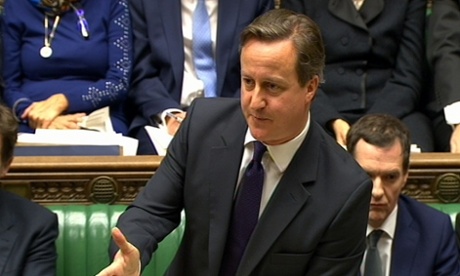
Cameron says he will have 'one last go' at negotiating a better deal for UK in EU
We should have one last go at negotiating a better deal.
It’s a telling phrase that justifies the old journalistic cliche about this being his “clearest sign yet” that he would be willing to back an out vote in an in/out referendum if he failed to get the deal he wanted by 2017.
Cameron also declined to knock down the reports that he will be demanding the right to impose border controls on migrants from countries already in the EU. (See 8.59am.) Speaking in Rochester, where he has been on a campaign visit, he said:
We need further action to make sure we have more effective control of migration. ... I think we need to be clear that the immigration system hasn’t been working properly. Greater control is required, but fairness should be at the heart of it.
People recognise that Britain is an open, tolerant country, but immigration in recent years has been too high.
Updated
The Labour party’s Lyons review into housing, which was previewed in the Guardian this morning, has now been published.
The Lyons Housing Report is the most radical and comprehensive plan to tackle the #HousingCrisis in a generation http://t.co/Ebtdm1NRGq …
— Labour Housing (@labour4housing) October 16, 2014
It is 180-pages long.
Ashcroft marginal seats poll finds Labour on course to be largest party
Lord Ashcroft has published some fresh polling today from 11 marginal constituencies. They are all Conservative seats, with Labour in second place. The results suggest that Labour is on course to become the largest party at polling day.
But the figures do not necessarily point to Ed Miliband gaining a majority.
Here’s an extract from Lord Ashcroft’s commentary.
Where does this leave our wider analysis of the general election battleground? Let us return to the equation I explained in my presentation at the Conservative conference last month.
The calculation revolves around the Magic Number, which is the difference between the number of Conservative seats in the House of Commons and the number of Labour seats. Today, the Tories have 303 Members of Parliament, and Labour have 257: the Magic Number is 46. (This could of course change again after next month’s by-election in Rochester & Strood, and again after any further by-elections or defections).
It follows that the Magic Number is also the combined number of net Conservative losses and net Labour gains required for the two parties to have the same number of seats after the election. If this total is less than 46, the Tories remain the largest party. If it is more than 46, Labour become the largest party.
My research so far shows no net advantage to the Conservatives on the Lib Dem battleground: we have identified eight Lib Dem seats in which the Tories are currently ahead, but another eight in which on current polling the Lib Dems would lose to Labour. To make matters worse for the Tories, my research also puts UKIP ahead in two of their seats, in addition to the one already lost in Clacton.
If that situation persists, the Conservatives can afford to lose no more than 21 seats to Labour at the general election if they are to remain the largest party. Unfortunately for them, we have already identified 29 seats currently held by the Conservatives that would fall to Labour if my poll results were repeated at an election.
In other words, Labour would become the largest party if results in the seats I have already polled turned into results on election day – and there could well be more to come.
Ashcroft found an average swing of 5% from the Conservatives to Labour in the 11 constituencies he surveyed.
It is worth reading his poll (pdf) alongside this analysis of Labour battleground seats (pdf) that Lewis Baston produced for Progress earlier this year. Baston said Labour had to win 27 seats to become the largest party, and 67 seats to have an overall majority.
The 27th seat on Baston’s list is Brentford and Isleworth. That was one of the seats Ashcroft polled, and he found Labour on course to win there with a 13-point lead.
Of the 11 seats, Ashcroft found the Tories ahead in just one, Gloucester. That is 38th on Baston’s list of Labour targets.
Ukip's EFDD group in the European parliament has broken up
The Europe of Freedom and Direct Democracy (EFDD) group in the European parliament, set up by Ukip and other Eurosceptics parties after the European elections, has collapsed.
This is from Jaume Duch, the European parliament’s spokesman.
Latvian MEP Iveta Grigule left #EFDD group today. #EFDD no longer has members from at least 7 countries, so declared dissolved today. #EP
— Jaume Duch (@jduch) October 16, 2014
The news has also made Le Figaro.
Le groupe europhobe Europe de la Liberté et de la Démocratie directe formé au Parlement européen et dirigé par le Britannique Nigel Farage a été dissous après la défection de son élue lettone Iveta Grigule, a annoncé le Parlement européen.
Theresa May's evidence to the intelligence and security committee - Summary
Here are some of the key points from the hearing.
(Because I missed quite a lot of it when the video feed went down, this is not a very comprehensive summary. I’ll post more later.)
- May said that government would soon issue a code of practice intended to limit the extent to which the police use the Regulation of Investigatory Powers Act (Ripa) to identify journalits’ sources.
- She defended the bulk collection of metadata by GCHQ. “We have to have a haystack to be able to find the needle we need,” she said.
- She said the bulk collection of metadata was “not in itself an invasion of privacy.”
-
She said that she only turned down a “very, very small” number of requests for surveillance warrants from the intelligence services.
The Daily Mirror’s Jack Blanchard is not impressed by what he heard during the hearing.
Not entirely sure either the Home Secretary or the members of the ISC really understand very much about the Internet. Which is worrying
— Jack Blanchard (@Jack_Blanchard_) October 16, 2014
Listening to these very important politicians talk incoherently about "the cloud" is like listening to my Dad talking about "the interweb"
— Jack Blanchard (@Jack_Blanchard_) October 16, 2014
Labour’s Fiona MacTaggart goes next.
Q: Do you feel informed about what the intelligence agencies are doing?
Yes, says May.
Q: If people do not understand the surveillance commissioner process, how are the agencies accountable?
That is why she is trying to publicise the system a bit more, says May.
Q: And is it always right for ministers not to comment on intelligence issues?
May says there are times when it is right for ministers not to comment on these matters.
And that’s it. The hearing is over.
I will post a summary shortly.
George Howarth takes over again.
Q: Nick Clegg and Yvette Cooper both said the two intelligence commissioners should be replaced by a single figure. Do you agree?
May says the government will consider this.
But she defends the existing arrangements, saying the intelligence commissioners produce valuable report. It is a shame more people don’t read them, she says.
Labour’s Hazel Blears goes next.
Q: But it is judges who authorise search warrants. What’s the difference?
May says, when a police search takes place, it is public. Surveillance intrusion is a different kind of intrusion.
Labour’s George Howarth goes next.
Q: You have already said you think it should be ministers who authorise warrants. Some people say these decisions should be taken by judges, or by a technical panel. Why do you think ministers should take on this task?
May say she feels strongly about this. When you are authorising someone to look at a person’s communication, or to intrude on their privacy in another way, it should be someone who is democratically accountable, she says.
It should also be a person able to look at the wider context, not just someone looking at the technical aspects.
May says she would like the public to understand this process a bit more.
They should be able to look at a minister and say, ‘That is someone who can be got rid of’. That is not the case with a judge.
Sir Menzies Campbell goes next.
Q: Do you see a distinction between post and emails?
May says she would see a communication as a communication. She is not sure she would make a distinction.
Q: There is a difference in terms of volume. Therefore there is an argument that internet communications requires a different approach.
May says she would not accept that.
A communication is a communication, she says.
The fact that more people might use email does not mean that you should not be able to access it under the same strict conditions you can access other communications.
Q: The internet is there as a permanent record.
May says some letters are permanent too.
Michael Ancram (Lord Lothian) goes next.
Q: Isn’t the “cloud” based in the US?
Not all of it, says May.
The idea of the “cloud” being one thing in one place is not correct.
If someone sends a communication via the cloud to someone in the UK, that will count as an internal communication, if it is from someone in London to someone in Birmingham, for example, May says.
Lord Butler, the former cabinet secretary, is asking questions now.
Q: Do you accept that human rights apply to foreigners, not just people in the UK?
Of course, says May.
Q: If a communication is sent from someone in the UK, to someone in the UK, the fact that it might be routed through somewhere else in the world does not mean that it counts as an external communication in terms of the surveillance rules.
May says that is right.
Mark Field, a Conservative, goes next.
Q: Can we arbitrage? Do we go abroad to take advantage of laxer surveillance regimes?
Absolutely not, says May. She says she absolutely rejects that idea.
Sir Menzies Campbell is asking questions now.
Q: Am I right in thinking you see a difference between investigations in the UK and investigations abroad, in terms of the surveillance regime?
May says they do allow for a different approach.
Q: If there is an investigation in the UK, there is likely to be knowledge of the individuals. But if there is intelligence about an attack from abroad, it might not be possible to target people so precisely. So wouldn’t the intelligence agencies need to trawl more widely?
May says she would not use the term “trawling”. But the operations might be different, she concedes.
I’m sorry what we’ve missed. I’ll catch up later. But I’m in the committee now, and online.
Q: Should looking at data require the same level of authorisation as looking at content?
No, says May. They are different. Looking at content is more intrusive.
It is necessary to upgrade the ability to look at data, he says.
But we have not reached the point where you can say data is the same as content.
My colleague Alan Travis has been tweeting from the hearing.
Theresa May says that she has to spend a 'significant' part of her day signing intercept and surveillance warrants
— Alan Travis (@alantravis40) October 16, 2014
Theresa May defends bulk collection of everyone's personal data by GCHQ: "We have to have a haystack to be able to find the needle we need."
— Alan Travis (@alantravis40) October 16, 2014
Theresa May strongly resisting pressure from ISC to release stats showing how often bulk data mining leads to target being identified
— Alan Travis (@alantravis40) October 16, 2014
And the Mirror’s Jack Blanchard has more.
Theresa May: "This country is not subject to mass surveillance. There is a lot written about this that is not accurate."
— Jack Blanchard (@Jack_Blanchard_) October 16, 2014
Theresa May is asked how many requests for surveillance from security services she actually turns down. "The number is very very small."
— Jack Blanchard (@Jack_Blanchard_) October 16, 2014
Theresa May: We will issue a new code of practice to police re. spying on journalists' sources
— Jack Blanchard (@Jack_Blanchard_) October 16, 2014
Theresa May: "Collecting bulk data is not in itself an invasion of privacy."
— Jack Blanchard (@Jack_Blanchard_) October 16, 2014
May says bulk data collection an "important part" of fighting terror. But refuses point blank to give stats on no. of cases solved this way
— Jack Blanchard (@Jack_Blanchard_) October 16, 2014
The video feed, which is normally reliable, is completely up the spout. I will try to get into the hearing with a laptop.
I’m watching the hearing on the parliamentary website, but we’re having problems with the video feed.
May says she does question surveillance warrants.
She gives a “significant” amount of time each day to these matters, she says.
Hazel Blears go next.
Q: What would you say to people who say we are constantly under surveillance?
May says that is not right. Things are being said that are not accurate.
The hearing is starting now.
Sir Malcolm Rifkind, the chairman, says this is the committee’s seventh public hearing.
It will take evidence from May for an hour in public. Later it will take evidence from her in private.
Q: In your submission to us you say the government has a duty to protect the right to privacy, but also the right to life. Are they in any order?
Theresa May says she would not want to prioritise. At any one time, there might be different priorities.
The right to privacy and the right to free expression are not absolutes, she says.
Theresa May giving evidence to intelligence and security committee
Theresa May, the home secretary, is about to start giving evidence to the intelligence and security committee.
The committee is holding an inquiry into privacy and security, largely prompted by the Edward Snowden revelations about internet surveillance published by the Guardian, and it has been taken evidence in public this week.
According to the committee (pdf), these are some of the issues it wants to explore.
- expectations of privacy, and the extent to which it may be appropriate to intrude into an individual’s privacy in order to protect the rights and safety of others;
- whether it is acceptable to use intrusive capabilities in a targeted way against known threats, and whether it is ever acceptable to use such capabilities to gather information in larger quantities;
- whether the current statutory framework governing and regulating the Agencies’ intrusive activities delivers those principles; and,
-
whether there is scope for greater transparency in this area.
And here is Alan Travis’s story about yesterday’s hearing, which saw Nick Clegg and Yvette Cooper, the shadow home secretary, give evidence. Here is how it starts.
Legislation is to be introduced shortly setting up a privacy and civil liberties board within government to counterbalance the strong security interests in Whitehall, the deputy prime minister has said.
Nick Clegg said the details of the civil liberties board were being worked on but it would be modelled on its equivalent American body, which scrutinises policy initiatives at an early stage for their potential impact on privacy and civil liberties.
The Liberal Democrat leader announced the new body would be up and running before the election during his evidence to parliament’s intelligence and security committee’s inquiry into the future of security and privacy legislation. The inquiry follows the Edward Snowden disclosures on the scale of mass harvesting of personal internet and phone data.
Nick Clegg's LBC phone-in - Summary
Here are the key points from Nick Clegg’s phone-in.
-
Clegg said that Lord Freud’s comment about some disabled people not being “worth” the minimum wage was “deeply distressing and offensive” to people.
I think what was so offensive to people about the remarks recorded at the Conservative party conference that Lord Freud made was when he used this word ‘worth’ and he said some people with disabilities weren’t worth the minimum wage. I think that is what has, quite rightly, touched a raw nerve because it’s making a comment about someone’s individual value. I think that was just so offensive to people.
-
He said the Conservative party was in danger of becoming “interchangeable” with Ukip. Trying to match their policies was a “disastrous” policy, he said. He made the point when asked about today’s report saying David Cameron is planning to demand the right to block EU migrants from coming to the UK. Clegg said he did not know about this proposal, because it had not been raised in government. He went on:
The Conservatives have got to ask themselves a really fundamental question: are they going to constantly run after Ukip, which I don’t think is going to impress anybody. It only has one destination, by the way, they become interchangeable with Ukip, which is what Boris Johnson seemed to imply last week [in his Marr interview]. Why doesn’t the Conservative party leadership just come clean and say what they really want is to leave the European Union altogether ... This constant shilly-shallying, where every week they edge a little bit closer to Ukip, I think is a disastrous political strategy.
- He suggested that the former Sheffield United footballer Ched Evans should not be allowed to return to the game after finishing his jail sentence for rape. Clegg says it was up to the club to decide whether to take him back. But the club should remember that footballers now are “public figures”. What Evans did could not be wished away, Clegg said.
-
He accused the Conservatives of trying to find excuses to stop the proposed televised election leaders’ debates going ahead.
Crime figures are released - Rape offences recorded by police up 29%
The crime figures are out.
Overall, crime is down according to the crime survey (which measures people’s experience of crime), but the overall figures for crimes recorded by the police are unchanged.
And recorded crime figures for some offences have risen sharply.
This is from the Press Association.
Rape in England and Wales has surged to a record level, according to police figures.
The number of rapes recorded by the police increased 29% to 22,116 incidents in the year to June, the highest level recorded, the Office for National Statistics (ONS).
Statisticians said the rise was driven by an increase in the willingness to come forward and report the offences - dubbed the “Yewtree effect” after the Scotland Yard investigation into Jimmy Savile and others - as well as an improvement in police recording practices.
Knifepoint rape surged 48% in the same period, up 48% to 294 from 199 the previous year, while knifepoint sexual assaults were up 22% to 111 from 91.
Hate crime showed an increase of 5% to 44,480 incidents in the period, up from 42,236 the previous year.
Within the figures, race hate crimes were up 84% to 37,484 incidents and religious hate crimes were up 5% to 2,273 offences, which statisticians said was driven by higher levels of hate crime in the wake of the murder of soldier Lee Rigby.
There was a total of 7.1 million incidents of crime against households and adults in England and Wales in the year to 2014, a 16% decrease from 8.4 million incidents in the previous year, the ONS said.
Here is the ONS news release. And here is the statistical bulletin with full details (pdf).
Q: I’ve heard you have not quit smoking. Do you smoke in parks?
Clegg says he does not smoke in parks. But he agrees with Boris Johnson that the proposal to ban it in London parks is a bad idea.
If people want to ban smoking altogether, they should say so.
Q: How much do you smoke?
Very little, says Clegg. But he won’t give an exact answer.
And that’s it.
I’ll post a summary soon.
Q: Will you support Theresa May in her plans to impose a limit on the amount of time people can be kept on police bail?
Yes, says Clegg. He has called for this in the past.
Q: If Anne Robinson can have 15 contestants on the Weakest Link, why can’t the broadcasters have all the parties in their proposes TV leaders’ debates?
Clegg says he enjoyed the debates last time.
Q: Would you agree to the 2/3/4 formula proposed (with Clegg excluded from the first one)?
Clegg says he does not think it is right for half of the government to be excluded.
But he does not want this “argy-bargy” to be used as an alibi by one of the larger parties for the debates not to happen.
(He’s implying the Conservatives are trying to block it.)
Q: Paddy Ashdown says Cameron is trying to bring in the Greens to mess them up?
Clegg says the Conservatives are clearly trying to do this. They have already come up with an array of excuses. But they should not be allowed to do that, he says.
Q: Why are so many childminders leaving the profession? There is a ridiculous amount of paperwork now.
Clegg invites the caller to give him more details about the extra paperwork she is talking about.
Q: What should be done about the people issuing death threats on Twitter to Judy Finnigan’s daughter Chloe in relation to Finnigan’s comments about the Evans case?
Clegg says this is just awful. There are already laws that allow these people to prosecuted, he says.
Clegg says that is for the football club to decide.
But the club should remember that footballers these days are major public figures and role models.
Q: If the club takes him back, would you shake his hand if you were doing a photocall there? (Clegg is a Sheffield MP.)
Clegg says he won’t play that game.
Rape is an incredibly serious offence.
Evans has done his time. But the owners cannot just wish away the fact that happened.
It is not right for politicians to tell clubs what they should do.
But players are public figures. You cannot ignore that
Q: Will you support the prime minister when he makes immigration a red line in his talks with Europe?
Clegg says the Tories are in a “blind panic”. These ideas (ie, the proposals in the Times today - see 8.59am) have not been floated in government, he says.
He says the Lib Dems actually won when they went head to head with Ukip in Eastleigh.
If the Conservatives run after Ukip, the two parties will become “interchangeable”. That is what Boris Johnson seemed to be implying at the weekend.
This “constant shilly-shallying”, where the Tories become closer to Ukip every day, will be disastrous for them, he says.
Q: Is there anything you can learn from Ukip?
Clegg says Ukip has one MP. The Lib Dems have 55.
Nigel Farage is tapping into widespread cynicism about politics, Clegg says. But he says he does not agree with Ukip’s solutions. They also change their mind frequently. They do not really provide answers.
If Ukip came into power, it would be an absolute disaster for this country.
And some Ukip supporters know this, Clegg says.
Q: If Ebola is so dangerous, shouldn’t we stop planes coming to the UK?
Clegg says the government acts on medical advice. There is screening for some passengers. There are no direct flights from west Africa. But it would not be practical to stop all flights to the UK.
The advice is that the risk to the public in this country remains low, he says.
Q: Should there be screening at Dover port, as the Tory MP for Dover, Charlie Elphicke, suggests?
Clegg says the government will follow the medical advice.
Nick Ferrari picks up on this.
Q: If someone wants to work for £2 an hour, why shouldn’t they? We had a call this morning from someone whose son used to work for £1 an hour. When the minimum wage came in that was scrapped, and now he just watches TV all day.
Clegg says there are schemes to get the disabled into work.
What was wrong was to suggest that someone is not worth something.
Q: But should they be able to work for £1 an hour.
Clegg says we have the minimum wage.
Of course there ways people can come in for work experience.
But, if you are doing a full day’s work, it is right that employers have to pay the minimum wage.
Nick Clegg's LBC phone-in
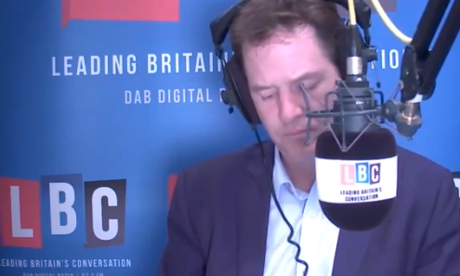
Nick Clegg is hosting his LBC phone-in.
The first caller brings up Lord Freud’s comments yesterday.
Q: Is there a case for helping businesses get socially disadvantaged people into work?
Clegg says there is a serious debate to be had about how to get disabled people into work.
But what was so “offensive” about Lord Freud’s comment was his use of the word “worth”, where he said some disabled people were not worth the minimum wage. That was what was so offensive.
To say someone is not worth something - [it’s] quite understandable that’s caused huge offence.
Q: Shouldn’t Labour have tried to find a solution, not just used it to attack the Conservatives?
Clegg says Freud said what he said. This word “worth” was “deeply distressing and offensive” to people.
There’s plenty around today. Theresa May, the home secretary, will be giving evidence to the intelligence and security committee as part of its inquiry into privacy and security (pfd). There’s Call Clegg, as usual on a Thursday. And there may be considerable interest in a story in the Times and the Sun saying David Cameron is on the verge of demanding the right to curb EU migration. Here’s an extract from the Times story (paywall).
David Cameron is considering demanding that Britain be given an “emergency brake” on the number of European jobseekers after promising MPs a “game-changing” new immigration policy.
The prime minister has so far said only that he wants to curb benefit tourism and extend blocks on migrants from newly joined EU countries. Under increasing pressure from Ukip’s poll surge, however, Downing Street is now drawing up more radical options ...
Government sources last night insisted that no final decisions had been made either on the timing or the content of the announcement, but said that it would almost certainly come before Christmas. The main debate is whether it should be before or after the Rochester by-election on November 20.
One option under serious consideration is to demand from Brussels a so-called emergency brake on the number of migrants from particular EU countries. This would give ministers the power to block new arrivals if numbers increased above a set level on the grounds that further influxes would put unacceptable strains on public services and social cohesion.
I will be focusing in particular on the May hearing, but here’s the full agenda.
9am: Nick Clegg hosts his Call Clegg phone-in.
9.30am: Crime figures are released.
10.30am: Theresa May gives evidence to the intelligence and security committee
11am: Jeremy Hunt, the health secretary, gives a speech saying mistakes cost the NHS up to £2.5bn a year.
5pm: Gordon Brown lead a short adjournment debate in the Commons on the UK’s relationship with Scotland.
As usual, I will be also covering all the breaking political news from Westminster, as well as bringing you the most interesting political comment and analysis from the web and from Twitter. I will post a summary at lunchtime, and another at the end of the day.
If you want to follow me on Twitter, I’m on @AndrewSparrow.
Updated