Afternoon summary
- Theresa May, the home secretary, has published long-awaited plans to update surveillance legislation. In the Commons the draft investigatory powers bill was broadly welcomed by MPs, with the Labour party provisionally supporting the plans, but as experts study the small print, potential drawbacks have emerged. This afternoon Liberty, the human rights pressure group, said May was wrong to claim that she was giving judges the power to authorise interception warrants for the first time in centuries. Shami Chakrabarti, the Liberty director, said that in practice judges would only have very limited powers to block warrant decisions taken by ministers. See 4.30pm.
- Number 10 has announced that flights to Sharm el-Sheikh have been suspended because the British government thinks the Russian plane that crashed after leaving the airport may have been brought down by a bomb. Here is the Number 10 statement.
The Prime Minister called President Sisi yesterday evening to discuss what measures the Egyptians are taking to ensure the tightest possible security arrangements at Sharm el-Sheikh airport.
While the investigation is still ongoing we cannot say categorically why the Russian jet crashed. But as more information has come to light we have become concerned that the plane may well have been brought down by an explosive device.
In light of this and as a precautionary measure we have decided that flights due to leave Sharm for the UK this evening will be delayed. That will allow time for a team of UK aviation experts, currently travelling to Sharm, to make an assessment of the security arrangements in place at the airport and to identify whether any further action is required. We expect this assessment to be completed tonight.
In terms of flights from the UK to Sharm, there are no more departures today.
We would underline that this is a precautionary step and we are working closely with the airlines on this approach. The Prime Minister will chair a COBR at 18.45 to review the situation and we will provide an update after that meeting.
We recognise that this information may cause concern for those in Sharm and indeed for those planning to travel to Sharm in the coming days. We have deployed extra consular staff to Sharm who will be on hand at the airport, working with the airlines, to assist British holidaymakers there. For others, either in resorts at Sharm or planning a holiday to Sharm in the coming days, our advice is to contact your airline or tour operator.
At this stage we are not changing the level of our Travel Advice.
- The government has backed down on its plan to allow fracking in some of England’s most important nature sites. The controversial technique for extracting shale gas will not be allowed in Sites of Special Scientific Interest (SSSI) after all, ministers said on Wednesday, after previously opening the door to fracking in such sites in July.
That’s all from me for today.
Thanks for the comments.
Updated
Edward Snowden, the NSA whistleblower, has been posting more tweets about the bill.
#IPB seeks legal cover for programs made "secret" to avoid court challenges, not save lives. https://t.co/Jyh1yGoYRg pic.twitter.com/wULqpgiKrK
— Edward Snowden (@Snowden) November 4, 2015
Consensus according to every credible cryptographer and computer scientist, "Not safely:" https://t.co/kwhawRdIL1 https://t.co/OozKHf4fji
— Edward Snowden (@Snowden) November 4, 2015
"I don't need privacy, I've nothing to hide" argues "I don't need free speech, I've nothing to say." Rights = Power https://t.co/AOMc79DIOS
— Edward Snowden (@Snowden) November 4, 2015
It's not about something to hide, it's about something to lose.
— Edward Snowden (@Snowden) November 4, 2015
Tory MPs taking notes on how to defend the indefensible from the experts. Disappointing. #SnoopersCharter https://t.co/M0bhvO5YqH
— Edward Snowden (@Snowden) November 4, 2015
By my read, #SnoopersCharter legitimizes mass surveillance. It is the most intrusive and least accountable surveillance regime in the West.
— Edward Snowden (@Snowden) November 4, 2015
Updated
Here is a, fairly random, selection of Tweets about the draft bill from journalists and others.
From the Guardian’s George Monbiot
Instead of stopping #surveillance abuses revealed by Edward Snowden's revelations, Teresa May is legalising them. That's progress for you.
— GeorgeMonbiot (@GeorgeMonbiot) November 4, 2015
From Henry Porter
#snooperscharter has been exemplarily constructed and spun yet is still highly intrusive and a danger to a free society.
— henry porter (@HenryCPorter) November 4, 2015
From Tom Newton Dunn
Investigatory Powers Bill: the Wilson Doctrine is over. MPs' communications can be intercepted, but only with a judge and PM's approval.
— Tom Newton Dunn (@tnewtondunn) November 4, 2015
From David Allen Green, the FT’s legal commentator
The immediate reaction to any Bill, or Budget, is often not a good guide to its merits.
— David Allen Green (@DavidAllenGreen) November 4, 2015
One point can be made: the draft Bill envisages the Human Rights Act remaining in place.
— David Allen Green (@DavidAllenGreen) November 4, 2015
From the author Robert Harris
May's proposal quite staggering. Imagine if in 70s to fight IRA MI5 had demanded to know every shop visited, book read, inquiry made.
— Robert Harris (@Robert___Harris) November 4, 2015
From the barrister Matthew Ryder
In face of #Snowden litigation Govt went NCND on #Tempora powers. Today its somehow able to ask for them in #IPBill #inaccordancewiththelaw
— Matthew Ryder (@rydermc) November 4, 2015
NCND means “neither confirm nor deny”.
If it was so damaging to Nat Security for #Snowden to reveal bulk collection was going on… how is UK Govt now able to set it out in a bill?
— Matthew Ryder (@rydermc) November 4, 2015
From Charles Arthur, the technology journalist
Waiting for Theresa May to tell us that ISPs, such as TalkTalk, will safely and securely store our browsing history.
— Charles Arthur (@charlesarthur) November 4, 2015
From Ryan Gallagher, a journalist at The Intercept
Some positive oversight measures in #IPBill. But the proposed bulk retention powers among most invasive & sweeping in any Western democracy.
— Ryan Gallagher (@rj_gallagher) November 4, 2015
Updated
Liberty says May wrong to claim bill creates judicial authorisation for interception
Shami Chakrabarti, the Liberty director, has just been on BBC News making the same point David David Davis has been making. (See 4.20pm.) She said:
I’m hugely disappointed with this bill ... I have to tell you there is no judicial authorisation for interception in this bill. At most, there is a very, very limited role for judges in a rubber-stamping exercise. It is not judicial sign-off, it is not acceptable in a modern democracy ...
They have spun it as a double lock, but the second person, the judge, does not actually have a key.
She also claimed that the bill gave the bill “breath-taking” hacking powers.
Equally, we now have new powers of hacking, breath-taking new powers for the police and the authorities to hack into our systems and servers and devices in a way that leaves us all more permanently vulnerable to hacking, including from fraudsters and terrorists. This is a very, very flawed piece of legislation.

David Davis says judges won't get proper power to block interception warrants under May's plans
And here is the quote from the Conservative MP David Davis about what he sees as the flaw in Theresa May’s “double lock” proposal for judicial authorisation. (See 1.45pm and 3.25pm.)
I draw everybody’s attention to section 19(2), which tells the judicial commissioners they have to make decisions based on judicial review principles, not on the basis of the evidence. In other words the home secretary would have to behave in an extraordinary manner not to get his or her warrant approved. This is not the judge checking the evidence, it is the judge checking that the correct procedure has been followed.
This is not quite the protection it was represented as.
This is significant.
David Davis points out Judges will only be able to reject a Home Secretary's warrant on judicial review principles Narrower than presented.
— Patrick Wintour (@patrickwintour) November 4, 2015
Updated
Patrick Wintour and Henry Porter are both making the point that Labour’s response to the draft bill today (see 1pm) represents something of a Jeremy Corbyn climbdown.
Kier Starmer Home Office Minister said Sunday Jeremy Corbyn has agreed Labour response to May's Surveiillance bill. Bit of a JC volte face.
— Patrick Wintour (@patrickwintour) November 4, 2015
Labour's initial support for May bill surprising, given Corbyn voted against ID cards, mass retention of comms data & harsh anti terror laws
— henry porter (@HenryCPorter) November 4, 2015
Andy Burnham, the shadow home secretary, has just told BBC News that Labour will not play party politics with this if the government is getting it right “and they are getting it right on this”.
Anderson says draft bill has put parliament in charge of surveillance law
David Anderson QC, the independent reviewer of terror legislation whose landmark report A Question of Trust had considerable influence on the draft regulatory powers bill published today, has posted a more detailed response to it on his website.
Here are some of the key points he is making.
- Anderson welcomes the fact the bill will give parliament the chance to decide properly what surveillance powers the authorities should have.
The best thing about the Bill is that it puts Parliament in charge. For the first time, we have a Bill that sets out, for public and political debate, the totality of the investigatory powers used or aspired to by police and intelligence agencies. The list includes:
- some functions that were publicly avowed only a few months ago (“equipment interference”, including in bulk and by the police, and the use of bulk personal datasets);
- one function that was avowed only today – the use of section 94 of the Telecommunications Act 1984 for the bulk collection of communications data for the use of the intelligence agencies; and
- a proposal for police access to internet connection records for defined purposes, a watered-down version of proposals made in 2012 and never progressed because of Coalition disagremeents. It is accompanied by the operational case that I described as the minimum starting-point for a debate on this subject – published so that it can be scrutinised by all.
Not everyone will be happy about those powers. It will now be for Parliament to decide whether they are justified. That is the way things should be in a democracy – but rarely are at the moment, anywhere in the world. Whatever the content of the eventual UK law, it will no longer be possible to describe it as opaque, incomprehensible or misleading.
- He welcomes the fact that, for the first time in more than 300 years, the bill will stop interception warrants being issued without judicial involvement.
There will be a powerful, outward-facing super-regulator, and save in urgent cases, no warrant will enter into force without judicial approval – a reversal of consistent practice since at least the 17th century.
- He questions whether the safeguards go far enough.
Opinions will differ as to whether these safeguards go far enough. The judges need to be well-supported, and exposed to a sufficiently wide range of opinion for there to be no question of them operating as rubber stamps. It also needs to be asked whether there is sufficient independence in procedures for access to communications data, bearing in mind in particular the Digital Rights Ireland judgment on whose meaning the European Court of Justice has recently been asked to pronounce, and the particularly sensitive or intrusive nature of some data (for example, the fact that a lawyer may have communicated with a potential witness).
(In his report he said judges, not politicians, should be in charge of signing interception warrants. Theresa May’s “double-lock” approach - see 1.25pm - is a compromise.)
- He says he will be giving interviews tonight but that after that he won’t be commenting further.
I did my best to inform the debate (with the help of my small but diverse team) but that debate is now open to all, as it should be, and I hope as many knowledgeable people as possible will participate in it.
This is useful, although you will probably need GCHQ-grade magnifying equipment to actually read it.
A very useful table from the Investigatory Powers Bill setting out who can do what & the judicial oversight: pic.twitter.com/wQzldVa7F5
— Dominic Casciani (@BBCDomC) November 4, 2015
Alternatively, you can find it on page 33 of the draft bill (pdf).
David Davis is also complaining that the communications data of MPs - the record of who they contacted by phone etc, not the content of those communications - is not protected.
MPs are protected from interception warrants but their communications data has no such protection, leaving whistleblowers vulnerable #IPBill
— David Davis MP (@DavidDavisMP) November 4, 2015
Edward Snowden, the NSA whistleblower, has been tweeting about the draft bill.
"It's only communications data" = "It's only a comprehensive record of your private activities." It's the activity log of your life. #IPBill
— Edward Snowden (@Snowden) November 4, 2015
Updated
In the Commons David Davis, the Conservative MP and leading libertarian campaigner, said that Theresa May’s proposal for a double lock, requiring interception warrants to be signed by judges as well as ministers, did not go far enough. May should accept the proposal in David Anderson’s A Question of Trust report and put judges in charge, he said.
The claimed concession by the Home Office that an after-the-event check by judges for ministerial warrants is a retreat from the recommendations of the Government’s own independent reviewer of counter terrorism legislation, David Anderson QC, namely that domestic warrants should be judicially authorised. Judges are extremely unlikely to overrule a Home Secretary once he or she has already taken a decision.
At the weekend Davis said he did not think the bill would get through the Commons without judicial authorisation. Whether or not MPs decide that May’s compromise proposal amounts to proper judicial authorisation remains to be seen.
Sara Thornton, chair of the National Police Chiefs’ Council, said the police needed new powers to access information.
We use our powers of investigation, like access to communications data, to protect the public, preserve life and prevent and detect crime. Our capabilities have not kept up with changes in technology and how people communicate, meaning there are more and more blind-spots where we can’t trace criminal activity or find crucial information to protect people at risk of harm.
With independent scrutiny and authorisation, we need to be able to pursue investigative leads in a digital space by requesting information about where people are connecting to the internet; who they are speaking to and the sites they are visiting but not the content of what is said. This is the modern equivalent of using phone numbers in a targeted way to find out who someone has called or texted; a simple investigative capability that has been accepted for many years.
Julian Huppert, the former Lib Dem MP, sat on the joint committee that considered the 2012 draft communications data bill. He was highly critical of the proposed 2012 legislation. This is what he is saying about the draft investigatory powers bill.
Some powers have previously been kept hidden. New bill will explicitly include all bulk collection powers - definite progress! #ipbill
— Julian Huppert (@julianhuppert) November 4, 2015
If we know what powers are allowed, we can have a debate about what ought to be allowed. I'm fairly sure it will go too far! #ipbill
— Julian Huppert (@julianhuppert) November 4, 2015
Good if Home Sec really means extraordinarily broad telecoms act 1984 s 94 goes. https://t.co/NQXC9rl9Wy https://t.co/d7l8ssl8K9 #ipbill
— Julian Huppert (@julianhuppert) November 4, 2015
Judicial authorisation now .... TM says Home Sec has to approve ... but then a judge will have to approve it too. improvement on now #ipbill
— Julian Huppert (@julianhuppert) November 4, 2015
New single Investigatory Powers Commissioner to replace fragmented existing oversight. Good if properly independent and resources #ipbill
— Julian Huppert (@julianhuppert) November 4, 2015
Encryption clarity. Bill won't ban it, but will require companies to provide data unencrypted. Challenging ! https://t.co/7zgOLbIQi6 #ipbill
— Julian Huppert (@julianhuppert) November 4, 2015
In the Commons Nick Clegg, the former Lib Dem leader, was relatively positive about the draft communications data bill. (See 1.09pm.)
But his successor, Tim Farron, is striking a different tone on Twitter.
Make no mistake the Liberal Democrats will fight any attempt to bring back the so-called Snooper’s Charter under a different name.
— Tim Farron (@timfarron) November 4, 2015
Big Brother Watch, another privacy campaign group, has raised concerns about the draft bill, although it is not as critical as Liberty (see 2.19pm). This is from Renate Samson, its chief executive.
The recommendation of a ‘double lock’ of political and judicial sign off on the most intrusive powers appears to tick the box of independent judicial approval, but in a world which is increasingly connected online the future demands on a home secretary’s time could become impractical.
Requests for retention of internet connection records will provide access to the most detailed data on citizens, not just the who and when of a telephone record, but the what and how of the way we live our lives. The guarantee of security to this retained data will be critical. Furthermore, demands on technology companies to adhere to warrants for encrypted data, as well as the power to legally hack into our devices, could create legislative back doors which in a world of increased cyber-attack could make us more vulnerable to crime.
There is a great deal to be scrutinised in a very short space of time. For this legislation to really be a world leader in how to protect the privacy and security of law-abiding citizens, the bill will require a thorough investigation.
Ben Emmerson QC, UN special rapporteur on counter-terrorism and human rights, whose report to the UN general assembly last year described mass surveillance by intelligence agencies as “corrosive of online privacy”, expressed disappointment that May did not opt to transfer more power to judges. Commenting on the draft bill, he said:
Judicial review after the event is better than no judicial review at all. But it falls short of the putting the power to issue a warrant in the first place into the hands of an independent judge, which is where it belongs.
This illustrates very well the difference between an internet connection record, which Theresa May said would not give the police access to people’s “full web browsing histories” (see 1.45pm), and a full browsing history.
Some examples of the difference between Internet Connection Records (no warrant) and browsing history (warrant) pic.twitter.com/rDcjNqcTXa
— Mikey Smith (@mikeysmith) November 4, 2015
A Microsoft spokesperson offered a tentative welcome to the bill while adding caveats about private data and protection for customers. The Microsoft spokesperson said:
We think any reform must ensure a strong role for the courts in the authorisation of access to private data and avoid conflicts with the laws of other nations. We appreciate the government’s willingness to engage in an open debate about these important issues, and as this process unfolds, we will work to ensure that legislation respects these principles and protects the privacy of our customers.
Updated
The Open Rights Group, a privacy pressure group, has also criticsed the draft bill. This is from its executive director, Jim Killock.
This bill will redefine the relationship between the state and the public for a generation. The government needs to get it right and made sure that the UK’s law enforcement and security agencies can fight serious crime while upholding all of our human rights.
However, at first glance, it appears that this bill is an attempt to grab even more intrusive surveillance powers and does not do enough to restrain the bulk collection of our personal data by the secret services. It proposes an increase in the blanket retention of our personal communications data, giving the police the power to access web logs. It also gives the state intrusive hacking powers that can carry risks for everyone’s Internet security.
The joint committee must now listen to the concerns of activists and the public if they are to restore trust in the police and security services.
Liberty says draft bill is a 'breath-taking attack on internet security" of everyone in Britain
In the Commons MPs who in the past have been very critical of Theresa May on internet surveillance, like David Davis and Nick Clegg, were relatively positive about the proposals.
But Liberty has criticised them strongly. This is from Shami Chakrabarti, the Liberty director.
After all the talk of climbdowns and safeguards, this long-awaited bill constitutes a breath-taking attack on the internet security of every man, woman and child in our country.
We must now look to parliament to step in where ministers have failed and strike a better balance between privacy and surveillance.
In his story my colleague Alan Travis says that Theresa May’s statement contained an admission that communications data has been handed over to the security services in bulk since 1984.
In her statement, May also revealed for the first time that successive governments since 1994 have issued secret directions to internet and phone companies to hand over the communications data of British citizens in bulk to the security services.
She said these secret “directions” had allowed the security services to thwart a number of attacks in Britain, including the plot to attack the London Stock Exchange in 2010.
May revealed that the use of these powers – which show that GCHQ was also engaged in mass surveillance programmes on British citizens using their communications data – under the 1984 Telecommunications Act will be put on a more explicit footing in the new legislation and be subject to the same safeguards as other bulk powers.
This is the point that David Anderson, the independent reviewer of terror legislation, was referring to in his “avowal” tweet. See 2.01pm.
David Anderson, the independent reviewer of terror legislation, says on Twitter that he will be responding to the draft bill on the PM programme after 5pm.
But, judging by what he has been tweeting, he seems quite pleased with it. Here are some of those tweets.
Home Sec has just said "We have taken virtually everything David Anderson asked for on board".
— David Anderson (@terrorwatchdog) November 4, 2015
HSec's words on MI5's use of s94 Telecoms Act 1984 to collect domestic comms data in bulk were a significant and necessary avowal. 1/2
— David Anderson (@terrorwatchdog) November 4, 2015
If powers such as these are required, it is right that Parliament should have the chance to debate them. 2/2
— David Anderson (@terrorwatchdog) November 4, 2015
And Anderson retweeted this.
Bulk domestic data mining of phone records avowed. pic.twitter.com/84BMceA8sQ
— Eric King (@e3i5) November 4, 2015
(What this means is that GCHQ has been hoovering up bulk data for years, but that at least this bill is explicit about this, and that that is a good thing.)
Don't forget the new transparency report: goes well beyond investigatory powers. A new development. https://t.co/Z8UaCeZ4Jo
— David Anderson (@terrorwatchdog) November 4, 2015
I said an operational case was the minimum starting point for internet connection records. Here it is, for scrutiny: https://t.co/ZQCdSPP2FT
— David Anderson (@terrorwatchdog) November 4, 2015
A huge quantity of "overarching documents" have been published with the #IPBill: impact assessments, factsheets etc. https://t.co/qn2OMxkGuF
— David Anderson (@terrorwatchdog) November 4, 2015
Updated
Steve McCabe, a Labour MP, asks why internet companies are being asked to retain web browsing information for 12 months.
May says 12 months that current obligations on data retention apply for. It was felt 24 months would be too long, she says.
Theresa May's statement about the draft investigatory powers bill - Summary
Here are the main points from Theresa May’s statement.
- May insisted that today’s draft bill was quite different from the 2012 draft communications data bill that was branded the snoopers’ charter.
Let me be clear, the draft Bill we are publishing today is not a return to the draft Communications Data Bill of 2012.
It will not include powers to force UK companies to capture and retain third party internet traffic from companies based overseas. It will not compel overseas communications service providers to meet our domestic retention obligations for communications data. And it will not ban encryption or do anything to undermine the security of people’s data. And the substance of all of the recommendations by the Joint Scrutiny Committee which examined that draft Bill have been accepted.
So today’s Bill represents a significant departure from the proposals of the past.
- She said the government was not proposing to give the police access to people’s full web browsing history.
Mr Speaker, some have characterised this power as law enforcement having access to people’s full web browsing histories. Let me be clear – this is simply wrong. An Internet Connection Record is a record of the communications service that a person has used, not a record of every web page they have accessed.
So, if someone has visited a social media website, an Internet Connection Record will only show that they accessed that site, not the particular pages they looked at, who they communicated with, or what they said. It is simply the modern equivalent of an itemised phone bill.
- She said “strict limits” would apply to when the police could access this information.
Law enforcement agencies would not be able to make a request for the purpose of determining – for example – whether someone had visited a mental health website, a medical website or even a news website.
They would only be able to make a request for the purpose of determining whether someone had accessed a communications website, an illegal website or to resolve an IP address where it is necessary and proportionate to do so in the course of a specific investigation.
- She confirmed that a new “double lock” would apply to the issuing of warrants allowing the interception of communications.
While there was a good deal of agreement in the three independent reviews I have referenced, all three reached different conclusions on the question of who should authorise interception warrants.
The Intelligence and Security Committee supported authorisation by a Secretary of State. David Anderson said judges should carry out the authorisation. And RUSI said the authorisation of warrants should have a judicial element, but also recognised the important role of the Secretary of State.
I have considered the very good arguments put forward by the three reviews. My response is one that I hope the House agrees will provide the reassurance of both democratic accountability and judicial accountability.
So, as now, the Secretary of State will need to be satisfied that an activity is necessary and proportionate before a warrant can be issued. But in future, the warrant will not come into force until it has been formally approved by a judge.
This will place a “double lock” on the authorisation of our most intrusive investigatory powers. Democratic accountability, through the Secretary of State, to ensure our intelligence agencies operate in the interests of the citizens of this country, and the public reassurance of independent, judicial authorisation.
This will be one of the strongest authorisation regimes anywhere in the world.
- She said the prime minister would have to approve any warrant to intercept the communications of an MP.
For Parliamentarians we will go even further. This Bill will for the first time put into law the Prime Minister’s commitment that in any case where it is proposed to intercept the communications of a Parliamentarian – including members of this House, members of the House of Lords, UK MEPs and the members of the devolved legislatures – the Prime Minister would also be consulted.
- She claimed the new oversight arrangements - involving a new investigatory powers commissioner - would be “world-leading”.
I am clear we need a significantly strengthened regime to govern how these powers are authorised and overseen. So we will replace the existing oversight with a powerful and independent Investigatory Powers Commissioner. This will be a senior judge, supported by a team of expert inspectors with the authority and resources to effectively, and visibly, hold the intelligence agencies and law enforcement to account. These will be world-leading oversight arrangements.
- She claimed the draft bill contained some of the “strongest protections and safeguards” in the world.
Today, we are setting out a modern legal framework which brings together current powers in a clear and comprehensible way. A new Bill that provides some of the strongest protections and safeguards anywhere in the democratic world. And an approach that sets new standards for openness, transparency and oversight.
- She said the draft bill would be scrutinised by a joint committee of MPs and peers and that a revised bill would then come to parliament in the spring, with a view to it becoming law before the end of 2016.
Andrew Mitchell, the former international development secretary, says he used to sign warrants when he was in government on behalf of May and others. He says he backs the “dual key” approach proposed by May. But he wants an assurance that the judges authorising warrants are seen as independent, and that they are not judges seen as too close to the police.
May agrees with this point.
David Winnick, the Labour MP, says he is concerned about the “excessive powers” being given to the security services. If this were to be passed without amendment, it would be a “bitter blow to civil liberties”.
Can I tell you that I remain concerned, even though I’m one of the few who do remain concerned, about the excessive powers which will be given to the security authorities in addition to what they already have, though judicial involvement is better than no judicial involvement.
There’s a good deal of concern outside of this House and I certainly do consider if this measure was to be passed along the same lines without substantial amendments it would be very unfortunate and a bitter blow for civil liberties.
May says Winnick claimed there were substantial new powers in the bill. He is wrong, she says. Most of the powers in the bill exist in current legislation, she says.
But she admits that the powers relating to the retention of internet browsing history are new.
- May says most of the powers given to the police and intelligence services in the draft bill are not new.
Updated
Here’s a clip from May’s statement.
Keith Vaz, the Labour chair of the home affairs committee, asks who will train the judges to do this work.
May says this is not the first time judges have been asked to take on new national security responsibilities. Judges are used to taking difficult decisions, she says. She says she has more faith in the judiciary than perhaps Vaz does.
Updated
Owen Paterson, the Conservative former Northern Ireland secretary, says he is worried that the “double-lock” process for warrants will slow things down. He suggests it would be better to carry on with the existing system.
I believe strongly these decisions should be made by an elected member of this House, accountable to this House, and accountable to committees such as the ISC. I am concerned that involving another decision maker from the judiciary, who may not have particular skills in this area, will bring delay and will bring complication. How many hours after an early morning decision by a secretary of state will there be scrutiny by a judge?
May says the question about timeliness is a good one. There will be guidelines saying how quickly judges need to respond to requests for a warrant.
But there will be a provision allowing a secretary of state to approve a warrant in an emergency. When this happens, a judge will have to confirm it within five days.
Updated
In response to a question from the SNP’s Joanna Cherry, May says there is a “question mark” over whether a legislative consent motion is required for this bill (ie, whether the Scottish parliament has to approve it because it covers devolved matters).
The home secretary revealed for the first time in her statement that successive governments since 1994 have issued secret directions to internet and phone companies to hand over the communications data of British citizens in bulk to the security services.
She said these secret “directions” had allowed the security services to thwart a number of attacks in Britain, including the plot to attack the London Stock Exchange in 2010.
May said the use of these powers – which show that GCHQ was also engaged in mass surveillance programmes on British citizens using their communications data – under the 1984 Telecommunications Act will be put on a more explicit footing in the new legislation and be subject to the same safeguards as other bulk powers.
Updated
Nick Clegg, the former Lib Dem leader, says this bill is a “much improved model” compared to the 2012 draft bill, although he says he thinks there may be flaws “under the bonnet”.
He says the double-lock compromise on judicial authorisation is a compromise. But it may be cumbersome. Why did May rule out simple judicial authorisiation.
He says the provisions on internet browsing data are a big improvement on the 2012 bill.
May says not all the reports about the draft bill that appeared before today were the result of briefing.
Some of the most contentious plans from the 2012 model, such as the retention of third party data, have been dropped.
She says, if a child is abducted, the police can see from their phone records who they were in contact with. But currently the police cannot see who they contacted via the internet.
May welcomes the tone of Burnham’s response. But she says that she does not accept what Burnham said about David Cameron.
She says she has discussed this with David Anderson. It is not for her to say what he thinks, but she has taken on board most of his recommendations.
She says the content-interception plans will only cover serious crimes, as now.
On encryption, she says the government is not banning encryption. But it is asking providers to take reasonable steps to be able to read communications.
She says there will be something in the bill saying that judicial authorisation is needed for the police to access a journalist’s source.
On the double lock, she says both the judge and the secretary of state will have to approve a warrant. But there will be a process where a warrant applies after a secretary of state has approved it, provided that a judge subsequently confirms it.
Updated
Burnham says May has 'broadly' got the balance right
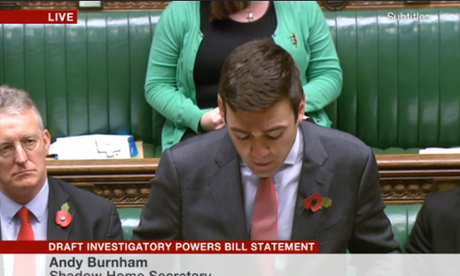
Andy Burnham, the shadow home secretary, says May has been listening to the concerns expressed in the last parliament. She has brought forward stronger safeguards, he says.
He says it would help if MPs sent out a unified message that this is neither a snoopers’ charter nor a plan for mass surveillance.
Has David Anderson expressed a view on the draft bill?
Can May assure MPs that the powers for content-interception will only be used for the most serious crimes?
What information will be stored by internet firms? Does May understand the concern the TalkTalk hack has generated?
If this bill does not apply to firms overseas, doesn’t that create a large hole? Will there be voluntary arrangements covering them?
Will there be protection for journalists too?
Burnham says he is pleased to see that May has shifted on authorisation. But having a two-stage process could bring in time delays? So how will it work? And what happens if the secretary of state and the judge come to different conclusions? Who will have the final say?
He says there are fears in the Muslim community that these powers will be used against them. It does not help when the prime minister implies Muslims condone extremism. And there fears about these powers being used against trade unionists. So will the government drop some of its more divisive measures, including those in the trade union bill.
Burnham says the plans in this bill go beyond party politics.
He says May has “responded to legitimate concerns and broadly got that balance right”.
- Burnham says May has “broadly” got the balance right.
- He says the draft bill does not amount to a snoopers’ charter or mass surveillance.
Updated
May: interception warrant for MPs would be approved by prime minister
May says there will be a “double-lock” process applying before the most intrusive warrants are approved.
They will have to be approved by a secretary of state, but then confirmed by a judge too.
This will be one of the strongest authorisation arrangements in the world, she says.
And there will be extra protection for MPs and members of the devolved legislatures. The prime minister would have to approve a warrant approving them, he says.
- May says any interception warrant covering an MP would have be be approved by prime minister.
Updated
May says there will be new oversight arrangements - a new commissioner, she says.
These will be “world-leading” oversight arrangements, she says.
May says the bill will make explicit provision for the intelligence agencies to acquire information in bulk. This is not a new power. It will replace a power under the Telecommunications Act 1984.
Bulk communications data has played a huge role in investigating terror attacks, she says.
These powers do not cover content, she says.
May says a transparency report is being published with the bill today.
Back in the Commons May says the provisions about accessing internet browsing history are just the modern equivalent of allowing the authorities to see an itemised phone bill.
Here is the first take of my colleague Alan Travis’s story about the draft bill.
New surveillance powers will be given to the police and security services, allowing them to access records tracking every UK citizen’s use of the internet without any need for any judicial check, under the provisions of the draft investigatory powers bill unveiled on Wednesday lunchtime.
It includes new powers requiring internet and phone companies to keep “internet connection records” – tracking every website visited but not every page – for a maximum of 12 months but will not require a warrant for the police, security services or other bodies to access the data. Local authorities will be banned from accessing internet records.
The proposed legislation will also introduce a “double lock” on the ministerial approval of interception warrants with a new panel of seven judicial commissioners – probably retired judges – given a veto before they can come into force.
But the details of the bill make clear that this new safeguard for the most intrusive powers to spy on the content of people’s conversations and messages will not apply in “urgent cases” – defined as up to five days – where judicial approval is not possible.
The draft investigatory powers bill published on Wednesday by the home secretary, Theresa May, aims to provide a “comprehensive and comprehensible’ overhaul of Britain’s fragmented surveillance laws. It comes two-and-a-half years after the disclosures by the whistleblower Edward Snowden of the scale of secret mass surveillance of the global traffic in confidential personal data carried out by Britain’s GCHQ and the US’s national security agency (NSA).
It will replace the current system of three separate commissioners with a senior judge as a single investigatory powers commissioner.
The draft bill explicitly includes in statute for the first time powers for the bulk collection of large volumes of communications and other personal data by MI5, GCHQ, MI6 and for their use of “equipment interference powers” – the ability to hack computers and phones around the world – for purposes of national security, serious crime and economic wellbeing.
May says today's bill is not a return to the 2012 'snoopers' charter'
May says the bill published today is not a return to the draft communications data bill of 2012 she says.
It does not require the retention of third-party data.
It does not oblige overseas firms to comply with domestic retention obligations.
And it does not ban encryption, she says.
She says it also accepts all the recommendations of the joint committee that looked at the 2012 bill.
A joint committee will look at this draft bill.
And a proper bill will be published in the spring, she says.
Updated
Theresa May's statement on internet surveillance
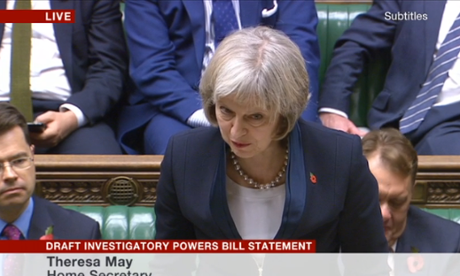
Theresa May is speaking now.
We live in a digital age, she says. Technology is having a profound effect, and digital offers many opportunities.
But it also offers threats.
In the last 12 months alone six significant threats have been detected in the UK.
More companies are under cyber-attack. And it is estimated that there are 50,000 people downloading images of children.
PMQs is over. Theresa May’s statement is about to start. On the microphones Cameron can be heard saying PMQs is taking longer and longer.
Updated
Nigel Dodds, the DUP, asks about the loss of jobs from a closure of a factory in Northern Ireland, partly due to high energy costs. And will the prime minister reverse the thrust of the policy on tax credits?
Cameron says firms deemed part of energy intensive industries do qualify for help.
He says Northern Ireland has powers to set its own rate of corporation tax. He wants a stronger private sector there.
On tax credits, he says the answer he gave to Corbyn applies; the plans will be announced three weeks today.
Andrew Mitchell, a Conservative, says the mental health campaign is an all-party one.
Cameron says more is being invested in mental health than ever before. Mental health should no longer be treated as a Cinderella service, he says.
Norman Lamb, a Lib Dem, thanks Cameron for backing the campaign that he, Andrew Mitchell and Alastair Campbell are leading asking for equality for mental health. Will Cameron ensure the spending review delivers the extra funding necessary?
Cameron praises Lamb for his work on this. There are now twice as many talking therapies as five years ago. But there is more to do, he says.
Steve Double, a Conservative, asks about Newquay airport.
Cameron says he is a huge fan of the airport, and a frequent user.
Labour’s Paul Flynn asks about the British servicemen and women who died in Iraq and Afghanistan. Will Cameron rethink his plans to join a four-sided civil war in Syria?
On Armistice Day we should put aside political debates like this, says Cameron.
Cameron confirms that government considering plans to part-privatise Channel 4
John Nicolson, the SNP MP, asks Cameron to confirm he has no plans to sell Channel 4.
Cameron says he is a huge fan of Channel 4. It was a great Conservative innovation. He wants to make sure it has a strong and secure future. He wants to look at all the options, including options for getting private investment into it. It would be wrong to “close our minds”, he says. He wants it to have a great future.
- Cameron confirms that government considering plans to part-privatise Channel 4.
Kevin Hollinrake, a Conservative, asks Cameron to confirm that he is committed to the north.
Cameron says the north needs a better deal on roads and rail. Some £13bn is now being spent, he says.
Labour’s Diana Johnson asks about a case involving parents in her constituency whose child died and who were then not able to find out what happened to the ashes.
Cameron says he will look into this.
Anne-Marie Trevelyan, a Conservative, says there are 150 patients in Bucharest needing expert burns treatment following the nightclub fire. But they do not have enough beds there. Can the UK help?
Cameron says this is a good suggestion. He will look into it.
Labour’s Gordon Marsden asks about the cuts to police funding. Cameron quotes a report saying Lancashire Police is exceptionally well placed to meet its police obligations.
Stephen Metcalfe, a Conservative, asks about apprenticeships and the skills gap. Will Cameron redouble his efforts to hit the 3m new apprenticeships target.
Cameron says he will. Many firms find that many people apply for apprenticeships, but that too many of them do not have the right qualifications. He says Nadhim Zahawi will be his new adviser on apprenticeships.
Snap PMQs verdict
Snap PMQs verdict: A scrappy, inconclusive PMQs. Cameron mocked Corbyn for returning to the tax credit question that worked so well for him last week, but there can be merit in persistence and, although Cameron had better answers than he did last week, Corbyn made his point effectively. Corbyn was probably less successful with his final three questions on the NHS, but Cameron’s attempts to shift the subject were not edifying either, and neither side can claim a win. But the high-minded, policy-focused tone seems to be slipping. This sounded very like an old-fashioned, Cameron/Miliband PMQs, and Cameron can no longer hide the scorn he clearly feels for Corbyn. But letting it show is not necessarily a good idea.
Corbyn says the prime minister did not reply to his point about the winter crisis.
John Bercow intervenes to stop the shouting, which seems particularly loud.
Corbyn says, if Cameron won’t answer his question, then perhaps he will address a point from the Kings Fund. It said the NHS was facing an inevitable decline in patient care unless something was done. Which is rising faster? NHS waiting lists or NHS deficits?
Cameron says Simon Stevens, the NHS England chief executive, asked for £8m extra in funding. The government has offered £10bn. The number of treatments are going up. If you want to know what is in crisis, it is Labour. Corbyn’s media adviser is a Stalinist, and his policy adviser is a Communist, he says.
Corbyn says if Cameron’s party cannot match its actions with its words, it should get rid of him. The NHS is in crisis. Will Cameron ensure everyone can rely on it. It is the jewel in everyone’s crown.
Cameron says, since he became prime minister, the number of doctors has gone up by more than 10,000, and the number of nurses up by more than 5,000. The UK is able to fund the NHS. But the countries Corbyn admires, with crazy socialist plans, have to cut their health service, he says.
Corbyn says the prime minister makes choices. A private in the army would lose over £2,000 next April. Surely the whole point of parliament is to put questions to those in authority. He asks a question from Kieron, a veteran of the first Gulf War. Is this how the government treats veterans?
Cameron says many soldiers will benefit from the £11,000 personal allowance coming in next year. Soldiers with children will benefit from the free childcare announcements. And he will see the full plans in three weeks time. That serving soldier is now dealing with an opposition leader who said he could see no point in the armed forces.
(Cameron is quoting Corbyn out of context here.)
Corbyn turns to junior doctors’ pay. He quotes a doctor saying this winter will be worse than last winter. Can Cameron guarantee there will be no winter crisis this year.
Cameron says the Royal College of Emergency Medicine supports what the government is doing. He urges doctors to go on the NHS website and see what their pay will be. No one will lose out. The NHS has the resources that it needs. It is a much stronger NHS, because we have a strong economy.
Jeremy Corbyn says he concurs with the prime minsiter’s remarks about Remembrance Sunday. We should all try to build a peaceful world.
Last week he asked the same question six times. Cameron has now had a week to think about it, so he will ask again. Can he guarantee no one will be worse off from the tax credit changes.
Cameron says he can guarantee that there will be a tax allowance that saves people money, and that there will be a national living wage of £7.20. As for the tax credit changes, he will answer details about them when they are announced. If Corbyn wants to ask the same question, that will be very entertaining.
Corbyn says this is not about entertainment. It is not funny for those affected. What abut this question from a Tory MP who said any mitigation should be full mitigation. What is his answer to that?
Very much the same answer, says Cameron. The government will announce its plans to move to a low tax, high pay economy then. But, if we don’t reform welfare, how will we fund the police service, or the health service, or defence? If we listened to Corbyn, we would still have families in London getting £100,000 in housing benefit.
Craig Tracey, a Conservative, says he is looking forward to his Armistice Day parade. Does Cameron agree it is important to maintain the 2% of GDP defence spending commitment.
Cameron does agree. The defence spending commitment, and the 0.7% aid one, and Trident are all important, he says.
David Cameron says this is the last PMQs before Armistice Day. He wants to pay tribute to those who gave their lives for their country.
Scotland Questions before PMQs is SO weird. one Tory and one Lab MP across the despatch box. And a shadow Scotland minister from Wales!
— Krishnan Guru-Murthy (@krishgm) November 4, 2015
Cameron at PMQs
PMQs is about to start.
Here is a preview of one question coming up.
Keep an eye on #PMQs - I will be asking the Prime Minister about the government's long-term plan for managing #OperationStack #Kent #Shepway
— Damian Collins (@DamianCollins) November 4, 2015
Corbyn says inviting Sisi to UK shows 'contempt for human rights' and threatens national security
PMQs starts in just under 15 minutes.
Labour has just put out a statement from Jeremy Corbyn criticising the government’s decision to invite the Egyptian president, Abdel Fatah al-Sisi, to London. Corbyn said:
David Cameron’s invitation to Britain today of the Egyptian president and coup leader Abdel Fatah al-Sisi shows contempt for human and democratic rights and threatens, rather than protects, Britain’s national security.
Support for dialogue and negotiated conflict resolution in the Middle East is vital to us all. But to welcome and bolster with military support the coup leader who overthrew a democratically elected president in 2013 and has presided over the killing and jailing of many thousands since makes a mockery of government claims to be promoting peace and justice in the region.
Support for dictatorial regimes in the Middle East has been a key factor fuelling the spread of terrorism. Rather than rolling out the red carpet to President Sisi, the prime minister should suspend arms exports to Egypt until democratic and civil rights are restored.
Have some thought for the journalists who will have to make sense of the draft investigatory powers bill quickly. This is from the BBC’s Gordon Corera.
Fun day ahead involving reading a 200 clause bill on technical surveillance powers and then condensing it into an easy to understand 2 mins
— Gordon Corera (@gordoncorera) November 4, 2015
Julian Huppert, the former Lib Dem MP, agrees with Henry Porter (see 11.12am) that who sits on the committee scrutinising the bill will be crucial.
One key thing is who will sit on the Joint Committee to study the draft #ipbill. Last time we absolutely slated the previous version! #fb
— Julian Huppert (@julianhuppert) November 4, 2015
Will the draft #ipbill committee have more securocrats on it? Any people knowledgeable about and interested in tech or privacy? #fb
— Julian Huppert (@julianhuppert) November 4, 2015
Updated
Henry Porter, the journalist and privacy campaigner, says there are rumours that Paul Murphy, the former Northern Ireland secretary, may chair a joint committee being set up to scrutinise the draft investigatory powers bill.
Murphy is a former chair of the intelligence and security committee, and would be seen as sympathetic to the concerns of the security services.
@AndrewSparrow Who will chair joint committee to examine May bill? Rumours are it is ISC trusty Paul Murphy - not good news for scrutiny.
— henry porter (@HenryCPorter) November 4, 2015
Draft investigatory powers bill - A background reading list
For more background, here’s a internet surveillance reading list.
- The Guardian story about the draft communications data bill in 2012. And here is the bill itself (pdf).
- The report from a joint committee of MPs and peers set up to consider the draft communications data bill (pdf). The report, which was published in December 2012, was very critical, saying the draft bill went too far. Here’s an excerpt.
We accept that there is a case for legislation which will provide the law enforcement agencies with some further access to communications data, but we believe that the draft bill pays insufficient attention to the duty to respect the right to privacy, and goes much further than it need or should for the purpose of providing necessary and justifiable official access to communications data. Clause 1 would give the secretary of state sweeping powers to issue secret notices to communications service providers (CSPs) requiring them to retain and disclose potentially limitless categories of data. We have been told that she has no intention of using the powers in this way. Our main recommendation is therefore that her powers should be limited to those categories of data for which a case can now be made. If in future a case can be made for the power to be increased, this should not be done without effective parliamentary scrutiny. We recommend the procedure for this.
- A report from the intelligence and security committee in March this year calling for an overhaul of surveillance laws. Here is the report (pdf) and here is the news release (pdf).
- The report from David Anderson, the government’s independent reviewer of terrorism legislation, in June this year called A Question of Trust. This 373-page report set out detailed proposals for a new bill. Here is the press release about it (pdf), here is the report (pdf), and here is the Guardian story about its publication. And here is a Martin Kettle column praising it. This is how it starts:
Occasionally in the long history of British policymaking someone manages to break through the confusion and reset the terms of an apparently unresolvable public argument. Edwin Chadwick on the poor law and public health, William Beveridge on the welfare system and Leslie Scarman on the police all changed things for generations – and for the public good – in their respective fields. The question today is whether the name of David Anderson – Britain’s watchdog on terrorism laws – should be added to the list of these national reformer-reconcilers.
With a fair wind behind it, his report on the future of surveillance laws, published yesterday, may eventually prove to have poured calming oils on a stormy argument that British governments have often seemed incapable of resolving. If Anderson’s plea is taken seriously, and we wipe the slate clean and start again on Britain’s efforts to balance security and privacy in the pursuit of crime in the borderless online world, his report really could be the turning point that policymakers have looked for and missed ever since 9/11.
On the Today programme morning Sara Thornton, chair of the National Police Chiefs’ Council, used an interview to explain why the police wanted internet surveillance laws to be updated.
Law enforcement needs access to communications data to protect the public and to investigate crime. We use communications data in day to day investigations. This is about what ordinary detectives do; they make the vast majority of applications for communciations data.
The bottom line is we are just not keeping up with technology. Five or six years ago it used to be about phone records; just about who’s calling who and where, not about the content at all. Of course, more and more of us are using the internet for those communications now. And therefore we need to have those internet communications records to find out what communication platforms people are using.
She also insisted that the police were not interested in looking about people’s website browsing histories.
Can I just say, it is categorically not the case that we want to see people’s internet browsing histories. It is not about that. It is about what communications platforms people are using, such as Facebook or WhatsApp.
I’ll give you a good example. You might remember Operation [Voicer?], a case of a paedophile ring who were jailed earlier this year. They had been filming the abuse of babies and toddlers and they had been streaming it on the internet. The gang are all in prison. But we know that over 260 people viewed that abuse online. We’ve identified quite a lot of them. But 38 we are still unable to identify. Now, if we had access to internet connection records, we would be able to find their IP addresses, their internet protocol addresses, and find them. We are not able to do that at the moment.

Several of the papers have stories previewing today’s draft investigatory powers bill, but only two of them have splashed on it.
In the Times (paywall) Sean O’Neill says Theresa May will give judges the power to veto ministers’ decisions about interception warrants.
A handful of judges will get the power to veto ministers’ decisions on all top-level antiterrorism spying operations under proposals being put forward by the home secretary today.
The panel of specially trained judges — expected to number at least ten — should review thousands of national security warrants each year and hold the intelligence agencies to account, according to draft surveillance laws to be presented to parliament.
The move represents a significant concession by ministers to the privacy lobby’s demand for greater scrutiny of spy agencies after the Edward Snowden leaks scandal. It is contained in the draft Investigatory Powers Bill, which aims to set out in more detail than ever before the state’s powers to spy on citizens, alongside a new range of safeguards for individuals.
Wednesday's Times front page: Judges get right to veto anti-terror operations #tomorrowspaperstoday #bbcpapers pic.twitter.com/E15LenmORZ
— Nick Sutton (@suttonnick) November 3, 2015
And in the Daily Telegraph Tom Whitehead says the draft bill will allow council officials to be jailed if they misuse snooping powers. (The Daily Mail focuses on the same line in its preview story.) The Telegraph reports:
Town hall officials will face up to two years in prison if they abuse snooping powers under a crackdown on council surveillance to be unveiled on Wednesday.
A new offence is to be created to target public authorities who inappropriately access phone and email records.
Local authorities will also be banned from accessing the web histories of members of the public when ministers publish the biggest overhaul of spying laws for 15 years.
The measures will be included in the Investigatory Powers Bill which includes a raft of proposals to expand the ability of the police and spy agencies to monitor suspects.
Wednesday's Telegraph front page: Prison for officials who abuse snooping powers #tomorrowspaperstoday #bbcpapers pic.twitter.com/HvJsBIn9DK
— Nick Sutton (@suttonnick) November 3, 2015
There is a lot of jargon in internet surveillance legislation that is hard to follow. The BBC has a handy guide translating some of the more difficult terms at the end of this Q&A.
There are few issues more fundamental in a liberal democracy than privacy and surveillance, and what powers we decide to give the state to allow it to monitor our communications. But none of this is easy or straightforward. A report earlier this year described one of the key Act’s governing this area as “obscure since its inception” and “incomprehensible to all but a tiny band of initiates”.
Today Theresa May, the home secretary, is announcing plans for a major overhaul of the legislation governing internet surveillance. We’ll be trying to ensure that what she proposes is fully comprehensible, and not just to “initiates”.
May’s announcement is the culmination of a process lasting more than three years. I will post more on the background later, but here are the key milestones.
- In June 2012 the coalition government published a draft communications data bill. This was published because the Home Office believed that changing technology meant it needed to update surveillance laws, but it included plans to monitor internet use, critics dubbed it the “snoopers’ charter”, the Lib Dems said they would never approve it and it was shelved. The legislation never came to parliament.
- In June 2013 the Guardian started publishing stories based on leaked information from Edward Snowden revealing the full extent of internet surveillance carried out by the National Security Agency in America and GCHQ in the UK. The revelations triggered a worldwide debate about privacy and security (although the debate was much more muted in the UK than it was in America and continental Europe, where lawmakers seemed to take privacy concerns more seriously.)
- This year, following the election of a majority Conservative government, David Cameron and May promised to bring the communications data bill back in a revised form. The result is the investigatory powers bill being published this afternoon.
My colleague Alan Travis has written a preview of what we will get. Here is his story, and here is how it starts.
Theresa May is to propose a major extension of the surveillance state when she publishes legislation requiring internet companies to store details of every website visited by customers over the previous year.
The home secretary will try to sweeten the pill of her revived snooper’s charter on Wednesday by announcing that the police will need to get judicial authorisation before they can access the internet connection records of an individual – something that is currently banned in the US and every European country, including Britain.
She will also try to strengthen the oversight of Britain’s surveillance by replacing the current fragmented system of three separate commissioners with an investigatory powers commissioner who will be a senior judge appointed by the prime minister on the recommendation of the lord chief justice.
I will mostly be focusing on the investigatory powers bill today, although I will also be covering PMQs. Here are the timings.
12pm: David Cameron faces Jeremy Corbyn at PMQs.
12.30pm: Theresa May makes a statement to MPs about the investigatory powers bill. The full bill is published simultaneously by the Home Office.
If you want to follow me on Twitter, I’m on @AndrewSparrow.
Updated