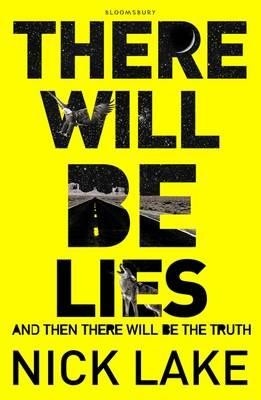
I needed somewhere to escape to during my GCSEs, so I dutifully stomped to Waterstones and bought a copy of There Will Be Lies by Nick Lake. Its urgent, neon yellow front cover accepted no argument – it had to be bought, there and then. No questions asked.
Having read my way – as have, I suspect, many bookworms of my generation – on a fairly predictable trajectory through the adventures of Harry Potter through Otto Malpense via Percy Jackson and Valkyrie Cain, my sixteen-year-old self squirmed slightly at the thought of another disenfranchised teenager being plunged into a quest of epic proportions and discovering their extraordinary significance. All I knew was that a girl met a talking coyote, from whom she found out she had to kill a Crone to save a Child. I braced myself –
– I couldn’t have been more wrong.
Instead, what I read was a beautifully-written, subtle thriller about identity, memory and family.
Shelby Cooper is a believable if atypical American teenager, who sprinkles her speech liberally with ‘like’s, says ‘Oh yeah?’ and ‘What’s the deal?’. She also uses words like ‘crepitation’ and ‘caesura’ – to begin with, I found the juxtaposition of her generally conversational narrative voice, with its prosaic language and clichés and this highbrow vocabulary, a tad unrealistic, but by the end I could almost accept how it feeds into the idea of a person not entirely comfortable in their own skin, who they are or even who they want to be (like all teenagers, in other words!).
Shelby’s mundane, repetitive existence, living alone with her mum, whose over-protectiveness feels less like a safety blanket and more like something which is strangling Shelby as the book progresses, is shattered when she is hit by a car of a Friday afternoon. She had just wandered out of the library (as per usual), having visited a section on Native Americans (out of the blue) – this felt slightly contrived to me, as though Nick Lake couldn’t quite conjure up a plausible explanation as to why she’d never visited this area before – and been handed a copy of the original, dark Grimm’s fairytales by rare male influence and inevitable heartthrob Mark.
Somewhat unexpectedly, a coyote then turns up to tell her there will be two lies, and, ominously, “then there will be the truth”.
We then accompany Shelby as she embarks on two parallel journeys – one with her mother, out of the town she knows for the first time in years, and one, while apparently sleeping, into the timeless ‘Dreaming’. This is the world of pre-European American myth, but with undertones of all fantasy and fairy tales. Ironically, the ‘Dreaming’ is far more vivid than anything described before – not just because Shelby, who is deaf, can hear everything here (this certainly helps to intensify some of the threatening sequences involving wolves). It is constantly left to the reader to decide whether the Dreaming is in some sense real; whether it is in fact ‘just a dream’ after all; or whether this is somehow Shelby internalising what is going on in the real world.
The real world, to its credit, offers no more security or reassurance. Is Shelby’s mother really as protective as she appears, or has she in fact kidnapped her daughter? What are lies and what is the truth?
As the story zig-zags between the Dreaming and Shelby and her mother’s road trip, I occasionally found myself frustrated that Nick Lake repeatedly used the idea of ‘Shelby woke up’ to leave the action on a convenient cliff-hanger. However, this is a slow burning thriller, and if you stick with it the parallels between the Dreaming and everything else are slowly teased out.
Nick Lake has clearly put a lot of thought into how his prose appears on the page – the fact that Shelby is deaf has enabled him to have some fun with this. At the start of the novel, everyone else’s speech is written in italics – except for Shelby’s – which gives it a silvery, not-quite-real feel; given the theme of lies and deception it also automatically throws anything anyone else says into question. When the coyote speaks to her, its dialogue is not enclosed with speech marks, and is not italicised, giving it an air of dependency. Within the Dreaming itself, everyone speaks without italics, which adds to the surreal sense that the Dreaming is somehow more vivid and real than the ‘real world’ itself. Chapters set in the Dreaming are separated from chapters set in the real world by a page containing just a single line of text, which acts as a bridge and, vividly, in a few short words, conveys how she travels from one reality to the next (“I’M SCATTERED LIKE THE STARS”). Not to give too much away, but when Shelby discovers that someone is not quite who she thinks she is, she starts to enclose her name in brackets, reflecting her own mental compartmentalising of what is happening to her.
I also enjoyed how Nick Lake slyly subverts the clichés and conventions of the genre of ‘coming of age’. The very end of the novel features a fairly major revelation – one which some readers may have been suspecting for some time – which changes the reader’s understanding of everything which has happened so far. However, what easily could have descended into a solemn, preachy sound bite is effortlessly and playfully undermined by Shelby’s sarcastic “But. But PLOT TWIST”.
This story uses many tried and tested tropes – an absent, mysterious father; portentous dreams; a bookish teenager plunged into the kind of adventure they have only read about – and puts a frequently entertaining and original spin on them.
Overall, I suspect that many people my age and older will enjoy this often heart-stoppingly exciting, insightful story, which will leave more than a little sense of the uncanny lingering in their minds for some time to come.
-
Buy this book at the Guardian Bookshop
Want to tell the world about a book you’ve read? Join the site and send us your review!