Magnetism, one of the fundamental forces in nature, helps us keep our favourite pictures on the fridge.
You may have even done an experiment in high school, by sprinkling iron fillings around a bar magnet and seeing the magnetic lines.
This way, you can see what we call the magnetic field.
Well, it turns out the Earth has a magnetic field as well.
Without it, radiation from the Sun would make Earth barren.
Stars, including our Sun, also have magnetic fields.
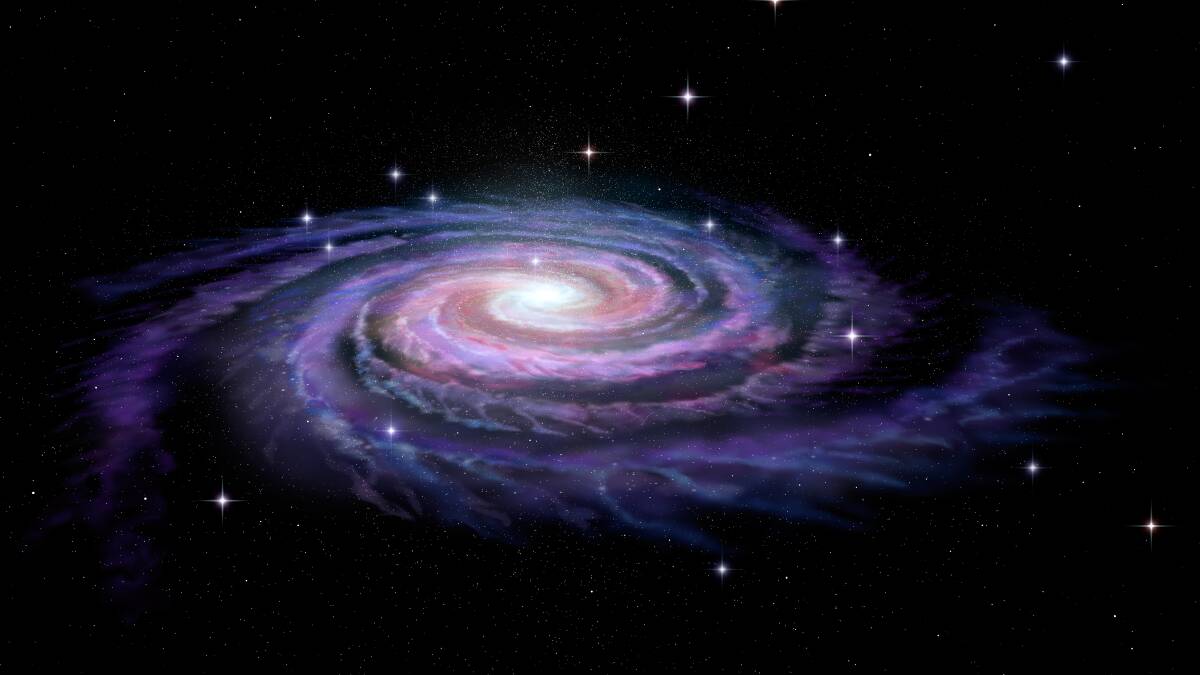
Almost all objects in the universe have magnetic fields. However, the largest ones are observed in spiral galaxies like our own Milky Way Galaxy.
To find and observe these magnetic fields in spiral galaxies, we use huge radio telescopes such as the Karl G. Jansky Very Large Array radio telescope in New Mexico, USA.
These fields appear to have smooth variations on giant, galactic-size scales of about 100 peta-kilometres (that is a 1 followed by 17 zeroes).
What powers this magnetism is believed to actually be the same way the Earth gets its magnetic fields - something called the dynamo theory.
If you have a wind-up torch, or in some bicycle lights, you've used the dynamo.
Spinning the handle or pedalling your bike, the energy is then converted through a magnet inside the torch or light.
This in turn induces electricity to run the lights.
In spiral galaxies, exploding stars called supernova inject energy into the galaxy, which creates turbulence.
In fact, this turbulence is similar to that you may experience on an airplane, but way more violent.
Like in the bicycle or torch, this is the spinning which in turn generates magnetic fields.
MORE SPACE:
-
How cold is space exactly, and how do we measure it?
-
Some of the smallest galaxies in the universe are visible from our backyard
-
What to do when one telescope just isn't good enough
Thanks to large supercomputers like the National Computational Infrastructure at the Australian National University here in Canberra, we can create huge computer simulations which generate turbulence and simulate the dynamo in galaxies.
When we do this, the magnetic field is also very turbulent.
So this raises an interesting question as to how these random magnetic fields at smaller scales, combine all together to appear smooth.
A possibility is that the properties across the whole of the galaxy conspire to create and smooth it all from the small-scale randomness.
It has only been until recently that we have big enough supercomputers to carry out these calculations.
It is a bit counter-intuitive to understand how turbulence at smaller scales gives rise to smoothness at larger scales.
Maybe the magnetic fields in spiral galaxies are not very different from life in general - chaos is a way to attain a structure.
-
Amit Seta is an astronomer at Mt Stromlo Observatory at the Australia National University.