It was a century ago, in April 1915, that the German army first used chlorine gas against the French at the second battle of Ypres. Developed as a weapon by the chemist Fritz Haber at the outbreak of the first world war, it was said to smell like a combination of pineapple and pepper. But it was also the smell of death.
Used as a means of sanitising water, chlorine is an essential element of public health. But as a concentrated gas, chlorine strips the lungs of their lining and leads to a slow disgusting death by asphyxiation. “In all my dreams, before my helpless sight / He plunges at me, guttering, choking, drowning,” wrote the war poet Wilfred Owen of it. “If you could hear, at every jolt, the blood / Come gargling from the froth-corrupted lungs … you would not tell with such high zest / To children ardent for some desperate glory / The old lie; Dulce et Decorum est / Pro patria mori.” So horrendous was the effect of chlorine gas that Clara Haber, wife of Fritz, killed herself in protest at her husband’s work.
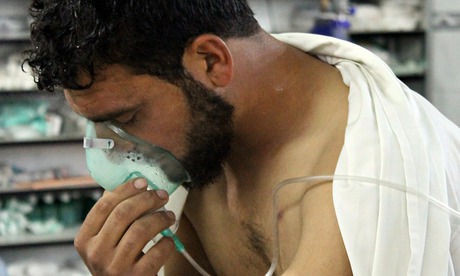
A hundred years later, this disgusting weapon is still being used. This time by the Syrian president Bashir al-Assad who, though he graduated as a medical doctor, is now dropping barrel bombs of the poisonous stuff on his civilian population. Assad continues to deny this, though there is now so much evidence that the international community is certain he is lying through his teeth.
Two years ago, threatened by the prospect of an allied strike, the Syrians claimed they had destroyed all their stockpiles of chemical weapons. This week, however, US secretary of state John Kerry said he was “absolutely certain” the Syrian regime was using chlorine gas against his own people. It was what President Obama had previously called a “red line” that Assad must not be allowed to cross. But having crossed it, repeatedly, Obama has done little but make disapproving noises. The problem is that Assad is fighting Islamic State, and so is seen by some quarters as almost an ally in the so-called war against terrorism.
The moral of this sorry tale is that there are no good guys here. The old lie referred to by Wilfred Owen, first expressed by the Roman poet Horace, that it is sweet to die for one’s country, is premised on the belief that war is a battle between good and evil. Its defenders admit that sometimes this distinction gets a bit fuzzy. But there are bad people and even worse people – and that’s the moral choice before us.
Even this is an overly comforting take on our involvement in the Middle East. All war is wicked. Spare me all this nationalistic reminiscing about the battle of Waterloo. Yes, the wickedness of war comes in various different shades. But let’s not use this to pretend that it’s ever the moral thing to do. Let’s not pretend that the billions of pounds worth of weapon sales to Middle Eastern regimes are made for anything other than the bottom line. And let’s not pretend that we can maintain clean hands when choosing sides between, say, those who kill with poison gas and those who kill by beheading.
The idea of moral war, like its cousin, the idea of holy war, is a dangerous mythology that seeks to justify bloodshed and leads us into horrendous alliances. Which is another way of saying that the most dangerous people in the world are those who think they are right. Which is another way of saying that morality, like religion, is a dangerous business.
Am I a pacifist? No, I don’t have the courage. And vulnerable people are worth protecting, with guns if necessary. But I don’t call this moral. I call it tragedy. Where are today’s Wilfred Owens to remind us all of this once again?